Understanding the speaker toe-in angle is critical for optimizing soundstage precision and stereo imaging. Proper adjustment directs sound waves toward the listener’s ears, reducing reflections and phase issues. Small changes can markedly improve clarity and spatial coherence, but achieving the ideal angle requires careful measurement and consideration of your room’s acoustics. We’ll explore how fine-tuning this parameter can elevate your listening experience and address common challenges in speaker setup.
Key Takeaways
- Toe-in angle involves angling speakers inward toward the listening position to improve stereo imaging and soundstage accuracy.
- Proper toe-in balances direct sound with reflections, creating a more immersive and natural listening environment.
- Typical toe-in angles range from 0° to 15°, adjusted based on room acoustics and speaker placement.
- Excessive toe-in narrows the soundstage and can distort spatial cues, reducing overall sound clarity.
- Fine-tuning the toe-in angle enhances instrument and vocal localization, tailored to music genre and personal preference.
What Is Speaker Toe-In Angle and Why Does It Matter?
The speaker toe-in angle refers to the inward rotation of the front edges of loudspeakers toward the listening position. Proper speaker positioning, including toe-in, directly influences the soundstage and imaging accuracy. By adjusting the toe-in angle, we can optimize the direct sound reaching the listener while minimizing reflections from nearby surfaces, which is essential for precise audio reproduction. Acoustic treatment complements this process by controlling reflections and resonances that can distort sound clarity. Correct toe-in ensures that the drivers’ sound waves converge accurately at the listening point, enhancing coherence and detail. Understanding and implementing the appropriate toe-in angle is a critical step in achieving a balanced, natural soundstage, especially when combined with effective acoustic treatment strategies.
How Adjusting Your Speaker Toe-In Affects Soundstage Quality
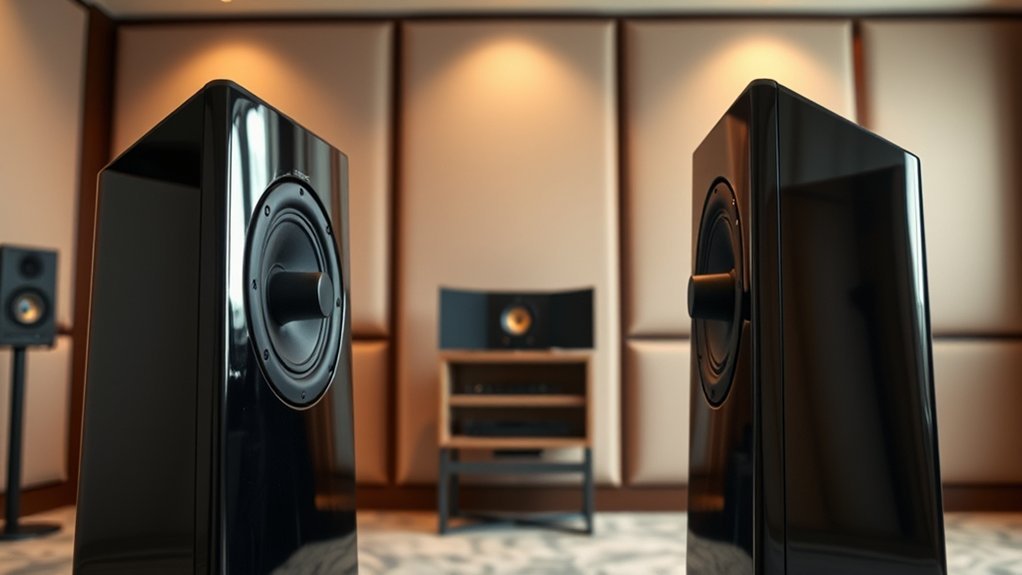
Adjusting the speaker toe-in angle directly influences stereo imaging and soundstage depth, shaping how accurately instruments and voices are localized. Precise toe-in settings can enhance soundstage clarity and spatial coherence, making the listening experience more immersive. Identifying the ideal toe-in angle involves balancing direct sound and reflected sound to achieve the desired soundstage characteristics.
Impact on Stereo Imaging
Ever wondered how the angle at which your speakers are toe-in influences the stereo image? Adjusting toe-in directly impacts the clarity, pinpoint accuracy, and overall coherence of sound sources within the stereo field. Proper toe-in enhances the listener’s perception of spatial positioning, making individual instruments and vocals more distinct. Conversely, improper toe-in can cause imaging smearing or imbalance, reducing precision.
- Precise toe-in aligns direct sound for improved localization and separation.
- Excessive toe-in may narrow the soundstage, affecting spatial cues.
- Speaker aesthetics and budget considerations often influence ideal toe-in settings, balancing visual harmony and acoustic performance.
Fine-tuning toe-in requires technical understanding but greatly improves stereo imaging, creating a more realistic and immersive listening environment.
Soundstage Depth Enhancement
When we fine-tune the toe-in angle of our speakers, we can considerably enhance the perceived depth of the soundstage. Proper toe-in reduces detrimental speaker resonance effects that can cause phase inconsistencies, thereby clarifying spatial cues. Adjusting toe-in directs sound waves more precisely toward the listening position, emphasizing the reverberant field and creating a layered, immersive soundscape. Acoustic treatment plays an essential role by minimizing reflections that could mask depth perception, ensuring that the direct sound remains dominant. Ideal toe-in alignment enhances inter-channel coherence, sharpening soundstage depth. This targeted approach improves the perception of distance and layering, making the soundstage appear more three-dimensional and natural. Effective combination of toe-in and acoustic treatment results in a more precise, immersive listening experience.
Optimal Toe-In Angles
Have you ever wondered how the specific angle of speaker toe-in influences the clarity and depth of your soundstage? Ideal toe-in angles typically range between 0° and 15°, depending on room acoustics and speaker placement. Adjusting the toe-in affects direct sound paths and early reflections, which shape soundstage perception. Key factors include:
- Fine-tuning speaker grill placement to minimize diffraction and enhance directivity.
- Adjusting speaker height to align tweeters with ear level, improving imaging precision.
- Incrementally changing toe-in angles while listening for improved stereo separation and soundstage width.
Precise control over these variables ensures the sound converges accurately at the listening position, resulting in a more immersive and defined soundstage. Proper toe-in, combined with ideal speaker height adjustment, maximizes both clarity and depth.
Finding the Right Toe-In Angle for Your Listening Space
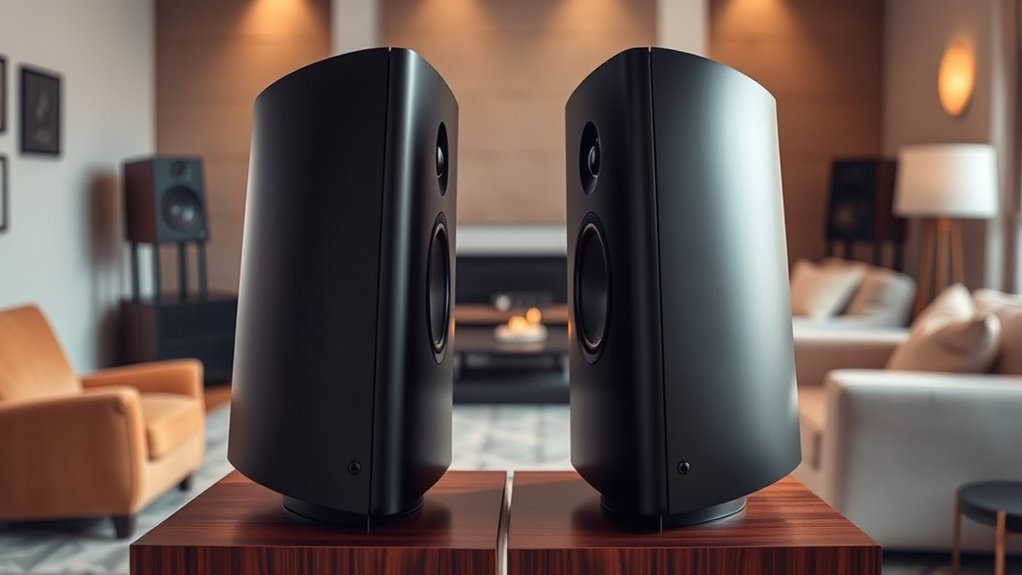
Room acoustics and speaker placement considerably influence the ideal toe-in angle, requiring precise adjustments based on the listening environment. We recommend measuring soundstage response and adjusting the angle accordingly to minimize reflections and maximize clarity. Careful consideration of these factors guarantees the toe-in angle complements your specific space for accurate sound reproduction.
Room Acoustics Impact
Achieving the ideal toe-in angle depends heavily on room acoustics, as the shape, size, and reflective surfaces influence sound dispersion and imaging. These factors directly impact how sound waves interact with the environment, affecting clarity and soundstage.
- Room dimensions determine the reflection patterns, requiring adjustments in toe-in for *best* imaging.
- Reflective surfaces like walls and windows can cause comb filtering, necessitating precise toe-in to mitigate reflections.
- Speaker material and listening distance influence how sound interacts with the room, guiding the necessary angle adjustments to maintain accurate imaging and tonal balance.
Understanding these parameters helps us fine-tune the toe-in for a balanced, immersive listening experience tailored to our specific environment.
Speaker Placement Tips
Determining the best toe-in angle for your speakers involves a systematic approach that considers both the acoustic environment and personal listening preferences. Accurate speaker calibration guarantees ideal soundstage and imaging, making the toe-in angle critical. Begin by evaluating your room’s acoustic treatment; reflective surfaces can distort sound, so adjusting the toe-in helps mitigate these effects. Use precise measurements to align the tweeters toward your listening position, typically forming an equilateral triangle. Experiment with incremental adjustments, listening for clarity and stereo separation. Proper calibration combined with strategic toe-in minimizes early reflections and enhances direct sound delivery. This method ensures your speakers are perfectly positioned, maximizing performance regardless of room acoustics or speaker design.
Step-by-Step Guide to Measuring and Setting Your Speaker Toe-In
To accurately measure and set your speaker toe-in, we begin by ensuring the speakers are positioned at the correct initial distance from the listening position. Proper alignment is essential for effective speaker calibration and optimal soundstage.
- Use a laser pointer or a plumb line to establish a precise reference line from each speaker to the listening chair.
- Measure the distance from each speaker to the listening position, ensuring consistency for balanced calibration.
- Adjust the speakers’ angles so that their tweeters direct toward the primary listening point, considering aesthetic considerations for visual symmetry.
This process ensures that the toe-in angle enhances sound coherence without compromising aesthetic appeal, resulting in a more precise and immersive listening experience.
Common Mistakes to Avoid When Toe-In Adjusting Speakers
One common mistake to avoid when adjusting the toe-in of your speakers is setting the angles too aggressively, which can cause sound imaging issues and unwanted reflections. Excessive toe-in narrows the soundstage and distorts imaging accuracy. Additionally, neglecting proper cable management can lead to accidental displacement during adjustments, affecting alignment. Always remove speaker grilles carefully to prevent damage and ensure precise angle adjustments. It’s also critical to regularly check cable connections, as loose or tangled cables can introduce noise or shift speaker positioning. Correctly managing cables and handling speaker components enhances stability and accuracy.
| Mistake | Consequence | Tip |
|---|---|---|
| Excessive toe-in | Narrow soundstage, imaging distortion | Use measured angles, test in room |
| Neglecting grille removal | Damage to speaker or grille | Remove grilles gently before adjustments |
| Poor cable management | Displacement or noise | Secure cables with clips or ties |
| Not verifying stability | Misalignment over time | Regularly check and re-adjust |
How Room Acoustics Influence Optimal Toe-In Settings
Room acoustics considerably influence the ideal toe-in settings for speakers, as reflected sound waves interact with surfaces, affecting soundstage, imaging, and clarity. Reflective surfaces like walls and ceilings can cause early reflections that alter perceived imaging, requiring adjustments in toe-in angle. Proper speaker stand placement helps minimize unwanted reflections and enhance sound dispersion. Additionally, removing speaker grills can reduce diffraction effects, clarifying direct sound paths and aiding in precise toe-in adjustments.
- Walls and ceiling reflectivity impact the optimal toe-in angle
- Speaker stand placement reduces boundary interference
- Speaker grill removal enhances direct sound clarity
Enhancing Stereo Imaging With Proper Speaker Toe-In
Proper speaker toe-in plays a crucial role in enhancing stereo imaging by aligning the sound sources to create a focused and cohesive soundstage. Precise toe-in minimizes phase discrepancies and maximizes the effectiveness of acoustic treatments, ensuring accurate sound localization. Regular speaker maintenance, such as checking for proper alignment and securing mounting hardware, maintains consistent imaging performance. Adjusting toe-in angles based on room acoustics helps refine soundstage width and depth. Here’s a concise overview:
| Toe-In Angle | Effect on Imaging | Recommendation |
|---|---|---|
| Zero to 5° | Wide, diffuse | Ideal for broad soundstage |
| 5° to 10° | Focused, precise | Suitable for nearfield listening |
| Above 10° | Narrow, pinpoint | Use with dedicated acoustic treatments |
| Adjustments | Fine-tune | Based on room acoustics and speaker maintenance |
| Consistency | Prime results | Regularly verify speaker alignment |
Troubleshooting Soundstage Issues Caused by Incorrect Toe-In
Incorrect toe-in angles often manifest as distortions in the soundstage, leading to a disjointed or unfocused stereo image. To troubleshoot, start by verifying speaker alignment and guaranteeing proper cable positioning, as loose or misrouted cables can influence perceived soundstage.
- Check for consistent speaker toe-in angles using a laser pointer or alignment tools.
- Inspect cable connections for secure contact and minimal interference, which affect sound clarity and imaging.
- Perform regular speaker maintenance, including cleaning terminals and verifying that stands or mounts are stable, to prevent alignment shifts.
Misaligned toe-in can cause phase issues and reduce imaging precision, so address these factors systematically. Correcting these elements ensures the stereo image remains cohesive, sharp, and accurately localized within the listening environment.
Tips for Fine-Tuning Toe-In for Different Music Genres
Different music genres often benefit from specific toe-in adjustments to optimize soundstage and imaging accuracy. For example, classical or acoustic recordings typically require minimal toe-in, promoting a broad soundstage and natural imaging. In contrast, rock and electronic music may benefit from a more pronounced toe-in to enhance clarity and focus. Adjusting speaker placement within your listening environment is essential; small changes in toe-in angle can markedly impact sound dispersion and stereo image. We recommend starting with a neutral toe-in, then fine-tuning based on the genre and personal preference. Always consider your listening environment’s acoustics, as reflective surfaces can alter perceived imaging. Precise toe-in adjustments tailored to music genre and environment ensure ideal soundstage and a more immersive listening experience.
Frequently Asked Questions
How Does Speaker Toe-In Impact Bass Response?
Speaker toe-in affects bass response by influencing speaker calibration and sound imaging, as angling speakers alters the directivity and phase alignment, resulting in tighter, more focused bass or boomy, less controlled bass depending on the angle.
Can Toe-In Adjustments Improve Speaker Longevity?
Adjusting toe-in subtly aligns acoustic calibration, acting as a gentle guardian for speaker maintenance. This precise angle reduces undue strain, potentially extending lifespan by optimizing sound dispersion and minimizing wear on internal components.
Is There a Universal Toe-In Angle for All Speakers?
There isn’t a universal toe-in angle because room acoustics and speaker alignment vary. We recommend starting with a 2-3° toe-in, then adjusting based on soundstage clarity and imaging, tailoring to your specific listening environment for ideal results.
How Often Should I Recheck My Speaker Toe-In Settings?
We recheck our speaker toe-in settings every few months, like tuning a finely crafted instrument, to prevent cabinet resonance and guarantee precise speaker alignment. Regular adjustments maintain ideal soundstage, avoiding misalignments caused by environmental shifts or vibrations.
Does Speaker Placement Affect Optimal Toe-In Angle?
Yes, speaker placement considerably influences ideal toe-in angle; room acoustics and speaker height alter sound reflection and directivity, requiring precise adjustments to achieve desired soundstage and imaging, ensuring the speakers perform at their best within your specific environment.
Conclusion
By dialing in the perfect toe-in angle, we craft a precise sonic map that guides sound waves directly to your ears, like a finely tuned instrument. This meticulous adjustment reveals a vivid, three-dimensional soundstage, revealing the nuances of each note. When we optimize toe-in, we don’t just improve clarity — we orchestrate an immersive listening experience, transforming your space into a concert hall of pure, pinpoint accuracy, where every detail resonates with crystal clarity.