Studies show that improper speaker-to-amplifier connections can reduce sound quality by up to 30%. As professionals, we recognize the importance of precise wiring to guarantee peak performance and safety. Connecting bookshelf speakers correctly involves careful attention to cable selection, polarity, and secure connections. If you’re looking to maximize your audio setup’s potential, it’s essential to follow a detailed, step-by-step process—so let’s explore how to do this effectively.
Key Takeaways
- Connect speaker wires to the amplifier’s output terminals, matching positive to positive and negative to negative.
- Use high-quality, solid core cables with secure connectors like binding posts or banana plugs.
- Place speakers at ear level and ensure wiring is neat, avoiding interference from power cords.
- Verify amplifier impedance matches speaker specifications for safe operation.
- Regularly inspect connections and adjust placement for optimal sound quality.
How Do Bookshelf Speakers Connect to an Amplifier?
How do bookshelf speakers connect to an amplifier? Typically, they connect via speaker wire terminals on both the amplifier and the speakers. Making sure proper speaker placement is essential; positioning speakers at ear level and maintaining equal distance from the listening position enhances sound quality. Proper acoustic treatment, such as placement away from reflective surfaces, minimizes sound distortion and improves clarity. When connecting, strip the wire ends and insert them securely into the amplifier’s speaker output terminals, matching polarity—positive to positive, negative to negative. The speaker terminals on the bookshelf speakers then connect correspondingly. This precise connection process, combined with strategic speaker placement and acoustic treatment, guarantees optimal signal transfer, reduces interference, and maximizes audio fidelity in your setup.
Choosing the Right Cables and Connectors for Your Setup
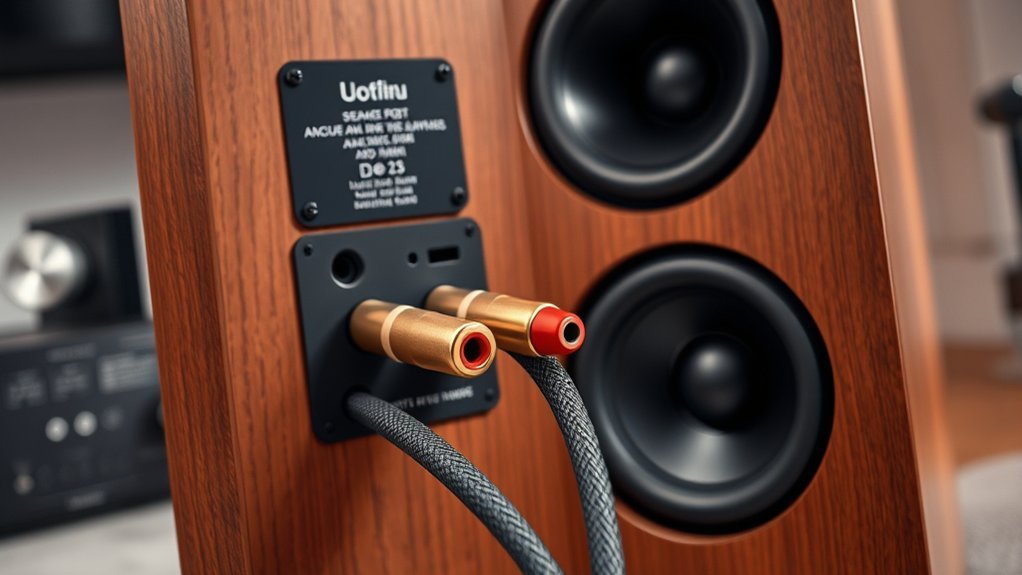
Selecting the appropriate cables and connectors is essential for guaranteeing high-quality audio transmission between your amplifier and bookshelf speakers. We recommend using high-grade speaker cables with solid core conductors to minimize resistance and signal loss. For wired connections, binding posts or banana plugs provide secure, reliable contact. When considering wireless connectivity options, make sure your chosen system supports high-fidelity audio codecs for peak sound quality. Proper speaker positioning also influences cable selection; longer runs require thicker gauge cables to prevent attenuation. Additionally, verify cables are shielded against interference, especially if running near power sources or other electronics. By carefully matching cables and connectors to your setup’s specifics, and considering wireless alternatives where appropriate, you’ll achieve clearer sound and more precise speaker placement for an ideal listening experience.
Step-by-Step Guide to Wiring Your Bookshelf Speakers to an Amplifier
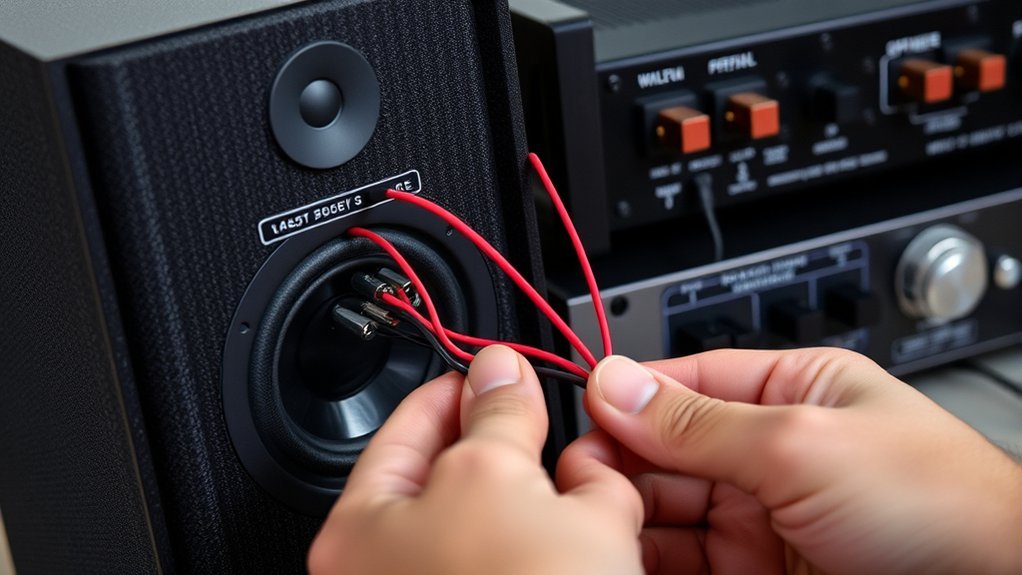
Wiring your bookshelf speakers to an amplifier involves a systematic process to guarantee ideal audio performance and safety. Begin by selecting suitable speaker placement, considering room acoustics to minimize reflections and standing waves. Connect the amplifier’s positive terminal to the speaker’s positive input, and the negative terminal to the negative input, ensuring polarity consistency to prevent phase issues. Use the appropriate cables and connectors for a secure, low-resistance connection. Confirm that the amplifier’s impedance matches the speakers’ specifications. Keep speaker wires clear of power cords to avoid interference. Proper wiring paired with strategic placement enhances sound clarity and imaging, leveraging room acoustics to maximize listening experience. This disciplined approach ensures both safety and superior audio quality.
Tips for Ensuring Safe and Optimal Sound Quality
To guarantee both safety and ideal sound quality, it’s essential to regularly inspect your speaker and amplifier connections for loose or damaged cables, as poor contact can cause distortion or equipment damage. Proper speaker placement minimizes interference and optimizes sound clarity. Acoustic treatment, such as diffusers and absorbers, reduces unwanted reflections, enhancing overall sound fidelity.
| Aspect | Best Practice |
|---|---|
| Speaker placement | Position speakers at ear level, equidistant from listening point |
| Cable inspection | Check connections monthly for corrosion or looseness |
| Acoustic treatment | Use panels to absorb high frequencies and reduce echo |
| Volume levels | Keep volume moderate to prevent distortion |
| Amplifier settings | Calibrate tone controls for balanced sound |
Troubleshooting Common Connection Issues With Bookshelf Speakers
When troubleshooting common connection issues with bookshelf speakers, it’s essential to systematically verify each component in the audio chain. First, check the speaker placement, ensuring they are positioned correctly and not obstructed, which can affect sound quality and connectivity. For wireless connectivity issues, confirm the speakers are within the effective range of the transmitter or router, and verify they are properly paired or connected via Bluetooth or Wi-Fi. Inspect all cables and connections between the amplifier and speakers for secure, damage-free contact. If wireless issues persist, reset the network or pairing settings. Additionally, update firmware if available. Precise speaker placement and stable wireless connections are critical to resolving most common issues and ensuring ideal audio performance.
Enhancing Your Audio Experience: Final Setup Checks and Recommendations
Achieving ideal audio performance requires thorough final setup checks and careful adjustments to guarantee every component functions harmoniously. Proper speaker placement is critical; ensure speakers are equidistant from the listening position, aligned at ear level, and form an equilateral triangle. Acoustic treatment minimizes reflections and standing waves, enhancing clarity. Verify that the amplifier settings match your speaker impedance and adjust the volume to prevent distortion. Use the following table to optimize your setup:
| Step | Action | Purpose |
|---|---|---|
| Speaker placement | Position speakers at ear level | Accurate sound staging |
| Acoustic treatment | Add diffusers or absorbers | Reduce reflections |
| Check wiring | Confirm secure connections | Prevent signal loss |
| Adjust gain and EQ | Fine-tune for balanced sound | Enhance tonal accuracy |
| Test playback | Listen critically | Ensure system cohesiveness |
Frequently Asked Questions
Can I Connect Bookshelf Speakers to a Smartphone or Tablet Directly?
We can’t connect bookshelf speakers directly to smartphones or tablets unless they have built-in Bluetooth compatibility and matching speaker impedance; otherwise, you’ll need an external Bluetooth receiver or amplifier to guarantee proper audio transmission and safety.
What Is the Ideal Speaker Placement for Optimal Sound Quality?
We position bookshelf speakers slightly away from walls, aligning with room acoustics to minimize reflections. Proper speaker positioning enhances sound quality, creating an immersive experience; subtle adjustments can dramatically improve your listening environment’s clarity and depth.
Are There Wireless Options for Connecting Bookshelf Speakers to Amplifiers?
Yes, there are wireless options utilizing wireless connectivity and Bluetooth compatibility, allowing us to connect bookshelf speakers to amplifiers seamlessly. These systems offer a technically precise, cable-free setup, enhancing convenience while maintaining high audio fidelity.
How Do I Upgrade My Speaker Cables for Better Audio Performance?
We upgrade speaker cables by choosing high-quality speaker wire types, like oxygen-free copper or silver-plated, ensuring proper gauge and minimal resistance. We also consider cable length considerations to prevent signal loss and preserve audio clarity.
What Safety Precautions Should I Follow During Setup?
We guarantee electrical grounding to prevent shocks and verify volume safety, avoiding sudden loud sounds. Always disconnect power before setup, handle cables carefully, and use proper insulation to minimize electrical hazards during connecting bookshelf speakers to the amplifier.
Conclusion
In conclusion, ensuring proper connections between your bookshelf speakers and amplifier is crucial for optimal sound quality. We recommend double-checking all wiring and maintaining proper polarity, as a chain is only as strong as its weakest link. Remember, “a stitch in time saves nine”—addressing connection issues early prevents more significant problems later. With careful setup and attention to detail, you’ll enjoy reliable performance and superb audio clarity from your system.