Many buyers overlook the importance of impedance and how it directly impacts amplifier compatibility, often leading to system inefficiencies or damage. Understanding key specs like wattage, frequency response, and sensitivity requires a more analytical approach to guarantee your speakers meet both your performance needs and technical constraints. If you want to make informed decisions that align with your setup, there’s a detailed process behind interpreting these figures—so, let’s explore what really matters when selecting speakers.
Key Takeaways
- Check the impedance to ensure compatibility with your amplifier for optimal power transfer and to prevent damage.
- Review the sensitivity rating to understand how loud the speaker will be with a given amount of power.
- Examine the frequency response to determine the range of sounds the speaker can accurately reproduce.
- Consider the power handling capacity to match your intended volume levels and avoid distortion or damage.
- Assess the speaker’s design and size to ensure it fits aesthetically and physically within your space.
What Are the Key Speaker Specs You Need to Know?
Understanding the key specifications of a speaker is essential for evaluating its performance and suitability for your needs. Critical specs include impedance, which influences compatibility with your amplifier, and sensitivity, indicating efficiency in converting power to sound. Speaker aesthetics matter too, as they affect integration into your space’s design, though they don’t impact sound quality directly. Equally important is brand reputation; established brands often guarantee quality control and reliable performance, reducing the risk of defects. Knowing these specs helps you compare models objectively and select a speaker that aligns with your technical requirements and aesthetic preferences. Focusing on these elements allows for a more informed decision, ensuring your investment delivers both sound excellence and visual harmony.
How Wattage Affects Your Speaker’s Performance
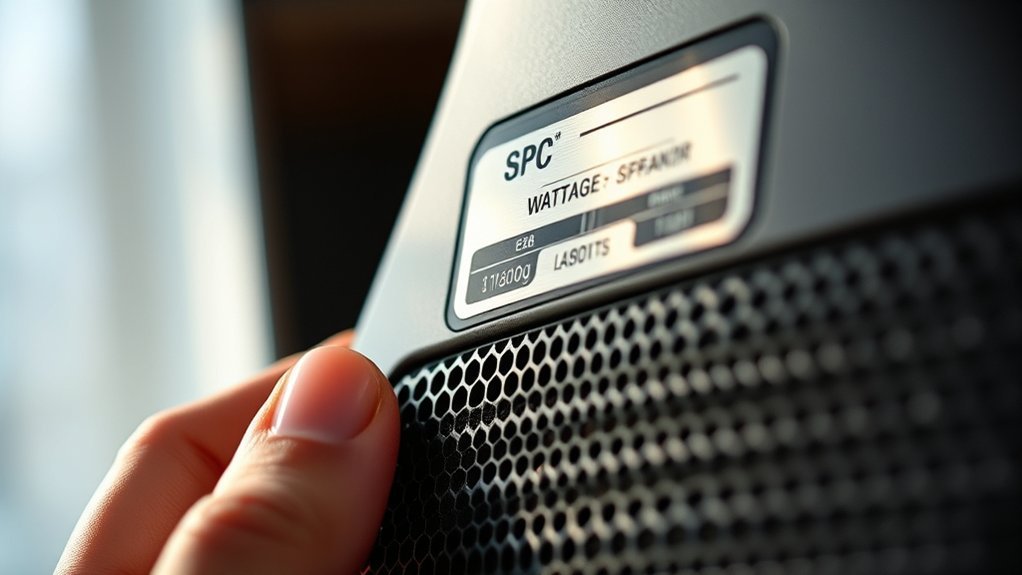
Wattage directly influences a speaker’s power handling capacity, affecting how much volume it can produce without distortion. Proper wattage alignment guarantees clarity at high volumes, preventing damage and maintaining sound fidelity. Understanding this relationship helps optimize performance for various listening environments.
Power Handling Capacity
How does the power handling capacity influence a speaker’s ability to deliver clear, distortion-free sound? Higher capacity allows speakers to manage increased wattage without distortion, reflecting better power efficiency and durability factors. Underpowered speakers risk clipping and damage, reducing overall performance. To visualize this, consider the following:
| Power Range (W) | Typical Use | Durability Factors |
|---|---|---|
| 50-100 | Small rooms, monitors | Moderate |
| 100-200 | Home theater, DJ sets | Good |
| 200+ | Concerts, large venues | High |
| 300+ | Professional equipment | Very high |
| Custom | Specialized applications | Tailored for longevity |
Understanding these specifications ensures peak performance and longevity, aligning wattage capacity with your specific needs.
Volume and Clarity
When a speaker’s wattage capacity increases, its ability to produce louder sound without sacrificing clarity improves considerably. Higher wattage allows the amplifier to deliver more power, which enhances volume and maintains sound integrity at higher levels. This directly benefits bass response, as increased wattage can drive woofers more effectively, resulting in deeper, more defined lows. However, it’s crucial to consider design aesthetics, as larger wattage speakers often have bulkier enclosures that may impact their visual appeal. Proper alignment between wattage and speaker design ensures maximum performance, avoiding distortion or overstated bass. Ultimately, understanding wattage’s role helps us select speakers that deliver clarity and power without compromising their aesthetic integration into our space.
Understanding Impedance: Why It Matters for Compatibility
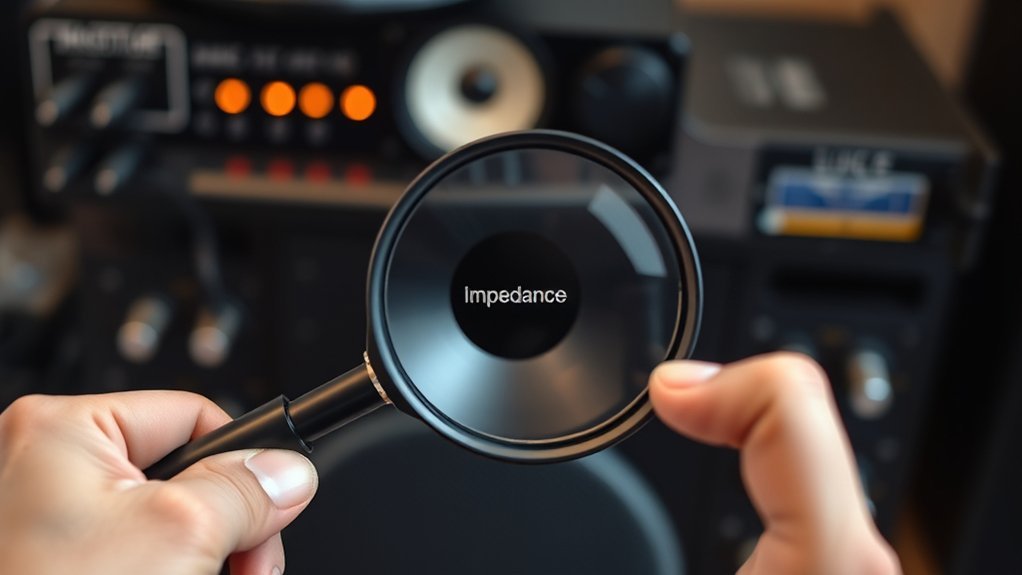
Understanding impedance is fundamental because it directly affects the compatibility between your amplifier and speakers. Impedance matching ensures that the electrical load presented by the speakers aligns with the amplifier’s output capacity, which is critical for peak performance and longevity. Mismatched impedance can lead to reduced power transfer, distortion, or even damage to components. When selecting speakers, verifying their impedance ratings—commonly 4, 8, or 16 ohms—is essential for maintaining electrical compatibility. Proper impedance matching allows the amplifier to deliver clean, efficient power without overheating or overloading. Recognizing the significance of impedance in the context of speaker specs helps prevent technical issues and maximizes sound quality, making it a key factor to think about before making a purchase.
Deciphering Frequency Response for Better Sound Quality
Understanding a speaker’s frequency response helps us evaluate its ability to reproduce sound accurately across the audible spectrum. The range indicates the spectrum of tones the speaker can produce, directly affecting sound clarity and detail. By analyzing the frequency range, we can determine how well a speaker captures both deep bass and high treble, ensuring precise audio reproduction.
Understanding Frequency Range
Frequency range is a fundamental aspect of speaker specifications that directly impacts audio fidelity. It defines the spectrum of sounds a speaker can reproduce, from bass to treble. Understanding this range helps us optimize speaker placement and acoustic treatment, ensuring the full frequency response is utilized effectively. A wider frequency range generally indicates more detailed sound reproduction, but real-world performance depends on how well the speaker integrates into the listening environment. Proper speaker placement can enhance low-end extension and high-frequency clarity, while acoustic treatment minimizes reflections that may distort the perceived frequency response. By analyzing the specified frequency range in conjunction with room acoustics, we can better predict how a speaker will perform in a given space, leading to more accurate and satisfying audio experiences.
Impact on Sound Clarity
How does the frequency response directly influence sound clarity? It determines how accurately a speaker reproduces audio across the audible spectrum. A flat, extended frequency response guarantees clarity by faithfully delivering both low and high frequencies without distortion. Proper speaker placement enhances this effect, minimizing reflections and standing waves that can muddy sound quality. Acoustic treatment further refines clarity by absorbing or diffusing unwanted resonances, allowing the speaker’s true response to shine through. When evaluating specs, look for a wide, even frequency response range, which indicates the speaker’s ability to handle diverse audio signals with precision. Together, strategic placement and acoustic treatment optimize the speaker’s frequency response, resulting in clearer, more accurate sound reproduction.
What Does Sensitivity Tell You About Speakers?
Sensitivity indicates how efficiently a speaker converts electrical power into sound, directly affecting its volume output relative to the input signal. The sensitivity measurement, usually expressed in decibels (dB) with a standard test tone at a specified wattage, provides a clear gauge of speaker efficiency. Higher sensitivity ratings mean the speaker produces more sound output with less power, making it suitable for environments where amplifier power is limited. Conversely, lower sensitivity speakers require more power to reach comparable volume levels. Understanding sensitivity helps us evaluate a speaker’s ability to deliver loud, clear sound without excessive amplification. This metric is essential for matching speakers to your amplifier’s power capacity, ensuring peak performance without distortion or undue strain on your system.
How to Use Speaker Size and Design to Your Advantage
While larger speakers generally produce more powerful sound, their size and design features can be strategically leveraged to optimize audio performance for specific environments. Design aesthetics influence not only visual appeal but also acoustic dispersion; sleek, optimized enclosures can reduce unwanted resonances. Material durability is vital for long-term performance, especially in demanding settings, ensuring the speaker maintains structural integrity and sound quality over time. The choice of enclosure shape and internal bracing impacts sound clarity and bass response, allowing us to tailor the speaker’s output to room size and acoustics. By understanding how size relates to sound projection and how design elements affect durability, we can select speakers that deliver precise, high-quality audio while fitting aesthetic and environmental requirements.
Comparing Specs to Find the Best Fit for Your Listening Space
When evaluating speaker specifications to determine the best fit for your listening space, it’s essential to analyze key metrics such as power handling, frequency response, and impedance in relation to your room’s size and acoustic characteristics. Proper matching guarantees ideal sound quality and prevents damage. Consider these factors:
- Room acoustics: Larger or more reflective spaces may require speakers with broader frequency response and higher power handling.
- Aesthetic design: Select speakers that complement your room’s decor without compromising acoustic performance.
- Impedance compatibility: Match speaker impedance with your amplifier’s output to ensure efficient power transfer and clarity.
Frequently Asked Questions
How Do I Interpret Speaker Durability and Build Quality Specifications?
We assess speaker durability by analyzing material quality and manufacturing standards, ensuring sturdy enclosures and resilient components. These specifications reveal how well speakers withstand wear and environmental factors, guiding us toward long-lasting, high-quality audio equipment.
Are There Specific Brands Known for More Accurate Speaker Specs?
Some brands, like KEF and Bowers & Wilkins, masterfully calibrate speakers for precise frequency response, making them astonishingly accurate. Their meticulous engineering guarantees you get reliable, industry-leading specs that dramatically enhance your listening experience.
What Are the Hidden Factors That Influence Speaker Performance?
Hidden factors like frequency response variations and impedance mismatches greatly influence speaker performance. We analyze these technical details to guarantee ideal audio clarity, recognizing that subtle discrepancies can affect sound quality despite seemingly accurate specs.
How Does Room Acoustics Affect the Importance of Speaker Specs?
Room acoustics, like a tuning fork, amplifies or dampens speaker specs; larger rooms or untreated spaces diminish clarity. So, room size and acoustic treatment are essential, making detailed speaker specs less critical in optimized environments.
Can I Rely Solely on Specs to Choose the Best Speakers?
We can’t rely solely on specs to determine speaker sound quality; technical jargon often masks real-world performance. Analyzing frequency response, sensitivity, and impedance helps us make more informed decisions, but listening tests remain essential for true evaluation.
Conclusion
Understanding speaker specs empowers us to make informed choices, ensuring ideal compatibility and performance. Did you know that speakers with higher sensitivity ratings can produce the same volume as lower sensitivity models but with considerably less power? This highlights the importance of balancing specs like impedance and sensitivity to match our audio systems effectively. By analyzing these details critically, we can select speakers that deliver precise sound quality while maximizing efficiency and longevity.