Did you know that the choice of stand can substantially alter your listening experience, yet many overlook this detail? While desk stands provide convenience, they can also introduce vibrations that muddy sound clarity, whereas dedicated speaker stands promise stability and precise positioning. Understanding these subtle differences is vital for optimizing sound quality, especially in constrained or professional environments. So, which option truly aligns with your space, budget, and audio goals? The answer might surprise you.
Key Takeaways
- Desk stands are ideal for compact setups and quick adjustments, while speaker stands provide stability for larger, heavier speakers.
- Proper placement on stands improves sound clarity, reduces vibrations, and enhances stereo imaging.
- Choose desk stands for space-saving, budget-friendly solutions; opt for speaker stands for durability and professional sound quality.
- The optimal placement depends on environment size, aesthetic preferences, and the need for adjustability and stability.
- Troubleshooting placement issues, such as cable clutter or instability, ensures better sound performance regardless of stand type.
What Are the Main Differences Between Desk and Speaker Stands?
What are the main differences between desk and speaker stands? Primarily, they differ in design intent and functionality. Desk stands are typically designed to hold speakers or monitors at eye level, often featuring a variety of material options like metal, wood, or plastic for stability and aesthetics. Adjustable features, such as height or tilt, are common, allowing us to customize positioning for ideal comfort and sound direction. Speaker stands, on the other hand, are usually more robust, emphasizing stable support for heavier speakers. They often incorporate adjustable features like height or angle to fine-tune sound dispersion. Material choices and adjustability directly impact durability and usability, making each stand type suited for specific placement needs and acoustic precision.
How Do Desk Stands Affect Sound Quality and Clarity?
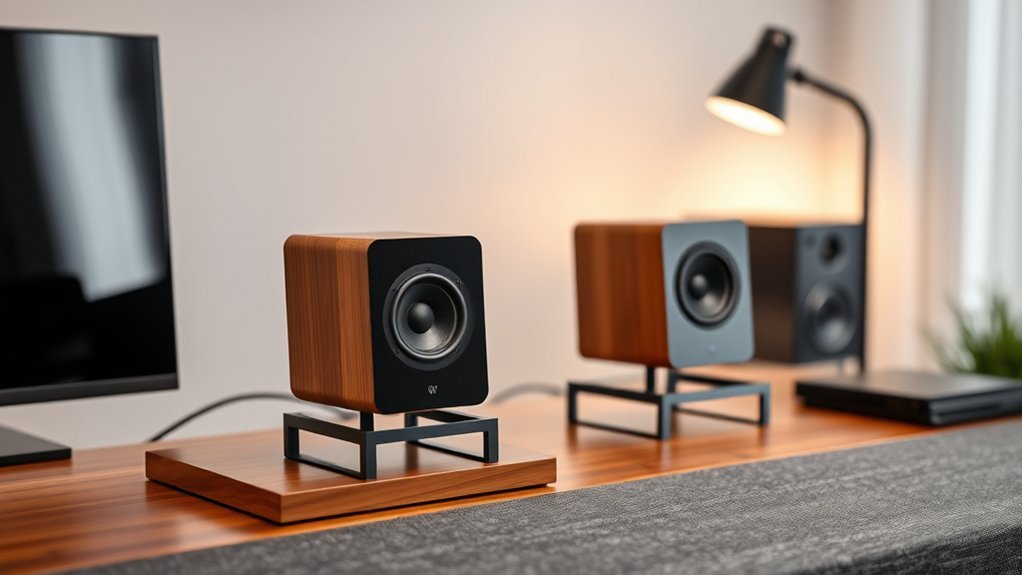
Using desk stands can considerably enhance sound localization, making it easier to identify the direction of audio sources. They also help reduce vibrations and resonance that often color sound quality, resulting in clearer audio. By minimizing these factors, desk stands contribute to a more accurate and detailed listening experience.
Improved Sound Localization
Desk stands can markedly enhance sound localization by positioning speakers at ear level, which reduces acoustic distortions caused by reflections and obstructions. Proper placement improves the accuracy of audio cues, allowing us to better identify the source direction. Additionally, stable placement minimizes vibrations, contributing to clearer sound images. Effective acoustic treatment and speaker insulation further refine localization, preventing sound leakage and interference. The table below highlights key factors affecting sound localization:
| Factor | Influence on Localization | Optimization Strategy |
|---|---|---|
| Speaker Height | Critical for accurate cues | Use stands for precise placement |
| Acoustic Treatment | Reduces reflections | Add absorbers near speakers |
| Speaker Insulation | Prevents sound leakage | Isolate speakers from surfaces |
| Reflection Points | Cause localization errors | Minimize reflective surfaces |
These elements collectively improve spatial accuracy of sound perception.
Reduced Vibrations and Resonance
When speakers are placed directly on a desk surface, vibrations can transfer from the enclosure to the supporting surface, creating unwanted resonance that muddies sound clarity. This transfer amplifies low-frequency resonances, leading to a muddled or boomy sound. Using desk stands substantially enhances vibration reduction by isolating the speaker from the desk, preventing these vibrations from propagating. Proper resonance control minimizes the interference caused by surface vibrations, resulting in cleaner, more accurate audio reproduction. By elevating and decoupling speakers from the desk, stands help stabilize the soundstage and improve overall clarity. This targeted vibration reduction and resonance control ensure that audio signals remain precise, delivering a more faithful listening experience with less distortion caused by unwanted resonances.
Advantages of Using Dedicated Speaker Stands
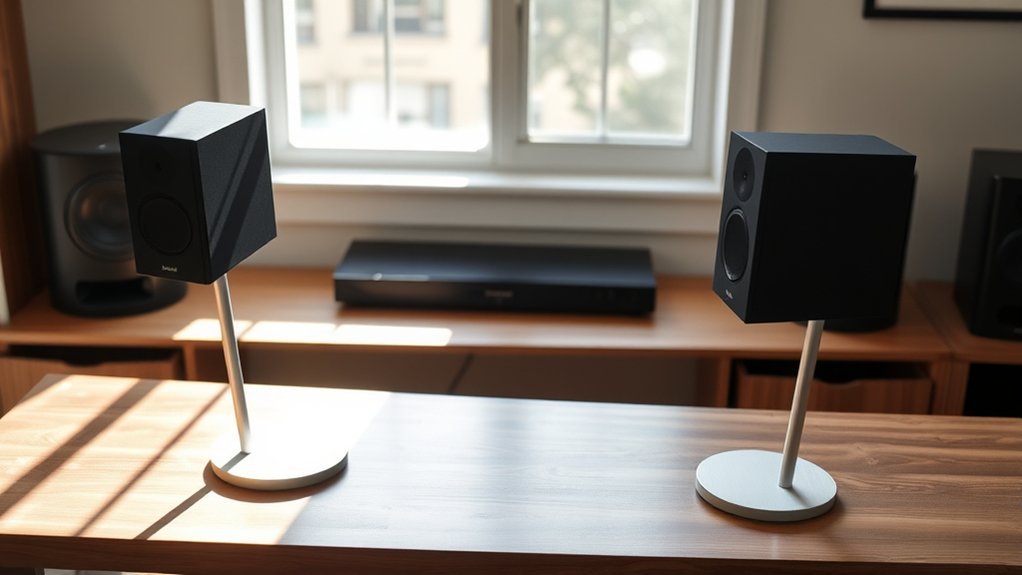
Using dedicated speaker stands offers notable benefits, including enhanced sound clarity by minimizing unwanted vibrations. They also reduce resonance that can distort audio, resulting in cleaner, more accurate sound. Additionally, proper height positioning ensures ideal listening angles, improving overall audio experience.
Improved Sound Clarity
Dedicated speaker stands elevate speakers to ideal listening height, which directly enhances sound clarity by minimizing distortions caused by improper placement. Proper positioning ensures that sound waves reach our ears without unwanted reflections or phase issues, resulting in clearer audio. This setup improves bass response by aligning drivers ideally, allowing low frequencies to project more accurately. Additionally, dedicated stands contribute to aesthetic appeal, providing a clean, professional look that complements any setup. The stability of stands also prevents unwanted vibrations, ensuring that sound remains precise. Overall, using speaker stands enhances clarity by refining sound dispersion, emphasizing detail, and creating a more immersive listening experience.
- Precise sound dispersion for balanced audio
- Accurate bass response with ideal driver alignment
- Enhanced aesthetic appeal complements your space
Reduced Vibrations and Resonance
Vibrations and resonance can considerably distort audio quality by causing unwanted sounds and muddiness, but dedicated speaker stands effectively mitigate these issues. They achieve this through vibration dampening materials, such as dense rubber or specialized pads, which absorb and isolate the speaker’s vibrations from the surface. Resonance control is enhanced by the stand’s design, preventing the speaker’s chassis from vibrating freely and transmitting sound distortions back into the audio signal. This not only stabilizes the speaker physically but also reduces the transfer of mechanical energy that causes resonance. As a result, audio remains clearer and more accurate, with less coloration or interference. By minimizing unwanted vibrations and resonance, speaker stands provide a more precise listening experience, ensuring that sound quality isn’t compromised by extraneous mechanical effects.
Optimal Listening Height
Proper placement of speakers plays a significant role in achieving ideal sound clarity, and one of the key factors is their listening height. Correct speaker height ensures the drivers are positioned at ear level, enhancing soundstage and imaging. When considering desk positioning, speakers placed too low or high can cause sound distortion and reduce detail. Using dedicated speaker stands allows for precise adjustment of speaker height, aligning them with the listener’s ears regardless of desk height or seating position. This not only improves stereo separation but also minimizes reflections from nearby surfaces.
- Adjusts speaker height for optimal sound imaging
- Reduces interference from desk and surface reflections
- Ensures consistent sound quality across different seating positions
When Is a Desk Stand the Better Choice for Your Setup?
A desk stand becomes the ideal choice when your setup requires a compact, easily accessible solution that minimizes clutter and maximizes convenience. It’s particularly advantageous when room acoustics are challenging, such as tight spaces or rooms with reflective surfaces, where precise speaker positioning can be difficult. A desk stand allows for closer placement to your ears, helping to optimize sound clarity and reduce the impact of room reflections. Additionally, it simplifies speaker positioning, enabling quick adjustments for better stereo imaging and soundstage. For users prioritizing a neat workspace without sacrificing sound quality, a desk stand offers a practical, space-efficient option that supports effective speaker placement while maintaining an organized environment.
Key Factors to Consider When Choosing Between Desk and Speaker Stands
When choosing between desk and speaker stands, we need to carefully evaluate several key factors that influence sound quality, stability, and practicality. Aesthetic considerations play a significant role, as the stand’s design should complement your setup without creating visual clutter. Portability options are also crucial, especially if you frequently move or adjust your workspace, making lightweight, easy-to-transport stands more appealing. Additionally, stability ensures your speakers remain secure and minimize vibrations that could distort sound.
Choosing the right stand depends on sound quality, stability, aesthetics, and portability for your workspace.
- Compatibility with existing equipment and space constraints
- Material durability and build quality
- Ease of assembly and adjustment mechanisms
Cost, Space, and Aesthetic Impact of Each Option
Cost, space requirements, and aesthetic considerations considerably influence the decision between desk and speaker stands. A thorough cost comparison reveals that desk stands are generally more affordable, often integrated into desks or existing furniture, while dedicated speaker stands can be more expensive due to materials and design. Space-wise, desk stands occupy minimal room, making them ideal for compact setups, whereas speaker stands require dedicated floor space, which may be limiting in smaller environments. Aesthetic considerations play a vital role; desk stands tend to blend seamlessly with a workspace’s design, maintaining a clean look. Conversely, speaker stands can add a visual statement or modern touch, but may disrupt the overall aesthetic if not chosen carefully. Ultimately, balancing these factors helps determine the most suitable option.
Troubleshooting Common Placement Issues
Despite careful planning, placement issues with desks or speaker stands can still arise, impacting sound quality and setup efficiency. Common problems include cable management difficulties, improper height adjustment, and unstable positioning. To resolve cable clutter, consider using cable clips or sleeves to organize and anchor wires neatly, reducing interference and tripping hazards. When facing height adjustment issues, verify the stand or desk supports the ideal listening height, ensuring the tweeters are ear level for accurate sound. Stability can be improved by tightening fasteners or repositioning the stand on a level surface. Addressing these issues systematically enhances sound clarity and setup durability, guaranteeing that your audio experience remains consistent and professional. Proper troubleshooting ensures your arrangement maintains both functionality and sound integrity.
Which Setup Best Suits Different Listening Environments and Budgets?
Choosing between desk setups and speaker stands ultimately depends on the specific listening environment and the available budget, as each option offers distinct advantages tailored to different needs. For smaller spaces or budget-conscious setups, desks with integrated stands often feature limited color options, but they excel in cost-effectiveness and simplicity. Conversely, dedicated speaker stands provide more customization, including diverse color options to match decor, and are typically constructed from highly durable materials like metal or dense wood, ensuring longevity. Material durability is vital for stability and vibration reduction, especially in larger or more active environments. Ultimately, if flexibility and aesthetics matter most, speaker stands may be preferable. For compact, budget-sensitive settings, desk setups offer practicality without sacrificing essential sound quality.
Frequently Asked Questions
How Do Vibrations Differ Between Desk and Speaker Stands?
We find desk vibrations tend to be higher due to surface instability, while stand stability minimizes vibrations, providing clearer sound. Properly isolated stands reduce vibrational transfer, improving audio quality and preventing unwanted resonance.
Can Speaker Stands Improve Bass Response?
Speaker stands can improve bass response through better subwoofer integration and enhanced acoustic isolation, reducing vibrations and unwanted resonances, ultimately delivering clearer, more precise low frequencies that markedly enhance overall sound quality and listening experience.
Are There Specific Materials Better for Sound Quality?
Think of speaker materials as the foundation of a building; sturdy, dense materials like metal or stone enhance sound clarity by minimizing vibrations, while softer woods may introduce resonance. Material impact directly influences overall sound quality and fidelity.
How Easy Is It to Relocate Each Setup?
Relocating desk setups is easier due to their integrated design, whereas speaker stands, while offering better aesthetic appeal, often involve more effort and cost comparison, making them less convenient but potentially more flexible for ideal sound positioning.
Do Stands Affect Speaker Durability Over Time?
We believe stands can impact speaker durability; sturdy, well-designed stands reduce wear over time, enhancing aesthetic appeal and justifying higher costs. With proper maintenance, stands protect speakers and guarantee longevity, making them a worthwhile investment.
Conclusion
Ultimately, choosing between desk and speaker stands resembles arranging a symphony—each element must harmonize with the environment. When we consider space, budget, and sound quality, the decision becomes clearer, like tuning an instrument for peak performance. By carefully analyzing these factors, we can craft a setup that not only looks balanced but also produces clarity and stability, much like a well-composed piece where every detail complements the whole, ensuring an immersive listening experience.