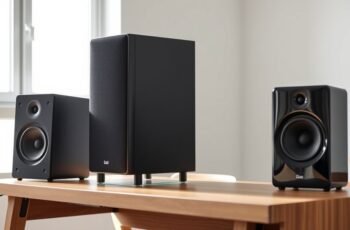
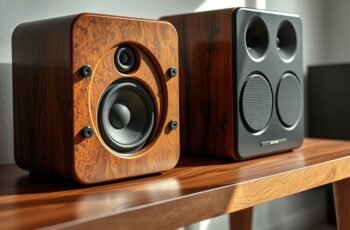
Imagine sitting in a well-treated room and comparing the precise imaging of KEF’s Uni-Q drivers to ELAC’s more robust, bass-forward response. Both brands excel in delivering high-quality sound, yet they do so through fundamentally different design philosophies and technological approaches. Understanding these nuances is essential for making an informed choice that aligns with your specific listening environment and preferences—something we’ll explore in detail as we examine their sound performance, build quality, and value.
Key Takeaways
- KEF excels in precise sound staging and imaging due to Uni-Q driver technology, ideal for detailed and immersive listening.
- ELAC offers a fuller, bass-rich sound profile with larger drivers, suitable for larger rooms and bass-heavy preferences.
- KEF’s refined cabinetry and driver materials minimize distortion, enhancing clarity and spatial accuracy.
- ELAC’s robust build and larger drivers deliver powerful, dynamic sound with greater room-filling capability.
- Choice depends on preferences for precise imaging and soundstage (KEF) versus impactful bass and versatility (ELAC).
How Do KEF and ELAC Bookshelf Speakers Differ in Sound Performance?
While both KEF and ELAC bookshelf speakers deliver high-quality audio, their sound performance characteristics differ markedly due to design focus and technological implementation. KEF speakers typically feature Uni-Q driver arrays, which enhance sound staging by providing a more coherent and immersive stereo image. This design allows for precise placement of instruments and vocals in space, creating a more natural listening experience. ELAC models, on the other hand, often emphasize robust bass response through larger drivers and port tuning, resulting in deeper, more impactful lows. While KEF’s sound staging excels in clarity and imaging, ELAC’s bass response contributes to a fuller, more dynamic sound profile. Both approaches serve different listening preferences, highlighting their unique technological priorities in sound performance.
What Are the Key Build Quality Differences Between KEF and ELAC?
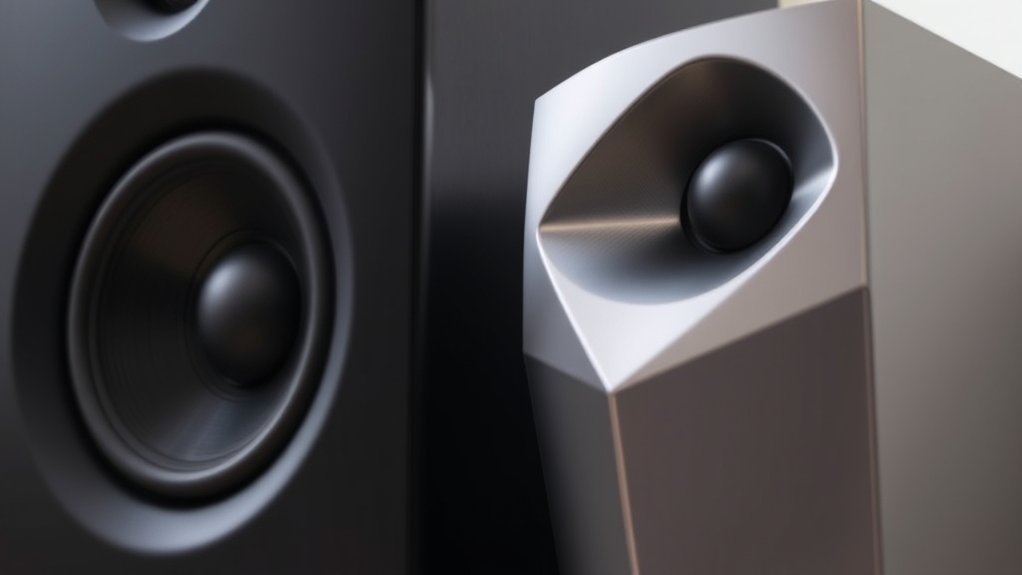
When comparing KEF and ELAC, we focus on material durability, finish quality, and the precision of component assembly. KEF tends to use high-grade materials with meticulous finish work, emphasizing cabinet rigidity and aesthetic refinement, while ELAC prioritizes robust construction with cost-effective yet durable components. Analyzing these differences reveals how each brand’s design choices impact long-term reliability and acoustic integrity.
Material Durability and Finish
Because material quality directly impacts longevity and aesthetic appeal, examining the build integrity of KEF and ELAC bookshelf speakers reveals notable differences. KEF employs high-density MDF with a durable veneer finish, prioritizing finish aesthetics that resist scratches and maintain visual appeal over time. Their use of premium materials enhances material longevity, ensuring consistent performance and reduced susceptibility to warping. ELAC, on the other hand, often utilizes MDF with a textured laminate or painted finish, which may be more prone to chipping or surface wear, slightly compromising finish aesthetics. While both brands emphasize solid core materials for structural stability, KEF’s meticulous surface treatments tend to offer superior resilience against environmental factors, reinforcing their commitment to long-lasting material durability and refined finishes.
Cabinet Construction and Design
The construction quality and design nuances of KEF and ELAC bookshelf speakers considerably influence their acoustic stability and aesthetic longevity.
- KEF employs MDF cabinet materials with internal bracing, reducing resonance and enhancing sound clarity, while ELAC favors high-density fiberboard with damping layers for similar stability.
- KEF’s cabinet design emphasizes rounded edges and a sleek profile, boosting aesthetic appeal and minimizing diffraction effects. ELAC tends toward more angular, boxy shapes, prioritizing structural rigidity over visual fluidity.
- Both brands incorporate internal damping materials, but KEF’s precision-engineered joints and reinforced panels contribute to superior vibration control, directly impacting sound fidelity and long-term durability.
Component Quality and Precision
KEF and ELAC diverge particularly in their approach to component selection and assembly precision, which directly impacts their overall sound quality and longevity. KEF emphasizes high-quality, rigid materials in drivers and crossovers, ensuring minimal distortion and consistent performance. Their focus on meticulous acoustic tuning involves precise speaker positioning within the enclosure to optimize sound dispersion. ELAC, on the other hand, employs carefully selected components with tight manufacturing tolerances, prioritizing detailed craftsmanship. Their acoustic tuning process involves rigorous measurements to refine crossover slopes and driver alignment. The assembly precision in KEF models often results in tighter tolerances, reducing unwanted vibrations, while ELAC’s focus on component quality enhances durability. Both brands prioritize component integrity, but KEF’s emphasis on speaker positioning and acoustic tuning yields a more refined soundstage.
Which Brand Offers Better Value for Money in Bookshelf Speakers?
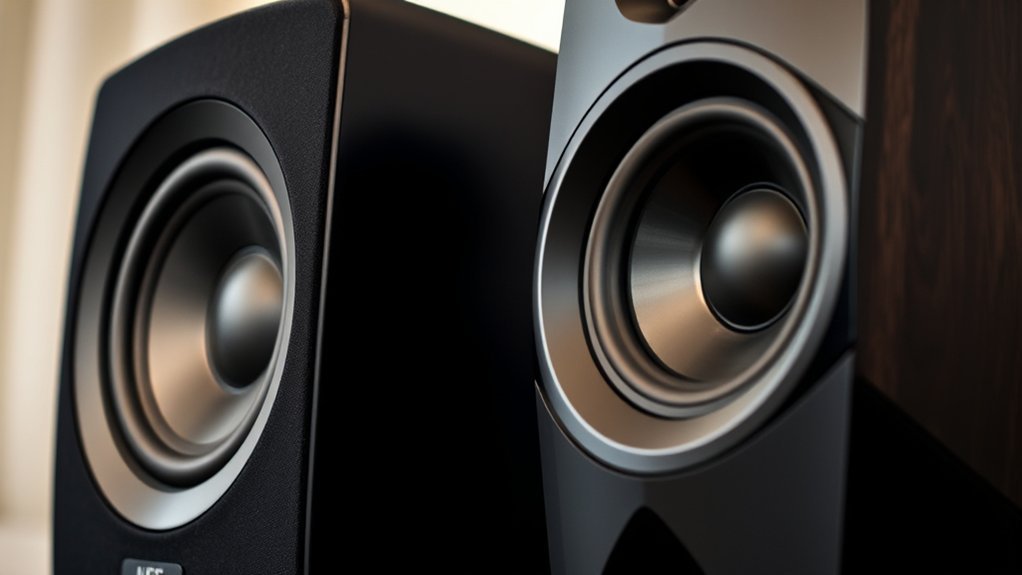
When evaluating value for money in bookshelf speakers, KEF and ELAC present compelling options with distinct strengths. Their pricing strategies reflect their target markets: KEF tends to position itself as a premium brand with higher price points, emphasizing advanced driver technology and refined cabinetry, while ELAC offers more accessible pricing without sacrificing core acoustic quality. Regarding brand reputation, KEF’s established heritage in innovation and design often justifies its premium pricing through perceived quality and prestige. Conversely, ELAC’s reputation for delivering solid performance at more affordable prices makes it attractive for budget-conscious consumers. Ultimately, KEF’s higher cost may be justified by its technological investments, whereas ELAC offers better value for those prioritizing affordability without compromising essential sound quality.
How Do KEF and ELAC Compare in Listening Environments and Room Compatibility?
We recognize that room size and acoustic treatment considerably influence the performance of KEF and ELAC speakers, affecting parameters like frequency response and imaging. KEF models, with their Uni-Q drivers, tend to excel in smaller to medium rooms due to their controlled dispersion, while ELAC speakers often perform well in larger spaces when paired with appropriate acoustic treatments. Analyzing these factors helps determine how each brand’s design aligns with specific listening environments for ideal sound quality.
Room Size Compatibility
Evaluating room size compatibility requires examining how KEF and ELAC bookshelf speakers perform across various listening environments, focusing on their power handling, driver design, and acoustic output. In smaller rooms, both brands excel with precise speaker placement, minimizing acoustic echo and maximizing clarity. KEF’s Uni-Q driver array offers wide dispersion, beneficial in medium-sized spaces, whereas ELAC’s drivers provide controlled output suitable for larger rooms.
- KEF’s design favors smaller to medium rooms, where its wider soundstage reduces the need for extensive acoustic treatment.
- ELAC’s higher power handling supports larger rooms, compensating for room modes and potential acoustic echo issues.
- Both brands require strategic speaker placement to optimize sound, especially in rooms with reflective surfaces, ensuring balanced sound distribution.
Acoustic Treatment Effects
Acoustic treatment considerably influences how KEF and ELAC bookshelf speakers perform across various listening environments, affecting sound clarity, imaging, and overall fidelity. Room acoustics, including reflective surfaces and room dimensions, play a critical role in how sound waves interact with speakers. Proper speaker placement minimizes boundary effects and standing waves that can muddy audio clarity. KEF’s Uni-Q driver array tends to benefit from strategic placement to optimize imaging, while ELAC’s design may be slightly more forgiving in less ideal setups. Both brands respond differently to acoustic treatments; KEF’s detailed soundstage requires more precise positioning, whereas ELAC’s balanced response can adapt better to varied room conditions. Ultimately, effective room acoustics and thoughtful speaker placement are essential for accessing each speaker’s full potential.
What Unique Sound Technologies Do KEF and ELAC Use?
Both KEF and ELAC leverage innovative sound technologies to distinguish their bookshelf speakers in a competitive market, with each brand focusing on proprietary designs that enhance audio fidelity. KEF’s Uni-Q driver array places the tweeter at the acoustic center of the midrange cone, creating superior sound staging and a more cohesive sound image. ELAC utilizes advanced driver materials and waveguide technology to optimize bass response and minimize distortion. Specifically:
- KEF’s Uni-Q technology improves sound staging, allowing precise imaging even off-axis.
- ELAC’s waveguide design enhances dispersion and bass response, reducing distortion.
- Both brands incorporate cabinet damping techniques that improve transient response and clarity.
These technological innovations directly influence how accurately the speakers reproduce sound, emphasizing clarity in bass and spatial imaging.
Which Speakers Are Better Suited for Different Audiences or Use Cases?
When choosing between KEF and ELAC bookshelf speakers, it’s essential to take into account the specific needs and environments of the intended users. KEF models, with their Uni-Q drivers, excel in providing a wide soundstage, making them suitable for smaller rooms or setups where precise speaker placement is challenging. Their bass response tends to be tight and controlled, benefiting users seeking clarity in midrange and high frequencies. Conversely, ELAC speakers often feature larger cabinets and more robust drivers, delivering a fuller bass response ideal for larger spaces or users prioritizing deep bass. Their placement flexibility allows for more forgiving positioning, but ideal sound quality still depends on proper speaker placement. Overall, KEF suits audiophiles prioritizing detail, while ELAC caters to those desiring powerful bass in versatile environments.
How Should You Decide Between KEF and ELAC Based on Your Listening Preferences?
Deciding between KEF and ELAC bookshelf speakers hinges primarily on your personal listening preferences and the specific qualities you value in audio reproduction. To make an informed choice, consider these factors:
- Speaker Placement: KEF’s Uni-Q driver array offers a broader sweet spot, ideal for varied placement or larger listening areas. ELAC’s design emphasizes accurate soundstage, requiring precise positioning for ideal imaging.
- Listening Habits: If you prefer immersive, expansive sound for movie nights, KEF’s spatial coherence suits you. For detailed, analytical listening sessions, ELAC’s neutral tonal balance provides clarity.
- Sound Signature Preference: KEF emphasizes a lively, detailed high end, whereas ELAC leans toward a balanced, natural response. Your preferred sound profile will guide your choice based on your typical listening environment and habits.
Frequently Asked Questions
Which Speaker Brand Has Better Customer Reviews Overall?
We find that ELAC generally receives more positive customer reviews, likely due to its solid brand reputation and modern speaker aesthetics, while KEF also garners praise but with slightly varied feedback on design and sound performance.
How Do KEF and ELAC Speakers Perform With Different Music Genres?
We find KEF and ELAC speakers handle diverse music genres well, with KEF’s larger speaker size enhancing detailed high frequencies, while ELAC’s bass response delivers deeper lows, making each suitable for different genre demands and listening preferences.
Are KEF or ELAC Speakers More Durable Over Time?
We find KEF speakers generally more durable over time due to their robust speaker design and high-quality build, supported by KEF’s strong brand reputation for engineering longevity; ELAC’s build quality is solid but slightly less resilient.
Do KEF or ELAC Offer Better Warranty and Support Services?
Like a well-oiled machine, KEF offers superior warranty and support, backed by a strong brand reputation and efficient customer service. ELAC’s support is solid but slightly less thorough, making KEF our top choice for reliability.
How Do KEF and ELAC Compare in Power Handling Capabilities?
We find KEF speakers generally handle higher power levels due to advanced acoustic tuning and robust driver construction, making them suitable for larger spaces. ELAC models often excel in controlled environments, with placement influencing their effective power handling capacity.
Conclusion
Ultimately, choosing between KEF and ELAC is like selecting the right lens for a camera—it depends on the scene you want to capture. KEF offers pinpoint accuracy for detailed soundscapes, while ELAC provides a broader, more robust auditory experience. Our decision hinges on your room size, listening style, and sonic priorities. By understanding these technical nuances, you can fine-tune your audio setup to perfectly match your auditory landscape.