When considering speakers for a desk setup, we recognize that nearfield monitors and bookshelf speakers serve distinct purposes, each with technical advantages and limitations. Our goal is to analyze their performance characteristics, placement requirements, and suitability for various audio tasks. Understanding these differences can directly impact your listening experience, whether for critical mixing or casual enjoyment. To make an informed choice, it’s essential to assess how these options align with your space and audio priorities.
Key Takeaways
- Nearfield monitors are designed for close proximity, offering flat frequency response ideal for critical listening and mixing on desks.
- Bookshelf speakers are larger, providing broader sound dispersion suitable for casual listening in desk environments.
- Monitors minimize room reflections with acoustic treatment, while bookshelf speakers can be affected by room acoustics and placement.
- Nearfield monitors prioritize accuracy and detailed imaging, whereas bookshelf speakers often produce warmer, subjectively pleasing sound.
- Choose monitors for professional, precise audio tasks; opt for bookshelf speakers for general, casual desk listening.
What Are Nearfield Monitors and Bookcase Speakers?
Nearfield monitors and bookshelf speakers are two common types of audio playback systems used in desk setups, each with distinct design characteristics and acoustic properties. Nearfield monitors are engineered for close proximity, offering minimized room interaction and a flatter frequency response, making precise speaker wiring essential for peak sound. They typically require dedicated acoustic treatment to reduce reflections and standing waves, ensuring accurate monitoring. In contrast, bookshelf speakers are broader in design, often incorporating larger enclosures that influence their acoustic output. They tend to diffuse sound more naturally but may need less intensive acoustic treatment. Understanding these differences helps us select the right system, emphasizing how acoustic environment and wiring considerations impact overall audio fidelity in a workspace.
How Do Nearfield Monitors Differ From Standard Speakers?
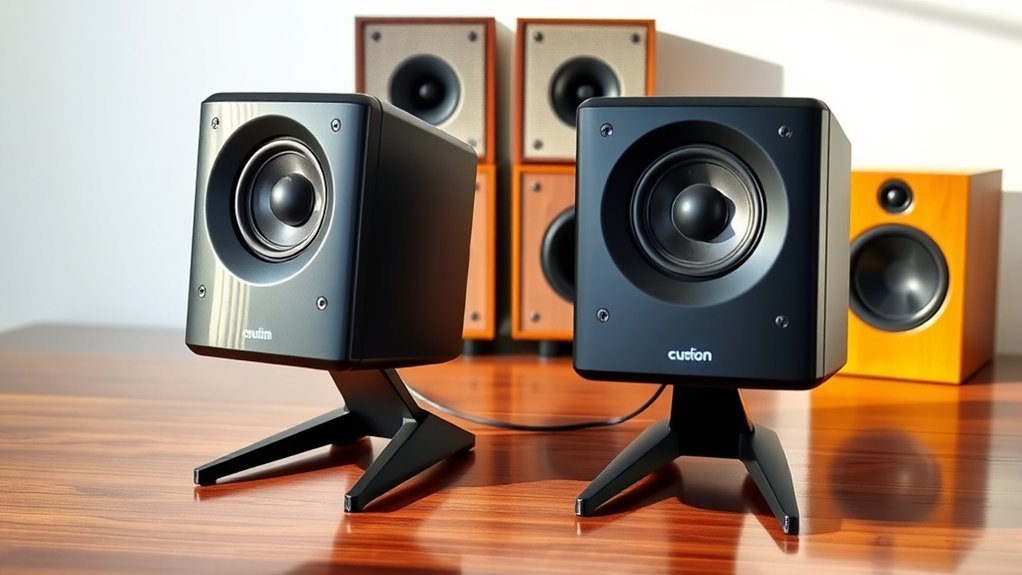
While standard speakers are designed to fill larger spaces with broad, often colored sound, nearfield monitors are specifically engineered for close-up listening, providing a more accurate and detailed audio reproduction. Their design emphasizes precise speaker positioning, typically placed at ear level and close to the listener, minimizing the influence of room acoustics. Nearfield monitors benefit from optimized driver alignment and reduced cabinet coloration, ensuring flat frequency response. Acoustic treatment plays a critical role, as nearfield setups require controlled environments to mitigate reflections and standing waves, enhancing clarity. Unlike standard speakers, which often rely on room size and placement, nearfield monitors prioritize direct sound to deliver accurate mixes and detailed listening, making them ideal for desktop applications and critical audio work.
Best Uses for Nearfield Monitors in Desk Setups
Nearfield monitors excel in providing precise audio reproduction, making them ideal for critical listening and mixing tasks. Their ideal placement on desks minimizes acoustic interference, ensuring consistent sound quality in studio or home environments. Consequently, they are best suited for applications requiring accurate monitoring rather than casual listening.
Precise Audio Monitoring
When aiming for accurate audio reproduction in a desk setup, nearfield monitors excel in providing precise monitoring crucial for mixing and critical listening tasks. Their design minimizes room influence, enabling clearer perception of sound details. Proper speaker calibration guarantees flat frequency response, essential for interpreting mixes accurately. Acoustic treatment of the environment further reduces reflections and resonances, enhancing fidelity. Nearfield monitors’ proximity to the listener allows for consistent sound imaging and stereo separation. They reveal subtle nuances in audio, making them ideal for mastering or detailed editing. The combination of calibrated speakers and well-treated acoustics creates a prime listening environment, delivering reliable, true-to-source audio reproduction necessary for professional-quality work. This setup guarantees every sonic element is heard with precision and clarity.
Optimal Desk Placement
Proper placement of nearfield monitors on a desk considerably influences their ability to deliver accurate sound reproduction. To optimize performance, we must consider room acoustics, as reflective surfaces and room dimensions impact sound clarity and imaging. Positioning monitors at ear level and equidistant from the listener creates a balanced stereo image. Slightly angling the speakers inward, forming an equilateral triangle with the listening position, minimizes phase issues. Additionally, stable placement enhances speaker durability by preventing vibrations and accidental damage. Acoustic treatments, such as bass traps and diffusers, help control reflections, further refining sound quality. Careful placement guarantees that monitors operate efficiently within their frequency response range, providing consistent, reliable performance and protecting their long-term integrity in demanding desktop environments.
Studio or Home Use
Due to their design focus, nearfield monitors excel in both studio and home environments where accurate sound reproduction is paramount. Their precise audio clarity benefits mixing, mastering, and critical listening tasks. In home setups, they integrate aesthetically well when paired with modern furniture, minimizing visual disruption. Unlike traditional speakers, nearfield monitors typically have lower power consumption, making them energy-efficient for extended use. Their compact size enables flexible placement, optimizing acoustic performance without sacrificing space. However, their technical design requires careful consideration of aesthetic integration, ensuring monitors blend seamlessly into various interior styles. Nearfield monitors are ideal for dedicated listening rooms, studios, or home offices where accuracy outweighs the need for high volume or broad sound dispersion. Their focused application enhances sound fidelity in constrained environments.
Advantages and Disadvantages of Bookcase Speakers for Your Desk
Bookcase speakers offer a compact and cost-effective solution for desktop audio, but their suitability depends on various technical factors. Their speaker durability can vary considerably, with some models featuring sturdy cabinets that withstand daily use, while others may be more fragile. Aesthetic appeal is also a key consideration; sleek, minimalist designs can complement modern desk setups, but less refined finishes may detract from your workspace’s visual harmony. Additionally, the materials used in construction influence longevity and visual integration. While they’re generally easier to position within limited space, their performance can be affected by placement constraints and acoustic reflections from nearby surfaces. Overall, selecting a model with durable construction and appealing aesthetics guarantees both functional reliability and visual cohesion in your desk environment.
Comparing Sound Quality: Clarity, Accuracy, and Depth
When comparing sound quality between nearfield monitors and bookshelf speakers, clarity, accuracy, and depth are critical metrics that reveal their performance in a desktop setup. Nearfield monitors typically offer a flatter frequency response, enhancing accuracy and detail. They excel in sound staging, providing precise imaging that helps distinguish individual instruments. Bookshelf speakers, while often warmer, can sometimes lack the neutrality needed for critical listening, affecting clarity. The depth of sound, or three-dimensionality, depends on how well each speaker reproduces spatial cues.
- Nearfield monitors focus on a flat frequency response for true accuracy.
- Sound staging is often more precise with monitors due to tighter imaging.
- Bookshelf speakers may produce a more colored or subjective sound.
- Depth perception hinges on the speaker’s ability to reproduce spatial cues accurately.
Space, Placement, and Aesthetics: Which Fits Your Desk Best?
Selecting the appropriate speakers for a desk setup requires careful consideration of space constraints, placement flexibility, and aesthetic integration. Nearfield monitors often have a compact footprint but may demand specific positioning for superior sound, which can impact desk organization. Bookshelf speakers typically require more space and may influence aesthetic preferences due to their size and design. Both options necessitate effective cable management to prevent clutter, especially in tight setups. Aesthetically, nearfield monitors tend to offer a modern, minimalist look, blending seamlessly with contemporary desks. Conversely, bookshelf speakers can add a decorative element but may require additional stands or supports. Ultimately, the choice hinges on balancing the available space, desired visual appeal, and the practicalities of cable routing.
Budget Considerations: Cost Differences Between the Two Options
Budget considerations considerably influence the choice between nearfield monitors and bookshelf speakers, as their cost structures vary markedly. A detailed price comparison reveals that nearfield monitors often have higher initial costs but may offer better long-term value through durability and precise performance. Conversely, bookshelf speakers tend to be more budget-friendly upfront, making them attractive for casual users or those with tighter budgets.
- Nearfield monitors usually require additional investment in acoustic treatment to optimize performance
- Bookshelf speakers often come as all-in-one units, reducing setup costs
- Cost efficiency depends on intended use; monitors excel in accuracy, justifying higher prices for critical applications
- Budget constraints can steer buyers toward more economical bookshelf options, but at the expense of some fidelity
Which Is Better for Music, Mixing, or Casual Listening?
When evaluating which setup is better for music, mixing, or casual listening, we focus on sound accuracy and clarity, as these directly impact the quality of each experience. Space and placement requirements also influence practical considerations, especially in a desk environment. Additionally, budget and value factors determine whether investing in nearfield monitors or bookshelf speakers aligns with the user’s specific needs and expectations.
Sound Accuracy and Clarity
While both nearfield monitors and bookshelf speakers aim to reproduce sound accurately, nearfield monitors generally deliver superior clarity and detail, making them better suited for critical listening, mixing, and mastering tasks. Their optimized frequency response guarantees a flat, transparent sound profile, revealing subtle nuances often missed by bookshelf speakers. Additionally, nearfield monitors typically feature better speaker durability, maintaining consistent performance over time under rigorous use.
- Precise frequency response helps identify mix issues accurately
- Enhanced clarity ensures detailed sound reproduction for critical tasks
- Better speaker durability supports long-term reliability
- Consistent sound quality improves overall mixing accuracy
Space and Placement Needs
Choosing between nearfield monitors and bookshelf speakers largely depends on the available space and the specific placement requirements of your setup. Nearfield monitors are designed for close positioning, minimizing room reflections, ideal for mixing and critical listening. Bookshelf speakers, however, often require more space for ideal placement, which can limit desk use but provide broader sound dispersion.
| Aspect | Nearfield Monitors | Bookshelf Speakers |
|---|---|---|
| Space Needed | Compact, minimal footprint | Larger, more room for placement |
| Placement Flexibility | Precise, close positioning | More versatile, farther placement |
| Color Options | Limited, focused on sound | Greater variety for aesthetics |
| Power Requirements | Generally higher, active models | Lower, passive options |
| Suitability | Critical listening & mixing | Casual listening & entertainment |
Budget and Value Factors
Budget considerations considerably influence the choice between nearfield monitors and bookshelf speakers, especially when evaluating their value for music production, mixing, or casual listening. Cost factors include initial purchase price, long-term power consumption, and aesthetic appeal. Nearfield monitors tend to have higher upfront costs but often deliver superior audio fidelity, making them ideal for critical listening. Conversely, bookshelf speakers may offer better value for casual use, with lower prices and energy efficiency. When analyzing cost-effectiveness, consider:
- Power consumption differences impacting operational costs
- Aesthetic appeal aligning with workspace design
- Longevity and durability relative to price
- Overall sound quality relative to budget constraints
Ultimately, the choice hinges on balancing immediate affordability with long-term value and application-specific needs.
Final Tips for Choosing the Right Speakers for Your Desk Setup
When selecting the ideal speakers for your desk setup, it’s essential to prioritize factors such as room size, acoustic environment, and your primary usage to guarantee the best sound quality. Consider speaker material, as it influences sound clarity and durability; options like MDF, MDF with damping, or metal enclosures each affect resonance and tonal accuracy. Additionally, assess power requirements to make sure compatibility with your audio source; underpowered speakers may distort at high volumes, while overpowered ones risk damage. Focus on matching the speaker’s power handling with your amplifier or audio interface’s output. Ultimately, a balanced combination of suitable material and appropriate power handling, tailored to your specific environment, will lead to a more precise and reliable listening experience.
Frequently Asked Questions
How Do Room Acoustics Impact Nearfield Monitor and Bookshelf Speaker Performance?
Room reflection and inadequate acoustic treatment can distort sound from nearfield monitors and bookshelf speakers, causing phase issues and muddiness. Proper acoustic treatment minimizes these effects, ensuring accurate sound reproduction and improved clarity in critical listening environments.
What Are the Maintenance Requirements for Nearfield Monitors Versus Bookshelf Speakers?
A stitch in time saves nine; both monitor and bookshelf speakers require regular inspection of speaker placement and cable management, with nearfield monitors often needing more meticulous calibration and dust cleaning to maintain ideal sound quality.
Can Nearfield Monitors or Bookshelf Speakers Be Used for Home Theater Setups?
We believe nearfield monitors excel in home theater setups due to their studio accuracy, providing precise sound, while bookshelf speakers offer aesthetic design appeal. Both can be adapted, but monitors deliver clearer, more detailed audio for immersive experiences.
How Does Power Handling Differ Between Nearfield Monitors and Bookshelf Speakers?
Power handling is like a fortress—nearfield monitors often boast higher power capacity, enhancing volume tolerance without distortion, while bookshelf speakers typically have lower limits, demanding careful matching to avoid damage during high-volume playback.
Are There Specific Brands or Models Recommended for Desk-Based Audio Setups?
We recommend brands like KRK and Yamaha, comparing models such as the Rokit 5 and HS5 for technical accuracy. These offer reliable performance, precise frequency response, and are ideal for detailed desk-based audio, fitting various budget and space constraints.
Conclusion
Ultimately, choosing between nearfield monitors and bookshelf speakers is like selecting the right lens for your camera—precision or warmth. Nearfield monitors sharpen your audio landscape with crystal clarity, ideal for critical work, while bookshelf speakers paint a broader, more inviting sonic picture for casual enjoyment. By aligning your space, budget, and listening needs, you’ll craft a sound environment that’s both technically sound and personally satisfying, turning your desk into a command center for sonic excellence.