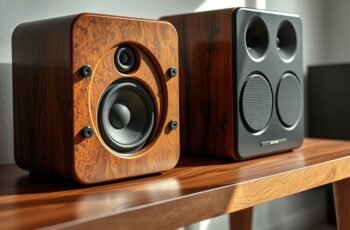
When selecting between passive and active speakers, we recognize that each offers distinct technical advantages and limitations, impacting your system’s performance and flexibility. Understanding these differences is essential for making an informed choice aligned with your space, technical expertise, and sound quality expectations. As we analyze their design, setup, and application, we’ll uncover which type best suits your specific needs—yet, the nuances of each option warrant a closer look before deciding.
Key Takeaways
- Active speakers have built-in amplification, offering easier setup and consistent sound, while passive speakers require external amps and more complex configuration.
- Passive speakers are more customizable and upgradeable, suitable for fixed, high-fidelity installations.
- Active speakers are ideal for portable, quick setups, and environments prioritizing convenience and mobility.
- Upfront costs for active speakers are higher, but they often reduce long-term maintenance and setup time.
- Choose passive for system flexibility and upgrades; opt for active if ease of use and portability are your priorities.
What Are Passive and Active Speakers? A Quick Overview
Have you ever wondered what distinguishes passive from active speakers in audio systems? The key difference lies in their internal design and how they interact with external components. Passive speakers require an external amplifier, making speaker placement essential to maximize sound dispersion and minimize acoustic treatment needs. Proper placement ensures balanced soundstage and reduces reflections that can muddy clarity. In contrast, active speakers contain built-in amplifiers, simplifying setup but still demanding precise positioning to achieve ideal acoustic performance. Both types benefit from targeted acoustic treatment to control room reflections and standing waves. Understanding these nuances helps us evaluate how speaker placement and acoustic treatment impact sound quality, guiding us toward the best choice for our listening environment.
How Do Passive and Active Speakers Differ in Design and Functionality?
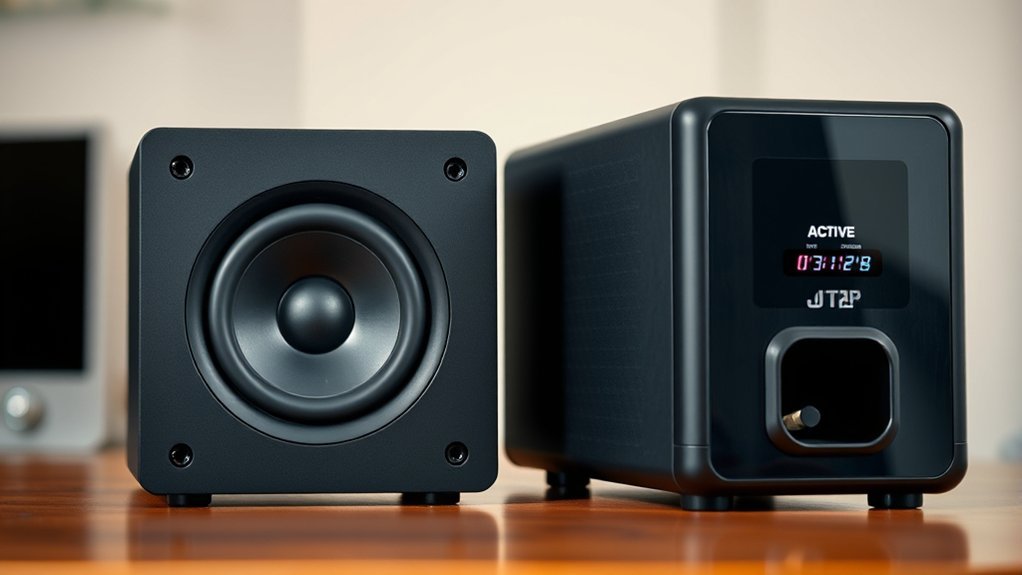
The fundamental difference between passive and active speakers lies in their internal circuitry and how they interface with audio sources. Passive speakers lack built-in amplification, relying on external amplifiers, which influences their design aesthetics, often favoring simplicity and versatility. In contrast, active speakers integrate amplifiers and signal processing components, resulting in a more compact, self-contained design. Functionally, this integration streamlines power management, allowing active models to optimize power distribution internally, reducing signal loss and distortion. The design aesthetics of active speakers tend to emphasize modern, minimalistic enclosures with sleek electronic interfaces, while passive models may prioritize traditional wooden cabinets and external controls. This distinction impacts not only visual appeal but also system flexibility, with active speakers offering streamlined setup and more precise power handling.
Pros and Cons of Passive Speakers for Your Audio Setup
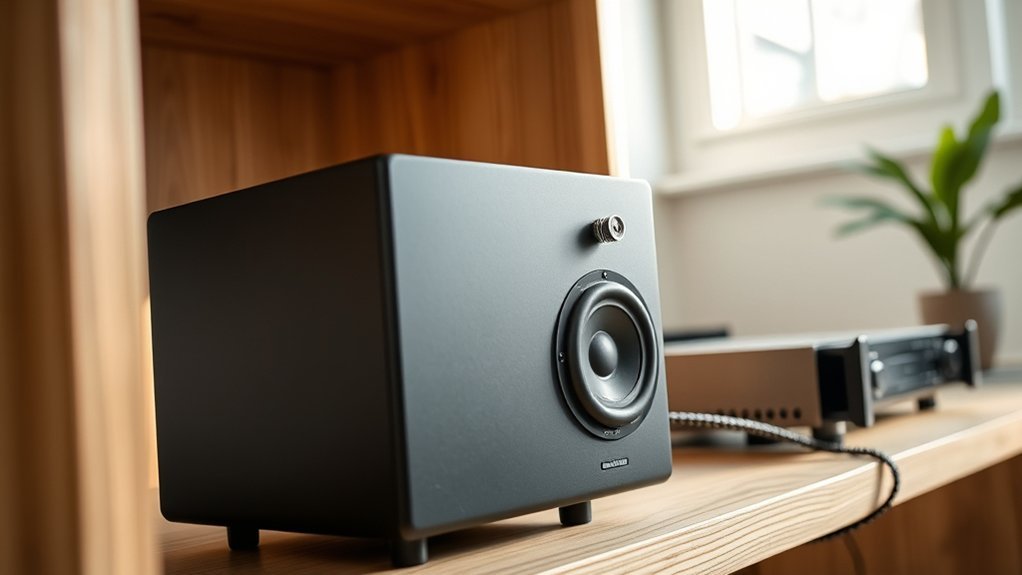
Passive speakers offer notable flexibility in configuration, allowing us to tailor our setups by choosing specific amplifiers to match our audio preferences. However, they require an external amplifier, which adds complexity and potential points of failure to the system. This trade-off between customization and increased component dependency is a key factor when evaluating their suitability for your setup.
Flexibility in Configuration
While passive speakers offer notable flexibility in configuration, their adaptability depends heavily on the selection of compatible components and overall system design. This flexibility impacts critical factors like speaker placement and acoustic treatment, requiring careful planning.
- Precise speaker placement allows fine-tuning for idealsound dispersion and stereo imaging.
- System components must match impedance and power handling specifications to prevent damage.
- Custom cabling and wiring configurations enable tailored signal routing.
- Adjustments in acoustic treatment can compensate for room acoustics, but require system compatibility.
- Integration with various amplifiers offers scalable power management, but complicates setup.
Requires External Amplifier
Since passive speakers rely on external amplification to produce sound, their requirement for an external amplifier considerably impacts system design. This setup allows for tailored power matching, but it also demands precise speaker placement to enhance sound quality, as improper positioning can lead to phase issues or uneven coverage. Additionally, acoustic treatment becomes vital to control reflections and reverberations, ensuring the passive system performs at its best. The need for external amplification offers flexibility in choosing high-quality amplifiers, but it introduces complexity, requiring careful integration and calibration. This setup can be advantageous in larger spaces where power and control are essential, yet it demands more technical knowledge for proper setup and maintenance, emphasizing the importance of detailed planning for speaker placement and acoustic environment.
Advantages and Disadvantages of Active Speakers
Active speakers integrate built-in amplification, simplifying signal flow and reducing external component requirements, which can enhance sound clarity and reduce setup complexity. However, their portability can be limited by size and weight, complicating deployment in dynamic environments. Analyzing these trade-offs helps determine whether their integrated power and potential for simplified configuration outweigh the logistical challenges they present.
Built-In Amplification Benefits
Built-in amplification in active speakers offers distinct advantages by integrating the power source directly into the speaker unit, which simplifies setup and reduces the need for external components. This design enhances power integration, allowing for precise control over amplification tailored to the speaker’s drivers. It minimizes cable clutter and potential connection issues, streamlining installation. Additionally, built-in amplification guarantees consistent power delivery, improving sound fidelity and dynamic range. It also facilitates easier troubleshooting, as internal components are more accessible for diagnostics. However, this integration can limit upgrade options and make repairs more complex if an internal amplifier fails. Overall, the benefits of built-in amplification—such as streamlined power management and optimized sound performance—are significant, especially for professional or high-fidelity applications.
Setup and Portability Challenges
While the integrated design of active speakers simplifies overall setup, it introduces specific challenges related to their portability and deployment. Their built-in amplification and wireless connectivity often increase size and weight, limiting ease of transport for mobile applications. The aesthetic design, while sleek, can become a disadvantage if speakers are bulky or fragile, complicating quick setups or outdoor use. Wireless connectivity, although convenient, may suffer from interference or signal loss in complex environments, impacting reliability. Additionally, integrated components reduce flexibility; upgrading or repairing parts requires more effort and can compromise portability. Overall, while active speakers offer streamlined setup, their size, weight, and dependence on wireless signals present notable barriers for users needing highly portable, versatile audio solutions.
Which Type Suits Different Listening Environments and Use Cases?
Choosing between passive and active speakers hinges largely on the specific listening environment and intended use case, as each offers unique advantages for different acoustic needs. Active speakers excel in versatile settings due to built-in amplification, remote control, and Bluetooth connectivity, simplifying setup and operation. Passive speakers, on the other hand, are better suited for fixed installations, requiring external amplifiers for precise power management.
Active speakers are ideal for versatile, portable setups with integrated controls; passive speakers suit fixed, high-fidelity installations.
Consider these factors:
- Portability needs for outdoor or mobile use
- Space constraints in small rooms or studios
- Sound fidelity demands in professional environments
- Ease of control via remote or app integration
- Compatibility with existing audio systems or wireless streaming
Each environment demands tailored solutions, balancing convenience, power, and sound quality to match specific use cases.
How to Choose Between Passive and Active Speakers Based on Your Budget?
When choosing between passive and active speakers within your budget, we need to weigh initial costs against amplification requirements, as active models often include built-in amplifiers, reducing the need for additional equipment. It’s also essential to analyze long-term investment benefits, considering factors like maintenance, upgrade potential, and overall system integration. By systematically evaluating these technical and financial considerations, you can identify the option that delivers the most effective performance aligned with your financial constraints.
Budget Compatibility Considerations
How does your budget influence the decision between passive and active speakers? Lower budgets often restrict options, making brand reputation and warranty coverage essential factors. Active speakers generally involve a higher upfront cost, but include built-in amplification, reducing additional equipment expenses. Passive speakers may seem more affordable initially but can incur costs for external amplifiers and installation. Consider brands with proven reputation for durability and sound quality, as this impacts long-term value. Warranty coverage is critical; comprehensive warranties protect against costly repairs, especially for active units with integrated electronics.
- Initial purchase price: Active speakers tend to be more expensive upfront.
- Long-term maintenance costs: Passive speakers might need external amplification and servicing.
- Brand reputation: Ensures reliability and sound quality.
- Warranty coverage: Reduces risk of unexpected expenses.
- Compatibility with existing equipment: Budget constraints influence integration options.
Amplification Requirements Overview
Since amplification is a core factor distinguishing passive from active speakers, understanding your budget constraints is essential in determining which type best suits your needs. Passive speakers require external amplification, adding initial costs for quality amplifiers, cabling, and power management. Conversely, active speakers integrate amplification, reducing setup complexity but often at a higher upfront purchase price. When considering speaker placement and acoustic treatment, passive systems demand more precise matching of power output and speaker impedance. Active speakers streamline this process, offering built-in amplification optimized for specific speaker configurations. Here’s a quick comparison:
| Aspect | Passive Speakers | Active Speakers |
|---|---|---|
| Amplification | External, separate component needed | Built-in, factory calibrated |
| Cost | Lower initial equipment investment | Higher initial purchase price |
| Setup complexity | More involved, careful matching required | Simplified, fewer components |
| Flexibility | Greater customization options | Less adaptable, integrated design |
| Acoustic Treatment | Critical for speaker placement | Less dependent on placement, integrated amp |
Long-Term Investment Benefits
Choosing between passive and active speakers hinges on evaluating their long-term investment benefits relative to your budget constraints. Active speakers often provide better long-term savings due to integrated amplification, reducing additional equipment costs and maintenance. Their plug-and-play design minimizes setup complexity, which can lower durability concerns linked to external components. Passive speakers, however, may require ongoing upgrades to amplifiers and crossover components, impacting overall durability considerations.
Consider these factors:
- Initial purchase cost versus cumulative expenses over time
- Built-in amplification reliability in active models
- Upgrade flexibility for passive systems
- Component compatibility affecting long-term durability
- Maintenance needs influencing long-term savings
Ultimately, active speakers tend to offer more predictable long-term value, especially when durability and ongoing costs are prioritized.
Compatibility and Setup Considerations for Passive vs Active Speakers
When evaluating compatibility and setup for passive versus active speakers, it’s essential to understand the specific requirements and limitations inherent to each type. Passive speakers rely entirely on external amplification, so evaluating their power handling capacity is critical to prevent damage and guarantee proper performance. Compatibility with amplifiers depends on matching impedance and wattage ratings precisely. In contrast, active speakers incorporate built-in amplifiers, simplifying setup but requiring compatible power sources and specific electrical outlets. Connectivity options also differ: passive speakers typically connect via speaker cables to external amps, while active models often feature integrated inputs like XLR, TRS, or RCA, offering more flexible connection choices. Recognizing these distinctions helps ensure proper system integration and reliable operation.
Sound Quality and Performance: What to Expect From Each Type
Passive and active speakers deliver different sound quality profiles due to their inherent design differences. Passive speakers rely on external amplification, affecting their overall sound clarity and bass response. They often produce a more natural, balanced sound, but require careful matching of components. Active speakers, with built-in amplification, typically offer superior control over sound performance, ensuring consistent sound clarity across frequencies. They excel in delivering tight bass response and precise imaging because the internal electronics are optimized for the driver setup.
- Passive speakers depend heavily on external amps for sound quality
- Active speakers have integrated amplification tailored to their drivers
- Passive models may suffer from less consistent sound clarity
- Active models generally provide superior bass response
- Both types can deliver high-quality sound with proper setup and components
Common Mistakes to Avoid When Selecting Your Speakers
Selecting the wrong speakers can considerably undermine your audio setup’s performance, often due to overlooked technical specifications or misaligned compatibility. A common mistake is neglecting proper speaker placement, which impacts sound staging and clarity. Incorrect placement can cause bass muddiness or treble harshness, especially if acoustic treatment isn’t considered. Acoustic treatment helps control reflections and resonances, but only if the speakers are positioned correctly. Failing to evaluate these factors leads to diminished audio fidelity and an unbalanced sound profile. Additionally, ignoring room acoustics or assuming all speakers fit the space can result in poor integration. To avoid these mistakes, analyze your room’s unique acoustic properties and plan speaker placement accordingly, ensuring compatibility with your environment and sound goals.
Which Speakers Are Better for Your Needs: Passive or Active?
Choosing between passive and active speakers depends heavily on your specific audio needs, room environment, and technical expertise. Passive speakers require external amplification, making speaker placement and acoustic treatment critical for superior sound. Active speakers, with built-in amplification, simplify setup but limit flexibility in component selection. Consider these factors:
- Precise speaker placement for balanced sound
- Acoustic treatment to minimize reflections and resonances
- Compatibility with existing audio equipment
- Ease of integration in complex setups
- Ability to fine-tune frequency response and power handling
Passive systems demand more technical knowledge, especially regarding impedance matching and crossover design. Active speakers offer streamlined operation but may restrict customization. Ultimately, your choice hinges on whether you prioritize flexibility (passive) or convenience (active) within your room’s acoustic environment.
Frequently Asked Questions
Can Passive or Active Speakers Be Upgraded More Easily?
Passive speakers are easier to upgrade due to cable compatibility and design flexibility, allowing us to swap out drivers or crossovers. Active speakers limit upgrades mainly to internal components, making passive models more adaptable for technical, detailed enhancements.
Do Active Speakers Require More Maintenance Than Passive Ones?
Active speakers generally require more maintenance due to their built-in amplifiers and complex electronics, making proper speaker placement and acoustic treatment essential to prevent overheating or damage, which increases their upkeep compared to passive models.
How Does Power Handling Differ Between Passive and Active Speakers?
We find that power handling in passive speakers depends on impedance matching and amplifier compatibility, requiring careful matching to prevent damage, while active speakers have built-in amplification, making power handling more straightforward and internally managed for ideal performance.
Are There Specific Brands Known for High-Quality Active or Passive Speakers?
We find brands like KEF and Adam Audio excel in high-quality active speakers, renowned for their precision, while brands like JBL and Yamaha offer reliable passive options. Comparing prices reveals premium quality often commands a higher investment.
Which Speaker Type Is More Suitable for Outdoor Use?
We find active speakers more suitable for outdoor use due to their wireless connectivity options and built-in amplification, which enhance portability and ease of setup, ensuring consistent sound quality in various environments without relying on external power sources or additional equipment.
Conclusion
Ultimately, choosing between passive and active speakers resembles selecting the right tool for a precise job. Passive speakers, like customizable chassis, demand careful matching but reward with flexibility and upgrade potential. Active speakers, akin to all-in-one instruments, deliver straightforward setup and consistent sound. By analyzing your space, technical skills, and sound goals, you can navigate this technical landscape confidently, ensuring your audio system becomes a finely tuned instrument that resonates perfectly with your environment and listening demands.