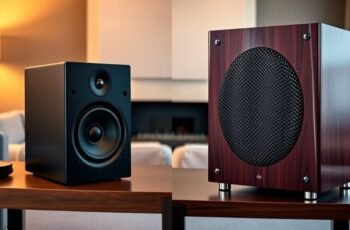
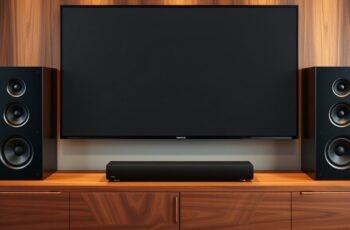
It might seem impossible, but the difference in sound quality between speakers with a narrow versus wide frequency range can be staggering. Understanding what constitutes a good frequency range for bookshelf speakers isn’t just about specifications; it’s about how those ranges influence clarity, balance, and overall listening experience. As we explore the technicalities, you’ll see why choosing the right range is critical for optimizing your setup—something that could dramatically change how you perceive your favorite music or movies.
Key Takeaways
- A typical good range for bookshelf speakers is approximately 60 Hz to 20 kHz, covering bass, midrange, and treble frequencies.
- Extended frequency response ensures more detail and nuance for a richer, more immersive listening experience.
- Proper placement and room acoustic treatment are essential to preserve the full spectrum and avoid sound distortion.
- Balance among bass, midrange, and treble frequencies creates a natural and cohesive sound.
- Matching speaker response to room acoustics and listening preferences enhances overall sound accuracy and enjoyment.
What Is the Typical Frequency Range of Bookshelf Speakers?
While the typical frequency range of bookshelf speakers varies depending on design and manufacturer, they generally cover from around 60 Hz to 20 kHz. Achieving ideal sound reproduction involves careful speaker placement to minimize reflections and boundary effects that can distort the frequency response. Proper acoustic treatment of the listening environment further enhances clarity, especially in the bass and high-frequency regions. These treatments reduce unwanted resonances and standing waves that may interfere with the speaker’s natural output. Understanding the typical frequency range helps in positioning the speakers effectively, ensuring that both low-end extension and high-frequency detail are preserved. Proper setup and acoustic considerations are essential to maximize the speakers’ capabilities within their specified range.
Why Does Frequency Range Matter for Sound Quality?
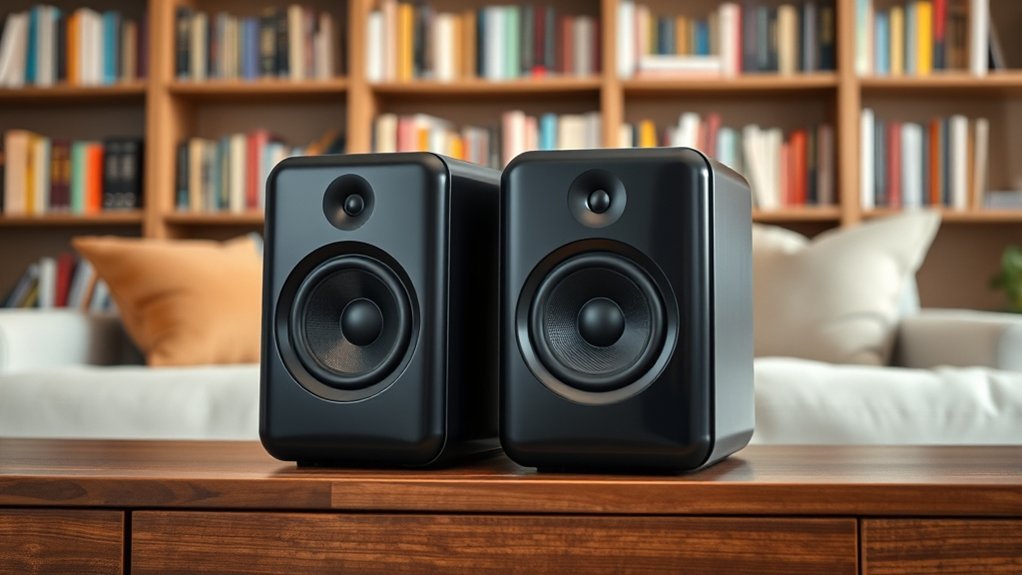
Understanding the audio frequency range allows us to evaluate how accurately speakers reproduce sound across different pitches. A broader range enhances the listening experience by capturing more detail and nuance, making music and dialogue more immersive. Additionally, an appropriate frequency range minimizes sound distortion, ensuring clearer, more precise audio reproduction.
Clarifies Audio Range
Have you ever wondered why some audio sounds richer and more immersive than others? The key lies in the speaker’s frequency range and how well it reproduces sound across different pitches. A wider range allows for more accurate audio reproduction, reducing gaps that can distort or dull sound quality. Proper speaker placement and meticulous audio calibration ensure that the frequency response is optimized, enhancing clarity and detail.
- Precise frequency response reduces audio distortion
- Consistent sound across the entire range
- Proper placement minimizes phase issues
- Calibration aligns speaker output with room acoustics
Enhances Listening Experience
A speaker’s frequency range directly influences the richness and clarity of the listening experience, as it determines the variety of sounds that can be accurately reproduced. When speakers cover a broader frequency spectrum, they deliver more detailed audio, enhancing overall sound quality. Proper speaker placement optimizes this effect, ensuring sound waves reach the listener without interference or phase issues. Additionally, acoustic treatment in the listening environment minimizes reflections and resonances that can distort sound, allowing the full frequency range to be appreciated. Together, strategic placement and acoustic adjustments help maximize the benefits of a speaker’s frequency capabilities. This synergy results in a more immersive, balanced sound that captures subtle nuances, thereby considerably elevating the listening experience.
Reduces Sound Distortion
A broader frequency range allows bookshelf speakers to reproduce sounds across multiple tonal layers more accurately, which directly reduces sound distortion. When speakers cover a wider spectrum, they minimize the need for excessive equalization, preserving audio fidelity. Proper speaker placement enhances this effect by reducing reflections and standing waves, while effective sound insulation prevents external noise from interfering with the audio signal. Without sufficient frequency coverage, lower or higher frequencies may distort, creating a muddled sound. Key considerations include:
- Ensuring adequate sound insulation in the listening environment
- Ideal speaker placement to avoid resonance and phase issues
- Using speakers with overlapping frequency responses for smooth sound passage
- Minimizing distortion caused by limited frequency range and external interference
Together, these factors help maintain sound clarity and reduce distortion, ensuring a high-quality listening experience.
The Full Spectrum: Understanding Bass, Midrange, and Treble
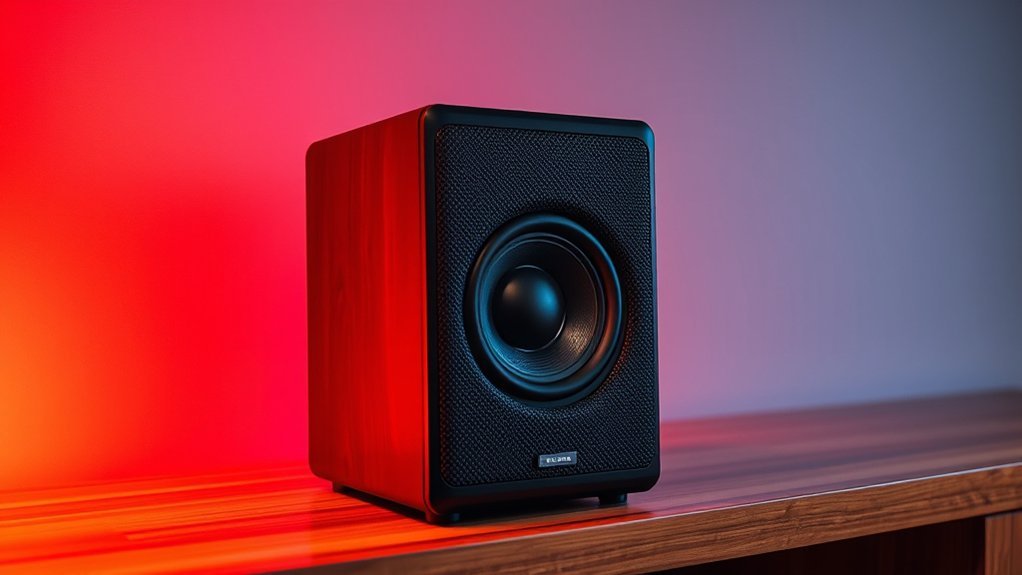
Understanding the full audio spectrum requires precise analysis of bass, midrange, and treble frequencies and how they interact. We examine how bass frequencies provide depth, midrange contributes clarity, and treble adds detail, emphasizing their balance for ideal sound reproduction. This foundation allows us to evaluate how bookshelf speakers deliver a cohesive and accurate listening experience.
Bass Frequencies Explained
Bass frequencies form the foundation of any full-range audio experience, providing depth and power that can markedly influence how music and sound are perceived. These low-end sounds, typically from 20Hz to 250Hz, are critical for realism, but they also require precise subwoofer integration and careful audio calibration. Without proper calibration, bass can become muddy or overpowering, disrupting the overall sound balance. Effective strategies include optimizing placement, ensuring phase alignment, and adjusting crossover points. When done correctly, these measures enhance clarity and punch, making the listening experience more immersive. Key considerations involve understanding room acoustics and speaker response, as well as ensuring your bookshelf speakers can accurately reproduce lower frequencies without distortion. Properly managed, bass frequencies provide impactful depth without compromising overall sound fidelity.
Treble and Midrange Balance
While bass frequencies establish the foundation of sound, the balance between treble and midrange critically shapes the overall clarity and tonal accuracy of a system. Proper speaker placement is crucial to optimize this balance, guaranteeing high frequencies are neither overly harsh nor dull. Acoustic treatment also plays an essential role; absorbing or diffusing reflections can reduce treble glare and midrange muddiness, creating a more accurate soundstage. Achieving ideal treble and midrange response involves fine-tuning speaker position relative to walls and listening height, minimizing diffraction and early reflections. This precise calibration ensures that high and mid frequencies blend seamlessly, allowing vocals and instruments to sound natural and well-defined. A balanced treble-midrange spectrum ultimately enhances listening clarity and detail across the full spectrum.
What Is Considered a Good Frequency Range for Most Listening Needs?
A good frequency range for most listening needs typically spans from around 20 Hz to 20 kHz, which covers the full spectrum of human hearing. This range guarantees that both bass fundamentals and high treble details are adequately reproduced. To enhance performance, consider speaker placement and acoustic treatment, which influence how these frequencies are perceived. Proper positioning minimizes phase issues and enhances clarity across the spectrum. Acoustic treatment reduces reflections and standing waves that can muddy high and mid frequencies.
A broad frequency range from 20 Hz to 20 kHz ensures clear, balanced sound across all listening environments.
Key considerations include:
- Precise speaker placement relative to listening position
- Room acoustic treatment to control reflections
- Balanced speaker positioning for even frequency response
- Ensuring the range covers your listening preferences and environment
A well-rounded frequency range combined with these factors results in ideal sound accuracy.
How Do Different Frequencies Impact Clarity and Balance?
Different frequencies contribute uniquely to the overall clarity and balance of sound, shaping how we perceive audio quality. High frequencies, such as treble, add detail and brightness, enhancing clarity, while midrange frequencies provide vocal and instrumental definition. Low frequencies underpin bass and warmth, influencing the fullness of sound. Effective audio calibration guarantees these frequency ranges are balanced, preventing muddiness or harshness. Proper speaker placement is vital; positioning influences how frequencies interact with the environment, affecting clarity and stereo imaging. Misaligned placement can cause uneven frequency response, diminishing overall sound quality. Understanding how different frequencies impact sound helps us optimize speaker setup and calibration, guaranteeing a balanced and precise listening experience that accurately reflects the audio’s intended clarity and tonal richness.
Are Wider Frequency Ranges Better for Small Spaces?
Wider frequency ranges in bookshelf speakers can offer significant advantages in small spaces by enhancing overall sound accuracy and tonal balance. In compact rooms, the interplay of room acoustics and speaker placement becomes critical; a broader frequency response can compensate for acoustic limitations, providing richer sound across the spectrum. However, the benefits depend on proper speaker positioning to minimize reflections and standing waves that distort sound.
- Broader ranges improve tonal detail, even with limited space
- Accurate reproduction reduces the need for extensive room treatments
- Proper speaker placement maximizes the benefits of wider frequency response
- Room acoustics influence how effectively these ranges translate to clarity
Ultimately, wider frequency ranges can be advantageous, but only when paired with ideal placement and acoustic considerations.
How to Evaluate Frequency Response When Choosing Bookshelf Speakers
Evaluating the frequency response of bookshelf speakers involves examining detailed specifications and conducting objective assessments to guarantee accurate sound reproduction. We focus on analyzing frequency response graphs, which reveal how well a speaker reproduces different frequencies across the spectrum. Proper speaker placement is critical; placing speakers too close to walls or sound insulation surfaces can cause bass booms or muddy sound, skewing perceived response. Additionally, examining how sound insulation affects the environment helps determine the ideal positioning for clear audio. A flat, extended frequency response indicates a speaker’s ability to deliver balanced sound without exaggerated bass or treble, essential in small or acoustically challenging spaces. Combining these technical evaluations ensures you select bookshelf speakers that provide precise, high-fidelity audio.
Common Frequency Ranges in Popular Bookshelf Models
Many popular bookshelf speakers deliver a frequency range that balances clarity and bass response, typically covering from around 60 Hz to 20 kHz. These ranges are influenced by design choices, including driver size and crossover points, which impact how well the speakers reproduce sound across different frequencies. Effective speaker placement and acoustic treatment are essential in optimizing these ranges, as they mitigate room effects and improve the perceived frequency response.
- Larger drivers often extend bass coverage lower, around 50-60 Hz
- Tweeter design influences high-frequency extension toward 20 kHz
- Room acoustics can accentuate or diminish certain frequencies
- Proper placement enhances the speaker’s natural frequency balance and clarity
Tips for Matching Your Speakers’ Frequency Range to Your Room and Preferences
To effectively match your bookshelf speakers’ frequency range to your room and personal preferences, it’s essential to take into account both acoustic environment and listening goals. Proper speaker placement optimizes frequency response and minimizes reflections, ensuring accurate sound reproduction. Position speakers slightly away from walls and at ear level to reduce boundary effects that can muddy clarity. Acoustic treatment, such as bass traps and diffusers, helps control resonances and enhances the speaker’s effective frequency range, especially in challenging room acoustics. Tailoring the setup to your listening preferences—whether emphasizing bass or clarity—may involve adjusting placement and treatment. By systematically analyzing these factors, you can create an environment that complements your speakers’ frequency range, resulting in a more balanced and satisfying listening experience.
Frequently Asked Questions
How Do Room Acoustics Affect Perceived Frequency Response?
Room acoustics considerably influence perceived frequency response through room resonance and reflections. Acoustic treatment mitigates these effects, reducing coloration and ensuring accurate sound reproduction, enabling listeners to perceive clearer, more balanced audio from bookshelf speakers.
Can a Narrower Frequency Range Still Provide High Sound Quality?
A narrower frequency range can still offer high sound quality if speaker materials optimize sound clarity; selecting high-quality components guarantees precise reproduction, emphasizing critical midrange and high frequencies, which compensates for limited bass response and maintains overall audio fidelity.
What Is the Typical Lifespan of Bookshelf Speakers’ Frequency Components?
We find that bookshelf speakers’ frequency components typically last 5 to 10 years, depending on usage and speaker durability. Proper maintenance and quality components can considerably extend component longevity, ensuring consistent sound performance over time.
How Does Speaker Placement Influence Effective Frequency Response?
Speaker positioning directly impacts effective frequency response by optimizing sound dispersion; proper placement minimizes reflections and dead spots, ensuring clearer, more accurate audio delivery that leverages the full frequency range of your bookshelf speakers.
Are There Specific Genres That Benefit From Wider Frequency Ranges?
Certain genres, like classical and jazz, benefit from wider frequency ranges, enhancing genre-specific audio and vocal clarity. This allows for more accurate instrument separation and detailed vocal reproduction, essential for an immersive, high-fidelity listening experience.
Conclusion
Ultimately, the ideal frequency range for bookshelf speakers aligns with our listening environment—much like tuning a finely crafted instrument. By matching speaker response to room acoustics and personal preferences, we guarantee clarity, balance, and immersion. When these elements converge—just as a well-calibrated dial or a perfectly tuned string—the result is a seamless auditory experience that captures the full spectrum of sound, creating an environment where music and dialogue resonate naturally and precisely.