When it comes to selecting speakers for music production, understanding the fundamental differences between bookshelf speakers and studio monitors can considerably influence your sound quality and workflow. While both types serve as audio output devices, their design priorities and performance characteristics diverge sharply. This distinction becomes especially critical as it impacts mixing accuracy and overall project fidelity. Exploring these differences can help you determine which option aligns best with your studio setup and production goals.
Key Takeaways
- Studio monitors are designed for accurate, flat sound reproduction ideal for mixing, while bookshelf speakers focus more on aesthetic appeal and general listening.
- Proper placement and acoustic treatment are crucial for both, but studio monitors typically require more precise room setup.
- Studio monitors offer higher fidelity and durability, making them suitable for professional music production; bookshelf speakers are more affordable and consumer-oriented.
- Compatibility with studio equipment and input options (XLR, TRS, RCA) is essential for studio monitors, while bookshelf speakers may have more limited connectivity.
- Long-term investment in studio monitors generally provides better accuracy and reliability for critical listening and mixing tasks.
Understanding the Key Differences Between Bookshelf Speakers and Studio Monitors
While bookshelf speakers and studio monitors may appear similar at a glance, they serve distinct purposes rooted in their design and acoustic characteristics. Material differences markedly influence performance; studio monitors often utilize high-quality, rigid materials to guarantee minimal resonance and accurate sound reproduction. In contrast, bookshelf speakers may prioritize aesthetic appeal and cost efficiency, which can lead to variations in cabinet construction and driver materials. Brand reputation also plays a critical role: established brands in the studio monitor market tend to guarantee consistent accuracy and durability, essential for critical listening. Conversely, bookshelf speaker brands may focus more on consumer preferences and sound signatures. Understanding these differences helps us select equipment aligned with our production goals and ensures precise, reliable sound monitoring.
How Sound Quality and Accuracy Impact Your Music Production
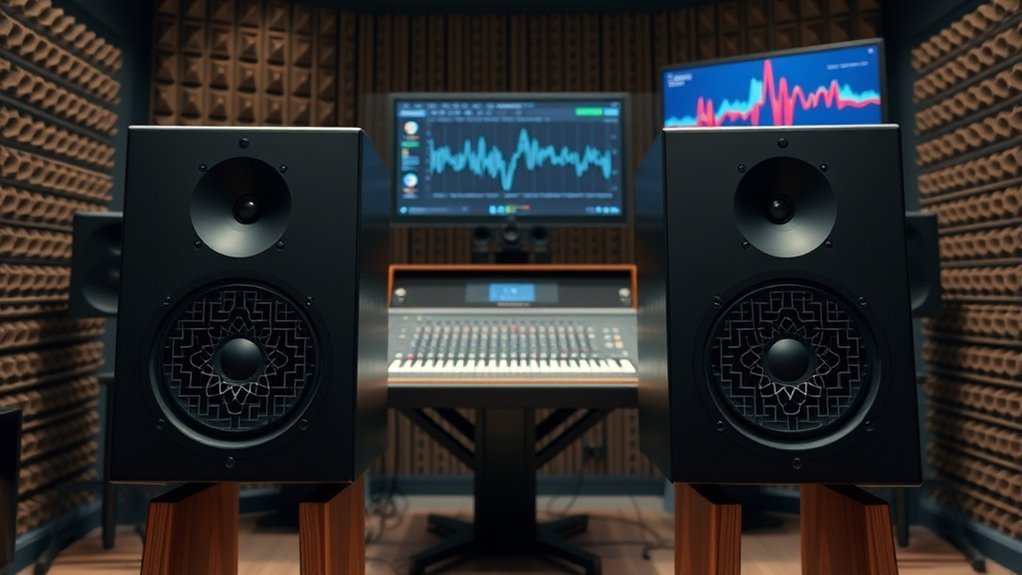
Sound quality and accuracy are fundamental to effective music production because they directly influence our ability to make informed mixing and mastering decisions. High sound clarity ensures that every detail, from subtle harmonics to transient attacks, is perceptible, allowing precise adjustments. Accurate frequency response is critical; it guarantees the monitor reproduces low, mid, and high frequencies faithfully without coloration or distortion. When sound is clear and responses are flat, we can identify problematic areas in the mix—such as muddiness or imbalance—more reliably. Conversely, poor sound quality introduces bias, leading to inaccurate EQ or level decisions. Ultimately, precise sound reproduction forms the foundation for a balanced, professional-sounding track, emphasizing the importance of choosing monitors that prioritize clarity and flat frequency response.
Design Features and Placement Tips for Optimal Performance
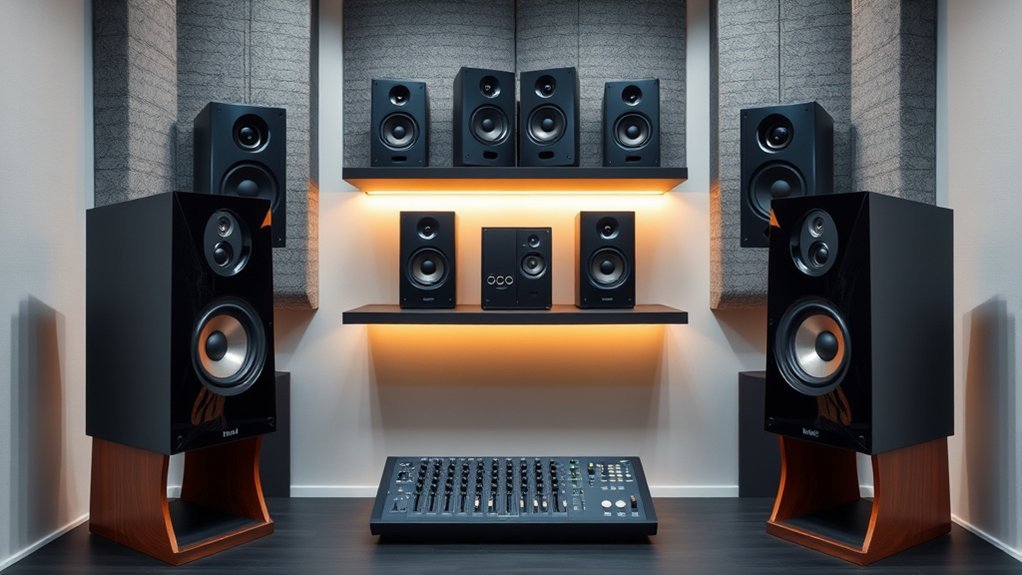
Effective speaker positioning and acoustic treatments are critical to achieving accurate sound reproduction. We recommend aligning speakers at ear level and maintaining symmetrical placement to minimize phase issues, while applying targeted acoustic absorption or diffusion to control reflections. Implementing these design and placement strategies guarantees consistent and precise monitoring across diverse listening environments.
Speaker Positioning Strategies
Achieving accurate audio reproduction hinges on precise speaker positioning, as even minor adjustments can considerably impact sound clarity and stereo imaging. To optimize performance, we focus on speaker isolation, which minimizes unwanted vibrations and external interference. Proper placement involves positioning speakers at ear level and establishing an equilateral triangle with the listening position, guaranteeing direct sound exposure. Additionally, understanding the acoustic reflex is vital; placing speakers away from walls reduces boundary reinforcement that can color the sound. Using isolation pads or stands helps decouple speakers from surfaces, preventing resonance and improving transient response. Fine-tuning the distance from walls and reflective surfaces ensures a balanced stereo image. These strategic positioning techniques are essential to maximize clarity, accuracy, and the overall listening environment for music production.
Acoustic Treatment Techniques
Optimizing the acoustic environment requires careful implementation of treatment features and strategic placement to control reflections and resonances. Effective room acoustics hinge on reflection control, which minimizes sound distortions caused by boundary interactions. We recommend installing broadband absorbers at primary reflection points—such as the side walls, ceiling, and rear wall—to reduce early reflections. Bass traps should be placed in room corners to manage low-frequency resonances. Diffusers can be added to diffuse sound energy uniformly, preventing flutter echoes and standing waves. Precise placement ensures that sound waves are absorbed or diffused appropriately, resulting in a more accurate listening environment. Proper acoustic treatment enhances clarity, tightens bass response, and provides a neutral soundscape essential for critical music production.
Which Is Better for Home Studios Versus Professional Environments?
Home studios typically require less extensive acoustic treatment and operate within tighter budget constraints, impacting equipment choices. Professional environments demand rigorous acoustic management and higher-cost monitors for precise accuracy, often justifying increased investment. Variability in listening environments also influences the selection, with professional setups prioritizing consistency and calibration.
Acoustic Treatment Requirements
Since acoustic treatment directly influences the accuracy of sound reproduction, the requirements differ considerably between home studios and professional environments. Professional spaces demand thorough room acoustics management, including bass trapping, diffusers, and enhanced speaker placement for precise speaker calibration. These measures minimize reflections, standing waves, and modal issues, ensuring linear frequency response. Conversely, home studios typically require simplified treatments focusing on reducing flutter echoes and early reflections with basic panels and strategic furniture placement.
- Dense bass traps in corners to control low-end resonances
- Absorptive panels at primary reflection points
- Diffusers on rear walls to scatter sound
- Precise speaker placement for ideal room response
Budget and Cost Efficiency
Budget considerations substantially influence the choice between bookshelf speakers and studio monitors, with cost efficiency playing a crucial role in determining suitability for different environments. A detailed cost analysis reveals that bookshelf speakers generally offer a lower initial investment, aligning with home studio budgets. Conversely, professional studio monitors often entail higher costs due to superior components and construction, reflecting market trends toward precision and durability. While studio monitors typically justify their expense through enhanced accuracy, bookshelf speakers may be more economical when absolute fidelity is less critical. For home studios, affordability and scalability drive selection, whereas professional setups prioritize long-term performance and reliability, despite higher upfront costs. Ultimately, understanding these financial distinctions helps inform ideal equipment choices aligned with specific production needs.
Listening Environment Variability
The effectiveness of bookshelf speakers versus studio monitors is heavily influenced by the acoustic characteristics and physical constraints of the listening environment. Variability in room acoustics, such as reflections, standing waves, and absorption, markedly impacts sound clarity and accuracy. In home studios, limited space and untreated surfaces can cause uneven sound distribution, increasing listening fatigue and reducing critical listening accuracy. Conversely, professional environments often feature acoustic treatments, optimized speaker placement, and larger spaces, which enhance sound fidelity.
Consider these factors:
- Room size and shape affecting sound dispersion
- Surface materials influencing sound reflections
- Speaker placement relative to walls
- Acoustic treatments minimizing reflections and standing waves
Budget Considerations: Cost, Value, and Long-Term Investment
Choosing between bookshelf speakers and studio monitors often hinges on budget considerations, as the initial cost, perceived value, and long-term investment potential considerably impact decision-making. A detailed cost comparison reveals that studio monitors typically have a higher upfront price but often deliver superior accuracy and durability, enhancing long-term value. Bookshelf speakers may be more affordable initially, yet they might lack the precision necessary for critical mixing, potentially leading to costly revisions later. When evaluating long-term value, we consider factors like build quality, calibration stability, and ability to adapt to evolving studio needs. Although studio monitors generally demand a larger initial investment, their consistent performance and fidelity tend to justify the higher cost over time, making them a more strategic long-term investment for serious producers.
Compatibility and Connectivity: Making Sure Your Speakers Fit Your Setup
Ensuring compatibility and proper connectivity between your speakers and existing studio equipment is essential for peak performance and workflow efficiency. We must verify that power compatibility aligns with your outlet voltage and speaker requirements to prevent damage or performance issues. Additionally, evaluating wireless connectivity options—such as Bluetooth or Wi-Fi—can streamline your setup and reduce clutter. Consider the input types available: balanced XLR, TRS, or RCA, which directly impact connection stability and sound fidelity. Compatibility with your audio interface’s output is crucial to avoid signal loss. Finally, confirm your chosen speakers support your preferred connectivity standards to maintain a seamless, reliable signal path, whether wired or wireless. Proper matching of these factors guarantees optimal sound quality and system integration.
Common Mistakes When Choosing Speakers for Music Production
One common mistake in selecting speakers for music production is neglecting room acoustics and speaker placement, which can considerably distort your monitor’s accuracy. Poor placement affects soundstage depth, making it difficult to perceive spatial relationships accurately. Additionally, inadequate speaker calibration leads to frequency response discrepancies, undermining mix clarity. Failing to account for room reflections and resonances skews how sound is perceived, resulting in mixes that translate poorly across different systems. Proper calibration ensures flat frequency response, while strategic placement enhances soundstage depth, providing a more realistic stereo image. Ignoring these factors hampers your ability to make precise adjustments, ultimately compromising the integrity of your production. Addressing room acoustics, speaker calibration, and placement is essential for achieving an accurate, reliable monitoring environment.
Which Speakers Should You Choose? A Practical Guide to Making the Right Decision
Selecting the appropriate speakers for music production requires a systematic evaluation of several key factors, including sound quality, room compatibility, and budget constraints. To make an informed decision, consider these elements:
Choosing the right music production speakers involves evaluating sound quality, room fit, and budget.
- Speaker durability: Opt for robust construction that withstands long-term use and transport.
- Aesthetic design: Choose visually appealing models that complement your studio environment.
- Sound fidelity: Prioritize accurate frequency response and minimal distortion for precise mixing.
- Room compatibility: Assess size and acoustic properties to guarantee ideal placement and performance.
Balancing these factors helps identify whether bookshelf speakers or studio monitors best suit your needs, guaranteeing reliable performance and seamless integration into your workflow.
Frequently Asked Questions
Can Bookshelf Speakers Be Used Effectively for Professional Music Mixing?
We believe bookshelf speakers can be used effectively for professional mixing if they provide accurate sound quality and flat frequency response. They are cost-effective alternatives, but critical listening and calibration are essential to guarantee reliable, precise audio monitoring.
Do Studio Monitors Require Special Room Treatment for Optimal Sound?
Yes, studio monitors require special room treatment for ideal sound; effective room acoustics and precise speaker placement minimize reflections and standing waves, ensuring accurate sound reproduction essential for professional music production.
How Does Speaker Size Influence Sound Accuracy in Music Production?
Speaker size considerably influences sound precision; larger speakers typically deliver deeper bass and broader frequency response, enhancing accuracy, while smaller speakers excel in clarity and detail. Balancing size and purpose is essential for ideal music production monitoring.
Are There Portable Options for Studio Monitors or Bookshelf Speakers?
We see portable options with wireless connectivity as a game-changer, like a stream of light cutting through darkness, offering precise, reliable sound for music production on the go. These devices blend mobility, tech, and sound clarity seamlessly.
What Are the Maintenance Needs for Studio Monitors Versus Bookshelf Speakers?
We find studio monitors require minimal maintenance due to high speaker durability and stable calibration needs, whereas bookshelf speakers may need periodic recalibration and more careful handling to preserve sound quality over time.
Conclusion
Ultimately, selecting between bookshelf speakers and studio monitors hinges on your specific needs and environment, much like choosing the right vessel for a voyage. While monitors excel in accuracy and are indispensable for professional work, bookshelf speakers offer aesthetic appeal and versatility for casual or home use. Carefully analyzing your budget, space, and production goals guarantees you make an informed decision, steering clear of the pitfalls that can turn a promising project into a historical footnote.