Studies show that our perception of sound can be influenced by even minor variations in frequency response, making it a critical factor in audio quality. Understanding how different equipment reproduces a broad or narrow range of frequencies is essential for achieving accurate sound. As we explore how frequency response shapes audio, you’ll discover why selecting the right gear can greatly impact your listening experience and what to look for when evaluating sound reproduction.
Key Takeaways
- Frequency response determines how well a device reproduces different audio frequencies, affecting overall sound accuracy.
- A flat, extended response provides clearer, more natural sound by accurately representing the full spectrum.
- Overlapping frequencies and narrow ranges can cause distortion, blurring, and loss of audio clarity.
- Specific frequency ranges—bass, midrange, treble—shape the tonal balance and character of sound.
- Properly managed frequency response ensures balanced, realistic audio without coloration or distortion.
What Is Frequency Response and Why Does It Matter?
Understanding frequency response is essential because it describes how a device, such as a speaker or microphone, reproduces different audio frequencies within the frequency spectrum. This response directly influences sound perception, determining which tones are emphasized or attenuated. Precise frequency response allows us to assess a device’s ability to accurately reproduce the full range of sound, from low bass to high treble. Variations in frequency response can alter how we perceive audio quality, affecting clarity, tonal balance, and realism. By analyzing a device’s frequency response, we gain insight into its capacity to faithfully convey audio signals across the spectrum. This understanding is vital for selecting equipment that aligns with specific sound reproduction needs and ensuring peak listening experiences.
How Frequency Response Shapes Sound Quality in Audio Devices
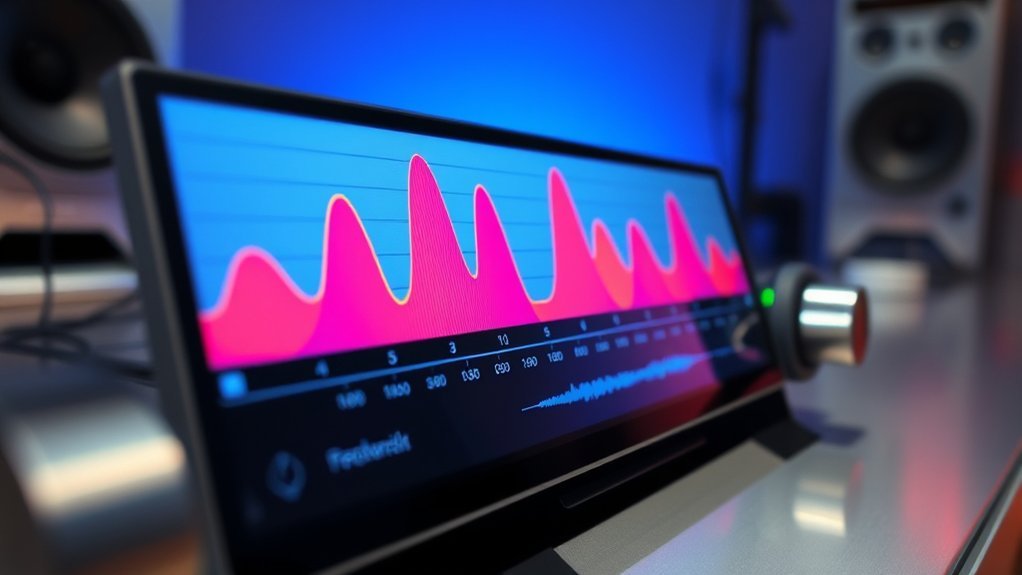
The frequency range coverage of an audio device determines its ability to reproduce the full spectrum of sound, directly affecting clarity and detail. Narrow ranges can omit essential elements, leading to a less accurate sound experience. Understanding how this range influences overall sound quality allows us to evaluate and select equipment that best preserves audio fidelity.
Frequency Range Coverage
How does the range of frequencies an audio device can reproduce influence sound quality? The frequency range determines the scope of sound waves the device can produce, directly affecting how vibration patterns translate into perceived sound. A broader range captures more nuanced sound waves, enhancing fidelity. Narrow ranges omit certain frequencies, degrading audio accuracy. Consider the following:
| Frequency Range | Sound Wave Type | Typical Use Case |
|---|---|---|
| 20 Hz – 20 kHz | Full spectrum | Consumer audio |
| 50 Hz – 15 kHz | Mid-range focus | Studio monitors |
| 100 Hz – 10 kHz | Vocal clarity | Headphones |
This coverage directly influences how vibrations propagate within devices, shaping overall sound quality and realism.
Impact on Clarity
A wider frequency response range typically enhances clarity by allowing an audio device to reproduce both deep bass and high treble with greater fidelity. This expanded range minimizes sound distortion, which can blur audio details and obscure important nuances. When frequency response is limited, certain sounds may be masked by others, leading to audio masking that reduces overall intelligibility. A broad response ensures that distinct frequencies are accurately represented, preventing overlap that causes muddiness. Consequently, listeners experience clearer vocals, precise instrument separation, and more accurate sound staging. Properly calibrated frequency response reduces the need for excessive equalization, preserving audio integrity. Overall, a thorough frequency response directly contributes to improved sound clarity, making every detail more perceptible and the listening experience more natural.
Understanding Frequency Range: Bass, Midrange, and Treble Explained
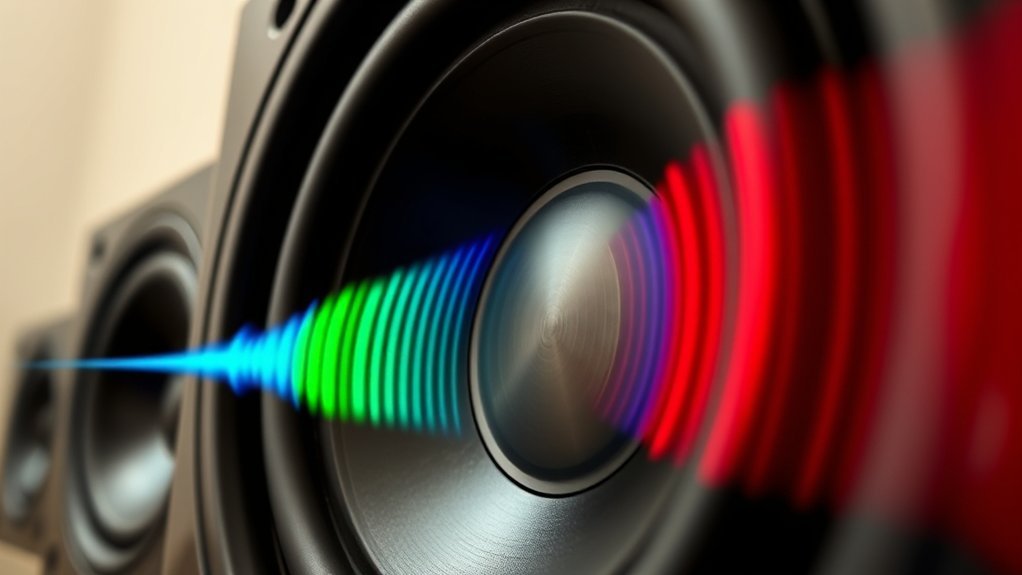
Have you ever wondered how different sounds in music and audio are categorized into bass, midrange, and treble? These ranges correspond to specific frequency bands that influence sound perception. Bass depth typically ranges from 20 Hz to 250 Hz and provides the foundation of audio, emphasizing low-end power and warmth. Midrange spans approximately 250 Hz to 4 kHz and carries most vocals and instruments, impacting clarity and detail. Treble, from 4 kHz to 20 kHz, adds brightness and treble clarity, highlighting crispness and articulation. Understanding these ranges helps us grasp how frequency response shapes overall sound quality. Precise control over each range allows audio engineers to optimize sound for clarity, depth, and brightness, ensuring a balanced listening experience across different audio systems.
How to Read and Interpret Frequency Response Charts
To accurately interpret frequency response charts, we first examine the axes to understand the frequency range and amplitude levels. Next, we analyze the response curve’s shape to identify how the audio device reproduces different frequencies. Finally, we assess the overall response to determine its suitability for specific audio applications.
Understanding Frequency Axes
How do we interpret the frequency axis on a response chart? The horizontal axis represents frequency, measured in Hertz (Hz), spanning from low to high frequencies. This axis displays the spectral balance of a sound system, indicating how different frequencies are reproduced. A flat response across this range suggests excellent tonal accuracy, meaning the system reproduces sound as intended without coloration. When analyzing charts, we focus on the relative height of the response curve at each frequency, which reveals peaks or dips that influence spectral balance. Understanding this axis allows us to assess how well a speaker or headphone maintains consistent output across the spectrum, directly impacting perceived sound quality. Accurate interpretation of the frequency axis guarantees a precise evaluation of the sound system’s ability to deliver balanced, true-to-source audio.
Recognizing Response Curves
Recognizing response curves involves examining the shape and features of the frequency response chart to assess a sound system’s performance. Response curves visually depict a system’s output across the audible spectrum, revealing peaks, dips, and flatness critical for audio calibration. A flat response indicates accurate sound reproduction, while deviations suggest overemphasized or diminished frequencies. Sharp peaks may reveal resonances, whereas valleys can signal cancellations or phase issues. Precise interpretation of these curves enables us to identify problematic areas that require adjustment, ensuring ideal audio calibration. By carefully analyzing the response curve’s slope and anomalies, we gain insight into the system’s tonal balance and fidelity, facilitating informed adjustments to achieve desired sound quality and consistency across different listening environments.
Interpreting Audio Range
What exactly does a frequency response chart reveal about a sound system’s capabilities? It illustrates the range of frequencies the system reproduces and the amplitude at each point, directly impacting audio perception. Interpreting these charts requires understanding that a flat response indicates consistent sound across all frequencies, enhancing natural sound reproduction. Variations or dips suggest potential issues in sound localization or frequency emphasis, affecting how accurately we perceive spatial cues. Recognizing the audio range helps us assess whether the system can handle the full spectrum of audible sounds, essential for precise sound localization. By analyzing these charts, we gain insights into the system’s ability to deliver clear, balanced audio, ensuring our perception aligns with the intended sound experience without distortions or gaps.
The Impact of Flat vs. Colored Frequency Responses on Listening
The distinction between flat and colored frequency responses profoundly influences the listening experience by shaping the accuracy and character of audio reproduction. Flat responses aim for transparency, minimizing coloration effects to deliver a true representation of the original sound, which is essential for critical listening and mixing. Conversely, colored responses intentionally emphasize or de-emphasize certain frequencies, adding coloration effects that can enhance musicality or emotional impact. The listening environment further interacts with these responses, amplifying or diminishing coloration effects based on room acoustics and speaker placement. Understanding this interplay helps us select equipment suited for our specific listening context, whether prioritizing neutrality for accuracy or embracing coloration for a more immersive, stylized sound.
Why Higher or Wider Frequency Ranges Don’t Always Guarantee Better Sound
Expanding a system’s frequency range does not inherently improve sound quality, as overlapping frequencies can cause auditory blurring. Broader ranges may introduce phase issues and reduce clarity if not properly managed. As a result, a wider frequency response alone does not guarantee a more accurate or pleasing listening experience.
Overlapping Frequencies Can Blur
While increasing the range of frequencies in a system might seem beneficial, overlapping frequencies can actually cause blurring and distortion. When multiple signals occupy similar spectral regions, harmonic distortion may occur, introducing unwanted artifacts. Additionally, phase cancellation between overlapping frequencies can reduce clarity and diminish sound quality. This interference often results in a smeared or fuzzy sound, undermining the benefit of a broader frequency response. To illustrate, consider the following:
| Frequency Range | Effect on Sound Quality |
|---|---|
| Narrow Bandwidth | Precise, clear sound |
| Wide Bandwidth | Potential for harmonic distortion |
| Overlapping Zones | Phase cancellation, blurring |
| Properly Managed Ranges | Balanced, accurate reproduction |
Effective design minimizes these issues, ensuring a cleaner, more accurate audio experience.
Broader Range Doesn’t Ensure Clarity
A wider frequency range alone doesn’t guarantee improved sound quality because broader spectra can introduce more complex interactions between signals, leading to potential interference. These range limitations often create clarity illusions, where listeners perceive greater detail without actual improvement in intelligibility. Expanding frequency response may include inaudible or irrelevant signals that mask or distort core audio information. Consequently, the perceived clarity can be compromised, not enhanced. Technical focus on a balanced, well-controlled frequency response is more essential than simply extending the spectrum. Overemphasizing range can obscure the importance of signal integrity and phase coherence, which are critical for clarity. Ultimately, broader ranges do not inherently resolve range limitations or eliminate interference; they can, in fact, exacerbate them if not managed carefully.
How Frequency Response Affects Different Types of Audio Equipment
Frequency response considerably influences how different types of audio equipment perform, as each device is designed to operate ideally within specific frequency ranges. Variations in frequency response impact sound quality through sound wave interactions, which determine how well a device reproduces audio signals. For example, narrow frequency ranges can cause frequency masking, where certain sounds obscure others, reducing clarity. Speakers and headphones with flat, extended responses accurately reproduce a broad spectrum of frequencies, minimizing sound distortion. Conversely, equipment with limited or uneven frequency responses may emphasize or de-emphasize certain ranges, affecting overall fidelity. Understanding these dynamics helps us recognize how equipment design influences sound quality, especially in complex audio environments where precise frequency reproduction is vital for faithful audio reproduction and minimizing sound wave interactions that degrade clarity.
Tips for Choosing Headphones and Speakers Based on Frequency Response
When selecting headphones or speakers, understanding their frequency response is essential for achieving accurate sound reproduction tailored to your needs. Consider the frequency range to ensure it covers your preferred audio spectrum, and evaluate how flat or emphasized the response is for sound fidelity. For precise audio calibration and sound equalization, choose gear with a well-defined frequency response to minimize the need for adjustments. The following table summarizes key factors:
| Factor | Implication |
|---|---|
| Flat Response | Accurate, neutral sound |
| Extended Bass Range | Better low-frequency reproduction |
| High-Frequency Extension | Clear treble, detail retrieval |
| Customizable EQ | Allows tailored sound with equalization adjustments |
Prioritize these aspects to optimize audio clarity and fidelity.
Common Misconceptions About Frequency Response in Audio Gear
Many assume that a broader or more extended frequency response automatically equates to superior sound quality, but this isn’t always the case. Psychoacoustic perception plays a crucial role in how we interpret sound, meaning the perceived quality depends on more than just frequency range. Factors like the device’s ability to accurately reproduce the intended sound signature matter more than extended ranges. Additionally, musical genre preferences influence what frequencies are essential; for example, bass-heavy genres prioritize low frequencies, while classical music emphasizes midrange clarity.
Consider the following misconceptions:
- A wider frequency range guarantees better audio fidelity
- Extended high frequencies always improve clarity
- Flat frequency response suits all genres equally
- More bass response enhances overall sound quality
- Perceived sound quality correlates solely with frequency range
How to Test and Evaluate a Device’s Frequency Response at Home
To accurately assess a device’s frequency response at home, we need reliable testing methods that do not require specialized laboratory equipment. Calibration techniques are essential to guarantee measurement accuracy, often involving test tones and verified playback sources. The listening environment considerably impacts results; a quiet, acoustically treated space minimizes reflections and noise interference. To evaluate, we follow a structured approach:
| Step | Action | Consideration |
|---|---|---|
| 1 | Use test tones or frequency sweep tracks | Ensure source calibration |
| 2 | Measure with a calibrated microphone or smartphone app | Place the device in a consistent listening position |
| 3 | Record and analyze frequency response | Account for room acoustics |
| 4 | Adjust for environmental variables | Maintain stable listening environment |
| 5 | Compare results to manufacturer specs | Identify deviations |
This method balances technical precision with practical at-home application.
Frequently Asked Questions
Does a Wider Frequency Range Always Mean Better Sound Quality?
A wider frequency range doesn’t always mean better sound quality; it can improve bass enhancement and treble clarity, but other factors like speaker design and room acoustics considerably influence overall audio fidelity and listener experience.
How Does Room Acoustics Influence Perceived Frequency Response?
Room acoustics markedly influence perceived frequency response through room resonance and sound absorption, which can emphasize or diminish certain frequencies, affecting clarity and balance. Proper acoustic treatment minimizes these effects, ensuring more accurate sound perception.
Can Headphones With Different Frequency Responses Sound Identical?
Headphones with different frequency responses can’t sound identical; subtle variations are inevitable. Our headphone calibration and precise analysis of frequency response curves reveal even minor differences, which substantially impact audio fidelity and listener perception.
Is Flat Frequency Response Preferable for All Music Genres?
We believe flat frequency response isn’t always preferable; equalization adjustments and speaker calibration optimize sound for each genre, emphasizing nuances and ensuring accurate reproduction, especially when tailoring audio experiences for diverse music styles and listening environments.
How Often Should I Check My Audio Equipment’s Frequency Response?
We recommend checking your audio equipment’s frequency response quarterly to maintain calibration consistency, account for equipment aging, and guarantee peak sound quality. Regular assessments help identify deviations that could compromise accurate audio reproduction.
Conclusion
Understanding and evaluating frequency response is essential for achieving accurate sound reproduction. By selecting equipment with a well-controlled, flat response, we guarantee clarity, balance, and realism in our listening experience. Testing devices at home confirms their performance aligns with specifications. Trusting precise data over assumptions helps us avoid tonal imbalances and distortion, ultimately allowing us to enjoy audio that truly reflects the original recording’s intent. Accurate frequency response knowledge empowers us to optimize our sound setups effectively.