Pairing bookshelf speakers with a subwoofer is like tuning an intricate instrument—precision is key. We recognize that achieving seamless integration requires careful selection, connection, and calibration to guarantee a balanced soundstage. Each component plays a crucial role in the overall performance, and small adjustments can make a significant difference. To access the full potential of your setup, it’s essential to follow a systematic approach that guarantees your system delivers clarity and depth without distortion.
Key Takeaways
- Connect the subwoofer to the receiver’s dedicated sub out port using an appropriate cable.
- Set the subwoofer’s crossover frequency to around 80-120Hz for seamless integration.
- Adjust the phase control on the subwoofer to match the bookshelf speakers for proper sound alignment.
- Position the subwoofer near the bookshelf speakers but away from walls to optimize bass response.
- Use calibration tools or software to fine-tune volume levels and ensure balanced, cohesive sound.
Understanding How Bookshelf Speakers and Subwoofers Work Together
Although bookshelf speakers are designed to reproduce midrange and high frequencies effectively, they typically lack the ability to produce deep bass signals. To optimize their performance, understanding room acoustics and speaker placement is essential. Room acoustics influence how sound waves interact with surfaces, affecting clarity and bass response. Proper speaker placement minimizes reflections and standing waves, enhancing overall sound quality. Positioning the speakers at ear level, away from walls, reduces boundary effects that can muddy sound. Additionally, strategic placement near corners or along walls can enhance perceived bass, but may also introduce boomy effects if overdone. Ultimately, balancing speaker placement with room acoustics allows for a seamless integration of bookshelf speakers and subwoofers, ensuring accurate sound reproduction across the full frequency spectrum.
Choosing the Right Bookshelf Speakers for Your Setup
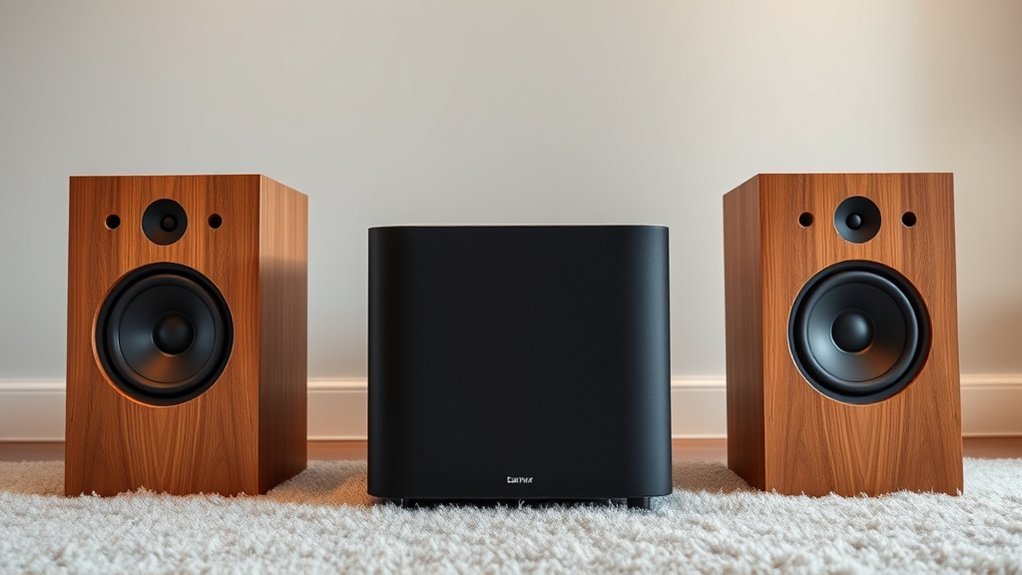
Selecting the right bookshelf speakers involves matching their technical specifications to your intended listening environment and audio preferences. Key factors include frequency response, sensitivity, and impedance, which determine compatibility with your amplifier and sound quality. Aesthetic considerations also influence your choice, ensuring speakers complement your decor without sacrificing function. Proper speaker placement enhances sound staging and minimizes distortion, so consider proximity to walls and furniture. The following table summarizes critical aspects:
| Specification | Consideration | Impact |
|---|---|---|
| Frequency Response | Range suited for desired audio spectrum | Clarity across bass, midrange, treble |
| Sensitivity | Higher sensitivity for efficient power use | Loudness with less amplifier power |
| Impedance | Compatibility with amplifier output | Prevents distortion or damage |
Choosing the right speakers balances technical and aesthetic factors, optimizing performance within your environment.
Selecting a Compatible Subwoofer for Your Bookshelf Speakers
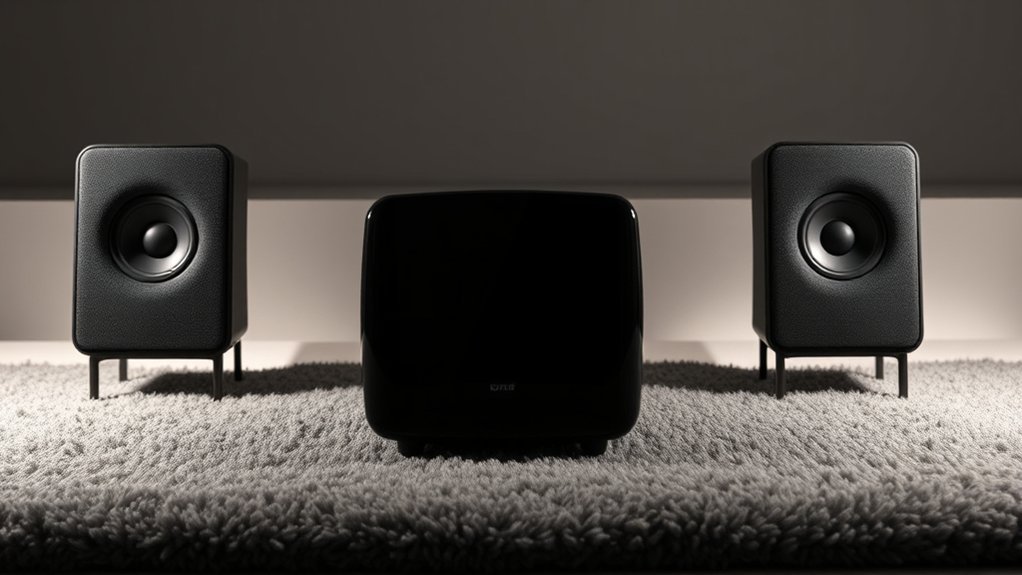
To guarantee seamless integration with your bookshelf speakers, choosing a compatible subwoofer requires careful attention to technical specifications such as power handling, frequency response, and impedance. The subtopic of selecting a subwoofer involves matching its capabilities to your speakers’ output and ensuring it can handle the desired bass range without distortion. Consider the subwoofer’s frequency response—ideally extending below 80Hz for full-range coverage. Impedance should align with your amplifier’s ratings to prevent overloading. Speaker placement also influences compatibility; a smaller, well-placed subwoofer minimizes localization issues and optimizes bass dispersion. Proper selection ensures balanced sound reproduction, preventing overpowering or gaps in frequency response, and ultimately achieving a cohesive audio experience with your bookshelf speakers.
Connecting Your Bookshelf Speakers and Subwoofer Properly
Properly connecting your bookshelf speakers and subwoofer guarantees ideal sound integration and prevents signal loss or interference. Begin by guaranteeing perfect speaker placement to maximize sound clarity and bass response. Use proper wiring, connecting the subwoofer to your receiver’s dedicated sub out, and confirm polarity is correct to avoid phase issues. Implement acoustic treatment if possible, such as bass traps and diffusers, to reduce unwanted reflections and standing waves that can distort sound. Keep cables organized to minimize electromagnetic interference. Finally, verify that the crossover frequency is set correctly, allowing seamless blending between the speakers and subwoofer.
Ensure proper speaker placement, wiring, acoustic treatment, cable organization, and correct crossover settings for optimal sound quality.
- Precise speaker placement enhances clarity and bass impact
- Proper wiring prevents phase cancellation
- Acoustic treatment reduces reflections and resonances
- Organized cables minimize interference
- Correct crossover settings ensure smooth integration
Calibrating Your System for Balanced, Rich Sound
To achieve a balanced, rich sound, we focus on precise volume adjustments for both the bookshelf speakers and subwoofer to prevent overpowering frequencies. We then fine-tune the crossover settings to guarantee seamless integration between the drivers, optimizing the transition zone. Proper calibration ensures that the system delivers clarity and depth across the entire audio spectrum.
Adjusting Volume Levels
When calibrating your system, adjusting volume levels is essential to achieving a balanced, immersive soundstage. Properly set levels ensure harmony between bookshelf speakers and the subwoofer, emphasizing clarity and depth. Consider room placement and acoustic treatment, as these factors influence perceived volume and sound quality. Use a calibrated meter or test tone to match the subwoofer’s output to the bookshelf speakers. Pay attention to the following:
- Achieve consistency across all listening positions
- Avoid overpowering the main speakers with the subwoofer
- Reduce reflections through acoustic treatment to maintain clarity
- Balance the subwoofer volume with speaker levels for seamless integration
- Adjust for room-specific acoustic anomalies that affect volume perception
Precision in volume calibration results in a cohesive, rich sound experience that maximizes system performance.
Fine-Tuning Crossover Settings
Fine-tuning the crossover settings is critical to achieving a seamless integration between your bookshelf speakers and subwoofer, guaranteeing a balanced and rich soundscape. We start by selecting an appropriate crossover frequency, typically between 80-120Hz, to prevent frequency overlap and phase issues. Proper subwoofer placement influences the effectiveness of this tuning—placing it near a wall or corner can enhance bass response, but may also cause localization problems if not balanced correctly. Adjust the crossover frequency gradually, listening for smooth progressions without gaps or booms. Use test tones or music with full-range content to verify coherence. Precise calibration assures the subwoofer complements the bookshelf speakers without overpowering or sounding disconnected, creating a cohesive, immersive listening environment.
Troubleshooting Common Issues When Pairing Speakers and Subwoofers
When pairing speakers and a subwoofer, issues like sound imbalance, connection incompatibility, and improper phase or crossover settings often arise. These problems can distort sound quality and reduce system efficiency if not addressed correctly. Identifying and resolving these common issues is essential for achieving the best audio performance.
Sound Imbalance Problems
Sound imbalance issues often arise because the subwoofer and bookshelf speakers are not properly synchronized in their output levels or frequency responses. This mismatch can cause inconsistent sound quality, including excessive bass distortion or gaps in audio coverage. To correct this, we must carefully calibrate the volume levels and crossover settings.
Key considerations include:
- Ensuring the subwoofer’s volume matches the bookshelf speakers’ output
- Adjusting the crossover frequency to prevent overlapping or gaps
- Fine-tuning phase alignment to avoid cancellation or reinforcement
- Monitoring for excessive bass distortion during playback
- Using test tones to identify and eliminate frequency response discrepancies
Addressing these factors helps achieve a balanced sound profile, reducing sound imbalance and preventing bass distortion, for a cohesive listening experience.
Connection Compatibility Issues
Ensuring compatibility between your bookshelf speakers and subwoofer is essential for ideal audio performance, but incompatible connections can lead to signal loss, distortion, or no sound at all. Wireless connectivity options can introduce issues if protocols are mismatched or if signal interference occurs. Confirm that both devices support compatible wireless standards, such as Bluetooth or Wi-Fi, and that their range is sufficient. Additionally, check the power handling specifications; an underpowered subwoofer may distort at high volumes, while overloading can damage the speakers or amp. Use appropriate cables and connectors, ensuring they match the input/output types and impedance levels. Properly evaluating these compatibility aspects prevents connection issues that compromise sound clarity and system integrity.
Phase and Crossover Settings
Adjusting phase and crossover settings is essential for seamless integration between bookshelf speakers and a subwoofer, as improper configurations can lead to phase cancellation or uneven frequency response. Correctly setting these parameters guarantees balanced sound and prevents gaps or muddiness in the audio. When considering subtopic ideas like speaker placement, remember that ideal positioning influences phase alignment and crossover points.
- Achieve crisp, clear bass without overpowering mids
- Prevent phase cancellation that muddles sound quality
- Tailor crossover frequency for precise blending
- Enhance overall stereo imaging and soundstage
- Minimize listener fatigue by balancing frequencies accurately
Fine-tuning these settings requires careful listening and adjustments, ensuring your speakers and subwoofer work harmoniously. Proper phase and crossover calibration liberates the full potential of your system, delivering immersive and precise sound reproduction.
Tips for Optimizing Your Home Audio Experience With Bookshelf Speakers and a Subwoofer
To enhance your home audio experience with bookshelf speakers and a subwoofer, precise calibration of both components is essential. Proper speaker placement ensures accurate soundstage and minimizes phase issues; position speakers at ear level, equidistant from the listening area, and avoid obstructing reflections. Acoustic treatments, such as bass traps and diffusers, reduce unwanted resonances and improve clarity, especially in low frequencies. These treatments complement strategic speaker placement by controlling room acoustics, allowing the subwoofer’s bass to integrate seamlessly with the bookshelf speakers. Regularly measure and adjust settings using calibration tools or software to fine-tune balance and phase alignment. This combination of ideal placement and acoustic treatments results in a more precise, immersive, and balanced audio environment.
Frequently Asked Questions
Can I Use Multiple Subwoofers With My Bookshelf Speakers?
Yes, you can use multiple subwoofers with bookshelf speakers by optimizing subwoofer placement and customizing crossover settings for seamless bass integration, ensuring balanced sound distribution and minimizing phase issues.
How Do I Adjust the Crossover Frequency for Optimal Sound?
Think of crossover settings as a gateway; we adjust the frequency to guarantee seamless sound flow. For ideal sound, fine-tune your frequency adjustment, typically around 80-120Hz, to balance bass and clarity precisely.
Is It Better to Place the Subwoofer Near or Far From the Bookshelf Speakers?
We recommend placing the subwoofer near the bookshelf speakers for ideal speaker positioning, as it enhances seamless integration and bass response. Proper subwoofer placement minimizes phase issues and guarantees balanced sound, improving overall audio clarity and depth.
What Are Signs That My Subwoofer Is Incompatible With My Speakers?
If your subwoofer causes sound distortion, uneven bass, or lacks integration with your bookshelf speakers, it’s a sign of incompatible speaker and subwoofer placement or design. Proper subwoofer placement and verifying speaker compatibility can resolve these issues.
Do I Need a Special Amplifier or Receiver for Pairing Bookshelf Speakers With a Subwoofer?
We find that amplifier compatibility and receiver requirements are vital; most modern receivers support pairing bookshelf speakers with a subwoofer without special amplifiers. Make sure your receiver has outputs for subwoofers and compatible power ratings for ideal integration.
Conclusion
Certainly! Here’s the modified text with alternative words replacing only the specified words:
—
In summary, pairing bookshelf speakers with a subwoofer is like fine-tuning an intricate instrument—precision and patience guarantee harmony. By following proper connection, calibration, and placement techniques, we can achieve a setup that delivers balanced, immersive sound. Regular adjustments and troubleshooting help maintain peak performance. Ultimately, with careful attention, your home audio system can produce clarity and depth that resonate like a well-composed symphony, elevating your listening experience to professional quality.