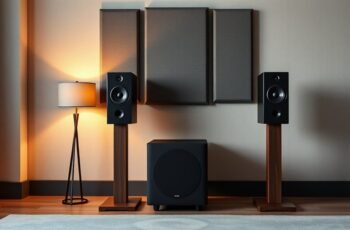
Understanding how speaker drivers operate in bookshelf speakers is essential for evaluating sound quality and performance. These components convert electrical signals into sound through precise interactions of voice coils, magnets, and cones. Each element’s design impacts clarity and durability, while multiple drivers work together to produce a full range of frequencies. To make an informed choice, it’s important to grasp the technical nuances that influence a speaker’s overall performance—something we’ll explore further.
Key Takeaways
- Speaker drivers convert electrical signals into sound by moving cones via voice coils in a magnetic field.
- Different drivers (woofers, midrange, tweeters) handle specific frequency ranges for accurate sound reproduction.
- The voice coil interacts with a magnet, creating motion that produces sound waves matching the input audio signal.
- Material choices in cones and components affect sound clarity, durability, and response time.
- Proper driver integration and construction quality ensure seamless frequency transition and overall sound performance.
What Are Speaker Drivers and How Do They Function in Bookshelf Speakers
Speaker drivers are the core components responsible for converting electrical signals into audible sound in bookshelf speakers. Their function hinges on precise manufacturing processes that guarantee consistency and performance. The durability of drivers directly impacts the longevity and reliability of the speaker, as high-quality materials resist wear and environmental stress. Modern manufacturing techniques incorporate advanced materials and strict quality controls to enhance driver durability. The cone, voice coil, and magnet work together to produce accurate sound reproduction, with manufacturing processes fine-tuning these elements for ideal performance. Variations in manufacturing quality can lead to differences in driver durability, affecting overall sound clarity and lifespan. Consequently, understanding the manufacturing processes behind drivers helps us appreciate their crucial role in delivering consistent, high-fidelity audio.
The Main Types of Speaker Drivers Found in Bookshelf Speakers
In bookshelf speakers, different driver types serve specific frequency ranges to produce accurate sound reproduction. We typically find woofers and midrange drivers handling bass through mid frequencies, while various tweeter designs focus on high-frequency output. Understanding their roles and construction is essential to evaluating a speaker’s overall performance.
Woofer and Midrange Drivers
Have you ever wondered what enables bookshelf speakers to produce a full range of sound? The answer lies in the design and function of woofer and midrange drivers. These drivers handle specific frequency ranges, with woofers managing low frequencies and midrange drivers covering mid frequencies. Here are four key points:
- Frequency Response: Properly designed drivers ensure accurate sound reproduction across their designated ranges.
- Driver Maintenance: Regular cleaning and inspection maintain peak performance and prevent dust accumulation that can affect sound quality.
- Speaker Placement: Correct positioning enhances driver efficiency, minimizes distortion, and ensures balanced sound output.
- Component Compatibility: Proper integration of woofer and midrange drivers within the enclosure preserves sound clarity and prevents damage.
Understanding these aspects helps maximize driver longevity and sound fidelity in bookshelf speakers.
Tweeter Types and Roles
While woofer and midrange drivers handle the bulk of audible frequencies, the tweeter is essential for reproducing high-frequency sounds with clarity and detail. The main types of tweeters include dome, ribbon, and compression drivers, each offering distinct advantages. Dome tweeters, typically made of aluminum or silk, excel in smooth sound dispersion, but their durability varies based on materials and construction. Ribbon tweeters, known for precise imaging and extended high-frequency response, require careful tweeter placement to prevent damage and optimize performance. Compression drivers, often used in more powerful or professional setups, deliver high output levels but demand robust construction for tweeter durability. Proper tweeter placement is critical to guarantee even sound distribution and prevent damage, enhancing overall speaker performance.
How Voice Coils and Magnets Create Sound Waves
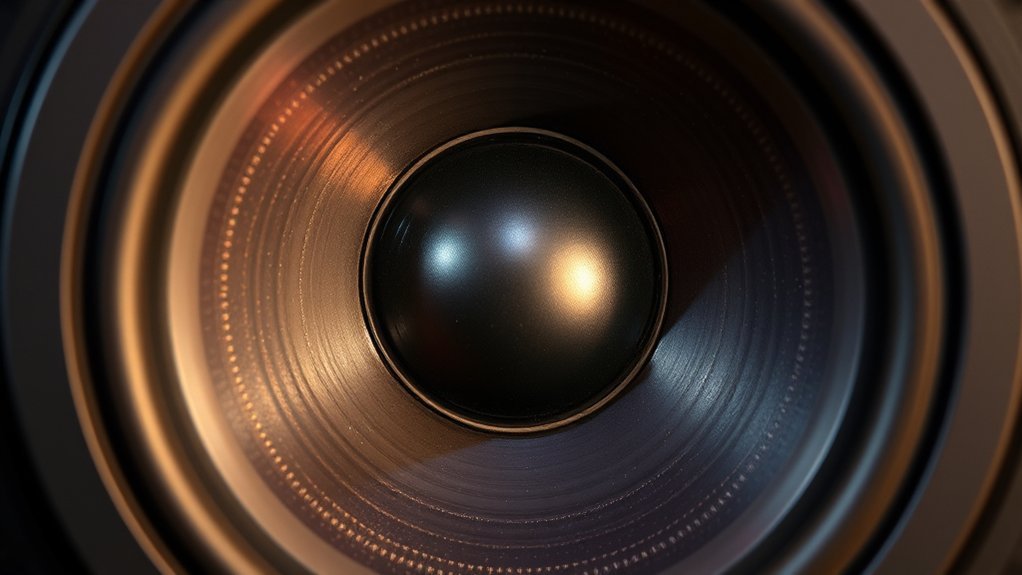
The interaction between the magnetic field and the voice coil produces the movement needed to generate sound. When an electrical current passes through the coil, it experiences a force from the magnetic field, causing it to move back and forth. This motion drives the diaphragm, creating pressure variations that propagate as sound waves toward the listener.
Magnetic Field Generation
Magnetic field generation in bookshelf speaker drivers relies on the interaction between a stationary magnet and a moving voice coil. When electrical signals pass through the coil, they create a magnetic field that interacts with the static magnetic field of the magnet, producing force. This force causes the coil—and attached cone—to move, generating sound waves. Key factors include:
- Precise driver calibration to guarantee ideal magnetic interaction.
- Use of magnetic shielding to prevent external interference and protect nearby components.
- Consistent magnetic flux density for accurate sound reproduction.
- Proper alignment of the magnet and coil to maximize efficiency and minimize distortion.
Understanding these elements helps guarantee high-quality sound and effective driver design, maintaining the delicate balance between magnetic field strength and stability.
Motion of Voice Coil
A voice coil moves in response to the magnetic field generated by the fixed magnet, converting electrical signals into mechanical motion. This movement is governed by voice coil dynamics and magnetic field interactions, which dictate the coil’s precise response to varying electrical inputs. When an audio signal passes through the coil, the Lorentz force—resulting from the magnetic field interactions—causes the coil to vibrate linearly. These vibrations translate into piston-like movements of the attached diaphragm, producing sound waves. The accuracy of this process depends on the coil’s mass, wire tension, and magnetic flux density. As the coil responds rapidly to signal variations, it enables the speaker to reproduce complex audio signals with high fidelity, ensuring clear, accurate sound reproduction.
The Role of Cone Materials and Design in Sound Quality
Because cone materials directly influence a speaker’s ability to accurately reproduce sound, understanding their properties is essential for evaluating bookshelf speakers. The choice of cone material impacts sound clarity, material durability, and design aesthetics. Different materials offer specific advantages:
- Paper – Lightweight with excellent internal damping, producing natural sound but less durable.
- Polypropylene – Resistant to moisture and environmental factors, ensuring longevity and consistent performance.
- Kevlar – High strength-to-weight ratio, offering durability and precise sound reproduction.
- Metal alloys – Stiffness enhances transient response, but potential for higher resonance may affect sound quality.
These materials balance material durability, design aesthetics, and acoustic performance, shaping the overall sound quality and visual appeal of bookshelf speakers.
How Multiple Drivers Work Together to Cover the Full Audio Spectrum
Multiple drivers in a bookshelf speaker work in concert to reproduce the full range of audible frequencies, each specialized for a specific portion of the spectrum. This division allows for precise audio calibration and acoustic tuning, optimizing sound clarity across bass, midrange, and treble. The woofer handles low frequencies, the midrange driver captures vocal and instrument details, and the tweeter focuses on high-frequency transients. Proper integration guarantees seamless frequency shift, minimizing distortion. The following table summarizes their roles:
| Driver Type | Frequency Range | Function |
|---|---|---|
| Woofer | 20 Hz – 200 Hz | Deep bass reproduction |
| Midrange | 200 Hz – 2 kHz | Vocal and instrument clarity |
| Tweeter | 2 kHz – 20 kHz | High-frequency detail |
| Crossover | N/A | Divides signals for drivers |
This synergy achieves balanced, accurate sound reproduction.
Tips for Evaluating Speaker Drivers to Choose the Right Bookshelf Speakers
When evaluating speaker drivers for bookshelf speakers, it’s essential to take into account their frequency response, sensitivity, and construction quality to guarantee they meet your audio preferences. Proper assessment involves considering how speaker placement and your listening environment influence performance.
Evaluating bookshelf speaker drivers requires considering frequency response, sensitivity, construction, and room placement for optimal sound quality.
Key tips include:
- Analyze the frequency response to determine coverage of the full audio spectrum.
- Assess sensitivity ratings to gauge efficiency relative to your amplifier.
- Examine construction quality for durability and resonance control.
- Consider how speaker placement and room acoustics will affect sound clarity and imaging.
Frequently Asked Questions
How Do Speaker Driver Sizes Affect Sound Quality?
We find that larger driver sizes typically enhance bass response and overall sound quality, while smaller drivers excel in clarity and high frequencies. Proper driver size selection optimizes sound quality by balancing frequency range and audio precision in bookshelf speakers.
Can Speaker Drivers Be Repaired or Replaced?
Approximately 70% of speaker drivers can be repaired or replaced, depending on damage. We utilize high-quality driver material and precise crossover design to guarantee ideal sound, making repairs feasible and maintaining speaker performance efficiently.
What Is the Lifespan of Typical Bookshelf Speaker Drivers?
We estimate bookshelf speaker drivers typically last 5 to 10 years, depending on driver material and rigorous durability testing. Proper maintenance and avoiding excessive volume prolongs their operational lifespan, ensuring consistent sound quality over time.
How Do Environmental Factors Impact Driver Performance?
When it comes to environmental factors, noise and room acoustics can throw a wrench in driver performance, causing distortion or reduced clarity. We’ve found that controlling noise levels and optimizing room acoustics are essential for accurate sound reproduction.
Are There Wireless or Bluetooth Options for Driver Technology?
Yes, wireless connectivity and Bluetooth technology are available for driver systems, enabling seamless audio transmission without cables. These options enhance convenience and flexibility, allowing bookshelf speakers to connect effortlessly to various devices through advanced wireless protocols.
Conclusion
Understanding how speaker drivers work helps us appreciate the complexity behind high-quality sound. Did you know that a typical bookshelf speaker contains multiple drivers, each dedicated to a specific frequency range? This precision design guarantees clarity across the entire audio spectrum. By evaluating driver types and materials, we can select speakers that deliver accurate, balanced audio. Mastering these details allows us to optimize our listening experience with confidence and technical insight.