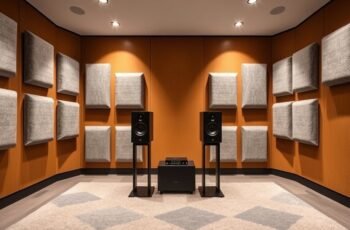
Understanding speaker specification sheets is essential for making informed audio choices, as these documents provide detailed insights into a speaker’s performance and compatibility. By analyzing parameters like frequency response, impedance, and sensitivity, we can determine if a speaker will meet specific environmental and usage requirements. However, interpreting these technical details accurately can be complex. To guarantee you select the best option, it’s important to grasp what each specification truly signifies and how they interrelate.
Key Takeaways
- Focus on key parameters like frequency response, impedance, power handling, and sensitivity to assess speaker performance.
- Understand that impedance (ohms) affects compatibility with your amplifier and overall system load.
- Check the frequency response to ensure the speaker covers the desired audio range for your environment.
- Compare sensitivity ratings to gauge efficiency and loudness at a given power level.
- Review construction details such as drivers, enclosure type, and crossover design for insight into durability and sound quality.
What Are Speaker Specification Sheets and Why Do They Matter?
Speaker specification sheets are detailed technical documents that provide essential information about a speaker’s performance characteristics and capabilities. They serve as a foundation for understanding how a speaker will perform in various environments, aiding in sound enhancement. These sheets include key data such as frequency response, impedance, and power handling, all critical for selecting the right equipment. Additionally, speaker branding plays a role in these specifications, as reputable brands often ensure consistent quality and reliability. By analyzing these sheets, we can assess whether a speaker aligns with our specific needs, whether for professional audio or consumer use. Ultimately, understanding these specifications helps us make informed decisions, guaranteeing excellent sound quality and effective sound enhancement tailored to our setup.
Key Components of Speaker Specs: Power Handling and Sensitivity
Understanding the key components of speaker specifications involves examining how power handling and sensitivity influence performance. Power handling indicates the maximum wattage a speaker can sustain without damage, directly impacting speaker durability and longevity. Proper power capacity aligns with amplifier output, ensuring consistent performance and minimizing risk of failure. Sensitivity measures how efficiently a speaker converts power into sound, often expressed as decibels per watt. Higher sensitivity means louder output at lower power, which is advantageous for energy efficiency and overall volume. Both parameters reflect a speaker’s build quality and are often correlated with brand reputation—trusted brands typically provide accurate specs and durable components. Recognizing these elements helps us select speakers that deliver reliable sound quality while ensuring long-term durability.
Understanding Frequency Response and Impedance

Since frequency response and impedance directly affect a speaker’s compatibility and sound quality, it’s crucial to analyze these specifications carefully. Frequency response indicates the range of audio frequencies a speaker can reproduce accurately, which influences how well it handles different genres and listening environments. Impedance, measured in ohms, determines how much load the speaker places on an amplifier; mismatched impedance can cause distortion or damage. Proper speaker placement and room acoustics markedly impact perceived frequency response, as reflections and standing waves modify sound clarity. When selecting speakers, verify their frequency range suits your room size and acoustical conditions, and confirm impedance matches your amplifier’s output. Precise understanding of these specs helps optimize sound quality and system compatibility in any listening space.
Decoding Speaker Drivers and Crossover Networks
Understanding speaker drivers involves identifying their specific roles, such as woofers, tweeters, and midrange units, each optimized for particular frequency bands. Crossover networks are essential components that direct these signals precisely by using inductors, capacitors, and resistors to filter frequencies. Recognizing how these elements work together helps in accurately interpreting specification sheets and evaluating speaker performance.
Driver Types and Roles
Have you ever wondered what differentiates the various drivers inside a speaker and how they work together? The role of drivers is essential, as each type handles specific frequency ranges. Driver types include woofers, midrange drivers, and tweeters, each designed for distinct roles. Woofers produce low frequencies, providing bass and depth; midrange drivers handle vocals and instruments; tweeters focus on high frequencies, delivering clarity and detail. These drivers are optimized for their roles through specific materials and designs. Understanding the function of each driver type helps interpret speaker specifications accurately.
- Woofers: Low-frequency reproduction, bass emphasis
- Midrange drivers: Vocal and instrument clarity
- Tweeters: High-frequency detail and brightness
- Driver roles: Define sound coverage and overall speaker balance
Crossover Components Explained
Crossover components are essential in directing specific frequency ranges to the appropriate drivers within a speaker system. A well-designed crossover network guarantees that each driver receives only the frequencies it’s meant to handle, enhancing sound clarity. Crossover design incorporates various components like capacitors, inductors, and resistors, each indispensable for filtering signals accurately. Speaker insulation also plays a crucial role by reducing electromagnetic interference, which can distort crossover performance. Precise crossover component selection and placement are fundamental for minimizing phase issues and frequency overlap. Understanding these elements helps us evaluate how effectively a speaker’s crossover network manages frequencies, securing balanced sound reproduction. Ultimately, a detailed comprehension of crossover components reveals how speaker designers achieve superior audio fidelity through meticulous engineering.
How to Read and Compare Speaker Size and Enclosure Types
When comparing speaker sizes and enclosure types, it’s essential to focus on the specific measurements and design characteristics that influence sound performance. Larger speakers typically produce deeper bass, while smaller ones offer precise midrange and treble. Enclosure types—such as sealed, ported, or bandpass—affect frequency response and efficiency. Design aesthetics also impact installation suitability and visual harmony within a space. Brand reputation informs reliability and overall quality, often reflected in construction and material choices.
- Speaker size (e.g., 6.5″, 8″, 12″)
- Enclosure type (sealed, ported, bandpass)
- Material quality and build design
- Brand reputation and design aesthetics
Interpreting Connectivity Options and Compatibility
Understanding the connectivity options on speaker specification sheets is vital for guaranteeing compatibility with your audio system. Wireless connectivity features, such as Bluetooth or Wi-Fi, enable seamless integration without physical cables, but require matching protocols and supported standards for peak performance. Compatibility considerations include input types like RCA, XLR, or optical, which must align with your existing equipment. It’s essential to verify power requirements and impedance ratings to prevent damage or mismatched performance. When evaluating wireless options, confirm your devices support the same standards to avoid connectivity issues. Precise attention to these details guarantees that the speaker will operate effectively within your setup, minimizing setup errors and maximizing audio quality. Correct interpretation of connectivity specifications ensures reliable, high-quality integration into your audio environment.
Identifying Additional Features and Performance Enhancements
We can identify additional features such as extra connectivity options, including optical or Bluetooth inputs, which expand compatibility. Enhanced sound technologies like DSP or custom drivers indicate performance improvements aimed at audio fidelity. Recognizing these elements helps us evaluate a speaker’s overall capabilities beyond basic specifications.
Extra Connectivity Options
Additional connectivity options on speaker specification sheets reveal important features that can profoundly enhance performance and versatility. These options often include wireless connectivity features like Bluetooth compatibility, enabling seamless, cable-free audio streaming. Bluetooth compatibility allows devices to connect effortlessly, supporting multiple profiles for high-quality audio transmission. Other features may include Wi-Fi connectivity, auxiliary inputs, or USB ports, expanding integration possibilities with various devices. These features are critical for flexible setups and multi-room audio systems. When evaluating speakers, consider the supported wireless protocols, range, and compatibility with your existing devices. Ultimately, extra connectivity options improve user experience through convenience and expanded functionality, making it easier to tailor audio solutions to specific environments.
- Wireless connectivity standards (e.g., Bluetooth, Wi-Fi)
- Bluetooth compatibility for device pairing
- Auxiliary and USB inputs for wired connections
- Multi-device support and range capabilities
Enhanced Sound Technologies
Enhanced sound technologies on speaker specification sheets highlight critical features that directly influence audio clarity, depth, and overall listening experience. These include advanced drivers, digital signal processing (DSP), and acoustic enhancements that improve sound fidelity. Speaker aesthetics often integrate these features seamlessly, maintaining sleek designs without sacrificing performance. Recognizing a brand’s reputation is essential, as reputable manufacturers tend to incorporate proven technologies for superior audio output.
| Feature | Impact on Performance |
|---|---|
| Digital Signal Processing | Precise sound tuning and noise reduction |
| Acoustic Enhancements | Richer bass and clearer treble |
| Advanced Drivers | Better frequency response and power handling |
| Speaker Aesthetics | Optimized placement for sound dispersion |
| Brand Reputation | Assurance of quality and consistency |
Common Mistakes to Avoid When Reading Speaker Specs
When examining speaker specification sheets, it’s essential to avoid common pitfalls that can lead to misinterpretation. Misreading parameters like frequency response or power handling can result in poor placement decisions and inadequate acoustic treatments. Overlooking the importance of speaker placement can hinder performance, regardless of specs. Additionally, ignoring how acoustic treatments influence sound can lead to mismatched expectations. Focusing solely on specs without considering environmental factors risks suboptimal results.
- Confusing nominal and program power ratings
- Ignoring the impact of speaker placement on acoustics
- Overlooking how acoustic treatments affect sound clarity
- Assuming specifications are universal without considering room conditions
How to Use Specification Sheets to Choose the Right Speakers for Your Needs
Using specification sheets effectively begins with understanding how each parameter aligns with your specific needs and environment. Speaker placement critically influences sound quality, so review parameters like dispersion pattern and frequency response to determine ideal positioning. Acoustic treatment also plays a crucial role; matching speaker power handling and sensitivity ensures clarity without distortion. Consider room size, shape, and existing acoustic conditions when interpreting specs to prevent over- or under-specifying. Use the data to identify speakers that complement your environment—whether for a small studio or large auditorium. Precise matching of speaker capabilities with your space’s acoustics ensures balanced sound. By analyzing these parameters carefully, we can select speakers that deliver accurate, consistent performance tailored to our specific setting.
Tips for Comparing Multiple Speaker Models Effectively
To compare multiple speaker models effectively, we need to focus on aligning their specifications with our specific performance requirements and environment. Key factors include evaluating frequency response, power handling, and sensitivity, which influence sound output and clarity. Additionally, consider how speaker placement impacts performance—optimal placement reduces distortion and enhances sound dispersion. Acoustic treatments in the environment can affect how speakers perform and should be factored into comparisons.
- Assess how different models handle various acoustic environments with treatments in place
- Prioritize specifications that support your desired speaker placement strategy
- Examine directivity and dispersion patterns for your specific space
- Consider durability and build quality relative to environmental demands
Frequently Asked Questions
How Do Speaker Specifications Impact Overall Sound Quality?
Speaker specifications directly influence sound quality through frequency response, shaping audio accuracy, and impedance compatibility, ensuring ideal power transfer and preventing distortion, which together create a clearer, more balanced listening experience for you.
Are Higher Power Ratings Always Better for Speakers?
Higher power ratings don’t always mean better speaker durability or broader frequency response; instead, they indicate potential maximum handling capacity, but actual performance depends on design, materials, and how well the speaker maintains sound quality under load.
What Is the Significance of Manufacturer Branding on Specs?
We believe manufacturer branding signifies brand reputation and marketing influence, which can impact perceived quality, reliability, and performance. Trusted brands often adhere to strict standards, providing confidence in specifications and ensuring consistent, high-quality audio output for consumers.
How Do Room Size and Acoustics Influence Speaker Selection?
In an ideal acoustic environment, room size and treatment shape speaker choice; larger spaces demand greater output, while effective room treatment minimizes reflections, ensuring accurate sound reproduction aligned with your specific room dimensions and acoustic profile.
Can I Rely Solely on Specs to Determine Speaker Performance?
We can’t rely solely on specs for speaker performance; sound clarity and frequency response are critical, but real-world listening tests reveal nuances. Specifications guide us, yet hands-on evaluation guarantees the speaker meets our precise audio quality standards.
Conclusion
By mastering how to read speaker specification sheets, we gain the ability to visualize the soundscape each model creates. We can imagine the crisp highs, deep lows, and balanced clarity, all tailored to our specific needs. Precise understanding allows us to select speakers that transform our spaces into immersive auditory environments. With this knowledge, we’re equipped to make confident, informed decisions—ensuring every note resonates perfectly, enriching our listening experience with clarity and power.