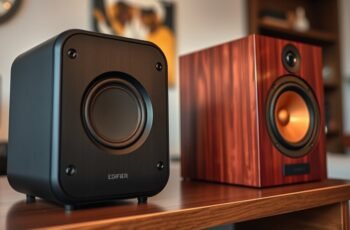
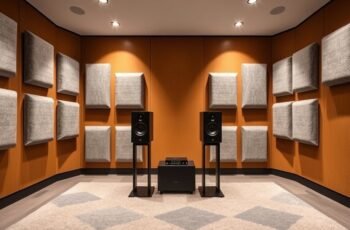
Imagine upgrading a home theater system and noticing that vocals sound clear while the bass feels underwhelming. This difference arises from the distinct roles of tweeters and woofers, which are designed to reproduce specific parts of the audio spectrum. Understanding how each driver functions can help optimize your setup, but the technical nuances behind their design and interaction often remain unclear. Exploring these details can reveal how to achieve a balanced, high-quality sound experience.
Key Takeaways
- Tweeters produce high-frequency sounds like vocals and cymbals, while woofers handle deep bass and low-frequency sounds.
- Tweeters are smaller and lightweight for rapid movement; woofers are larger and heavier for powerful low tones.
- Crossovers direct high frequencies to tweeters and low frequencies to woofers for balanced sound.
- Proper design and placement of each driver optimize sound clarity and stereo imaging.
- Upgrading or mismatching drivers can cause distortion; compatibility ensures better sound quality.
How Do Tweeters and Woofers Differ in Design and Function
Although both tweeters and woofers are essential components of a speaker system, they are distinctly designed to handle different frequency ranges. Tweeters are smaller, with lightweight diaphragms that enable swift movement, tailored for high-frequency sound reproduction. Woofers are larger, featuring heavier cones that generate lower frequencies with greater power. The design of each driver is closely linked to its role within the speaker enclosure, which aids in sound clarity and efficiency. Crossovers are critical in this setting, directing high frequencies to tweeters and low frequencies to woofers, preventing distortion. The precise construction of each driver and integration with crossover networks ensures ideal frequency response, allowing the system to produce a full, balanced sound spectrum.
Why High-Frequency Sounds Are Best Handled by Tweeters
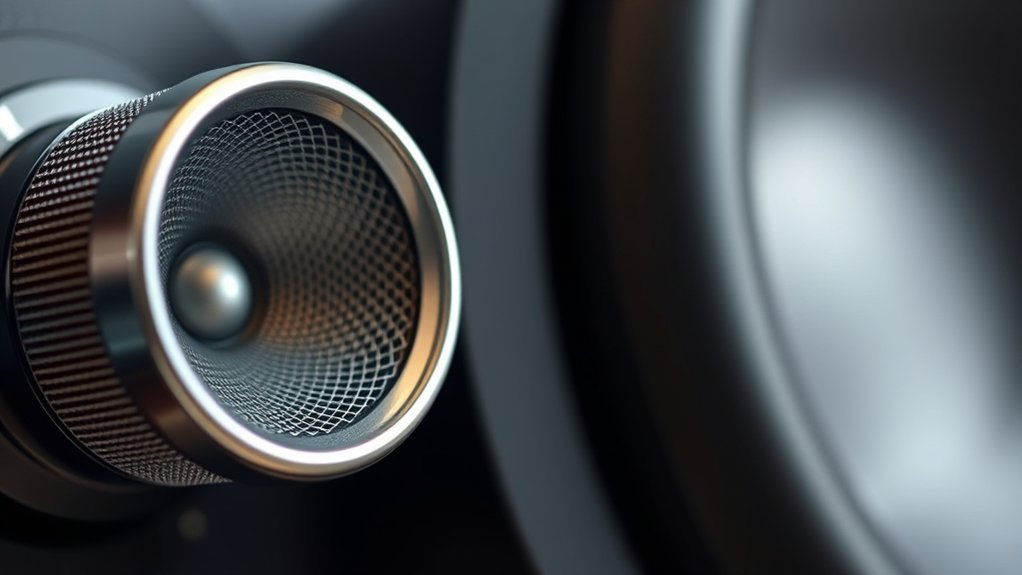
Tweeters are specifically engineered to handle high-frequency sounds because their small size and lightweight diaphragms enable rapid and precise movement. This design allows them to accurately reproduce the upper end of the frequency range, typically from 2,000 Hz to 20,000 Hz or higher. Their compact structure facilitates effective sound dispersion, ensuring high frequencies reach listeners clearly and evenly across the listening area. The ability to respond quickly to signal changes makes tweeters ideal for capturing the nuances of treble sounds, such as vocals and cymbals. Their precise movement minimizes distortion at high frequencies, enhancing clarity. Overall, the combination of size, material, and design optimizes their performance for high-frequency output, making tweeters essential for accurate and dynamic sound reproduction in audio systems.
How Woofers Deliver Deep Bass and Low-Frequency Range
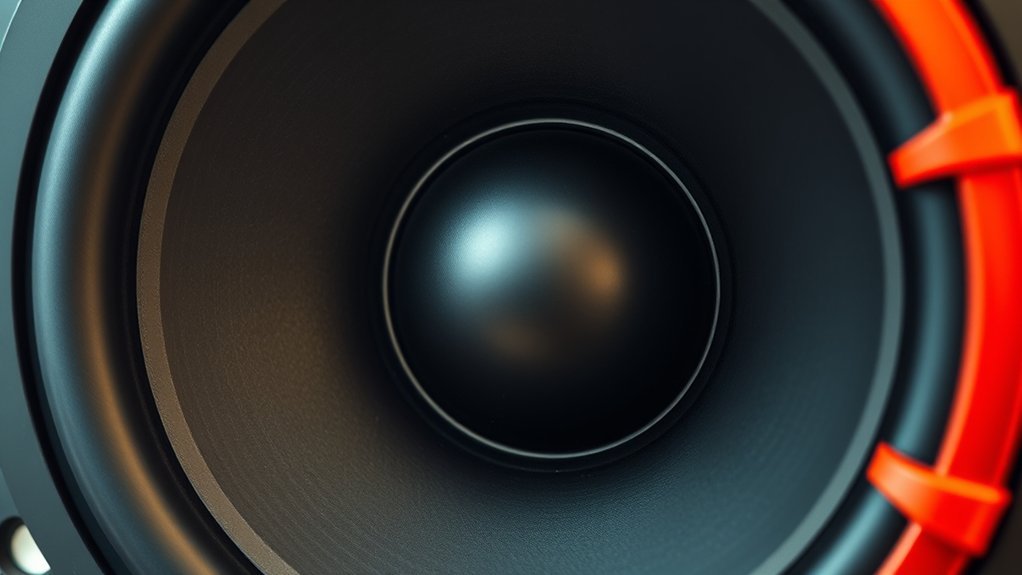
Woofers are specifically designed to reproduce deep bass and low-frequency sounds due to their larger size and heavier diaphragms, which enable them to move more air and generate powerful, low-pitched tones. Their efficiency relies heavily on the speaker enclosure, which enhances low-frequency response by reducing unwanted resonances and vibrations. Properly designed enclosures, such as sealed or ported boxes, optimize woofer performance and improve sound clarity. Additionally, crossover networks are essential; they direct low-frequency signals exclusively to the woofer, preventing distortion and ensuring accurate bass reproduction. The combination of a robust diaphragm, an appropriately engineered enclosure, and a precise crossover network allows woofers to deliver deep, impactful bass that fills the listening space with low-end richness.
Choosing the Right Driver for Your Listening Needs and Space
Selecting the appropriate driver depends on understanding your specific listening environment and audio priorities. Proper speaker placement greatly impacts the effectiveness of either driver, influencing sound staging and frequency response. For small, enclosed spaces, a driver with precise acoustic tuning guarantees clarity and reduces unwanted resonances. Larger rooms may benefit from drivers capable of broader dispersion, requiring strategic placement to maximize sound coverage. When choosing a driver, consider the acoustic properties of your space and how each driver interacts with it. Tweeters excel in high-frequency clarity, while woofers provide deep bass; matching these to your environment ensures balanced sound. Ultimately, understanding your room’s acoustic characteristics and adjusting speaker placement accordingly will yield peak performance tailored to your listening needs.
Common Mistakes to Avoid When Upgrading Your Audio Drivers
Upgrading your audio drivers without proper planning can lead to diminished sound quality and system imbalance. One common mistake is neglecting crossover compatibility, which can cause phase issues or frequency overlap, impairing clarity. Making sure your new drivers match the crossover specifications is essential for seamless integration. Another frequent pitfall involves installation errors; incorrect wiring or improper mounting can cause distortion or damage. Avoid rushing the process—double-check connections and polarity. It’s also crucial to verify that your amplifier can handle the impedance load of the new drivers to prevent overloads. By focusing on compatibility and meticulous installation, you minimize the risk of audio degradation. Staying informed about these critical factors helps ensure your upgrade enhances sound performance without unintended consequences.
Frequently Asked Questions
How Do Materials Affect the Performance of Tweeters and Woofers?
Materials influence performance through their composition and acoustic properties, affecting sound accuracy, clarity, and durability. We consider these factors to optimize driver response, ensuring precise reproduction for both tweeters and woofers in various audio applications.
Can You Upgrade Speakers Without Changing the Entire Audio System?
Upgrading speakers is like tuning a fine instrument; we can often do it without replacing the entire system. Ensuring speaker compatibility is key, and understanding upgrade costs helps us make precise, cost-effective improvements without overhauling our setup.
What Are the Signs of a Failing Tweeter or Woofer?
We notice signs of a failing driver through distorted sound, reduced volume, or inconsistent frequency response, indicating compromised driver durability. These issues suggest the tweeter or woofer struggles to accurately reproduce the intended audio spectrum.
How Does Speaker Placement Influence Sound Quality for Tweeters and Woofers?
Research shows proper speaker positioning enhances sound clarity by up to 50%. We focus on acoustic refinement, adjusting speaker placement to maximize tweeter and woofer performance, ensuring precise sound distribution and minimizing distortion for ideal audio fidelity.
Are There Differences in Power Handling Between Tweeters and Woofers?
We find that woofers handle higher power due to their broader frequency range and sound dispersion, whereas tweeters generally manage less power, focusing on high frequencies, which demands precise power handling to prevent distortion or damage.
Conclusion
Certainly! Here’s the modified text with alternative words replacing “In summary” and “ensure”:
—
To sum up, understanding the distinct roles of tweeters and woofers helps us optimize our speaker systems for clarity and depth. Matching the right driver to your listening environment guarantees a balanced soundstage and avoids common pitfalls. Remember, it’s all about playing to each component’s strengths—like fitting the pieces of a puzzle. When used correctly, these drivers work in harmony, delivering a sound experience that’s truly worth the effort.