When setting up for nearfield listening at a desk, understanding how proximity influences sound clarity is essential. By positioning monitors or headphones within a few feet, we can reduce room reflections and focus on the direct sound, improving accuracy. But achieving ideal results requires careful placement, calibration, and room treatment. Exploring these factors can greatly impact your listening experience, prompting us to examine what makes nearfield setups effective and how to implement them properly.
Key Takeaways
- Nearfield listening involves placing speakers within a few feet for precise sound reproduction.
- It minimizes room reflections, enhancing clarity and reducing reverberations.
- Proper placement at ear level and equidistant creates an optimal listening triangle.
- Using vibration isolation pads and acoustic treatment improves sound accuracy.
- Avoid common placement mistakes like proximity to walls or uneven speaker alignment.
What Is Nearfield Listening and How Does It Work?
Nearfield listening refers to a monitoring technique where speakers are positioned in close proximity to the listener, typically within a few feet, to deliver a more accurate and detailed sound. This setup minimizes the influence of room acoustics, making it ideal for critical listening and mixing. In a nearfield configuration, surround sound systems benefit from reduced reflections, ensuring precise channel separation. Acoustic treatment plays a vital role by controlling reflections and reverberations, further enhancing clarity. By focusing sound directly into the listener’s ears, nearfield listening provides a flat frequency response and minimizes phase issues. This approach is especially effective in desk setups, where space constraints demand focused, high-fidelity audio reproduction with ideal acoustic conditions for accurate sound monitoring.
Why Nearfield Listening Is Ideal for Desk Setups
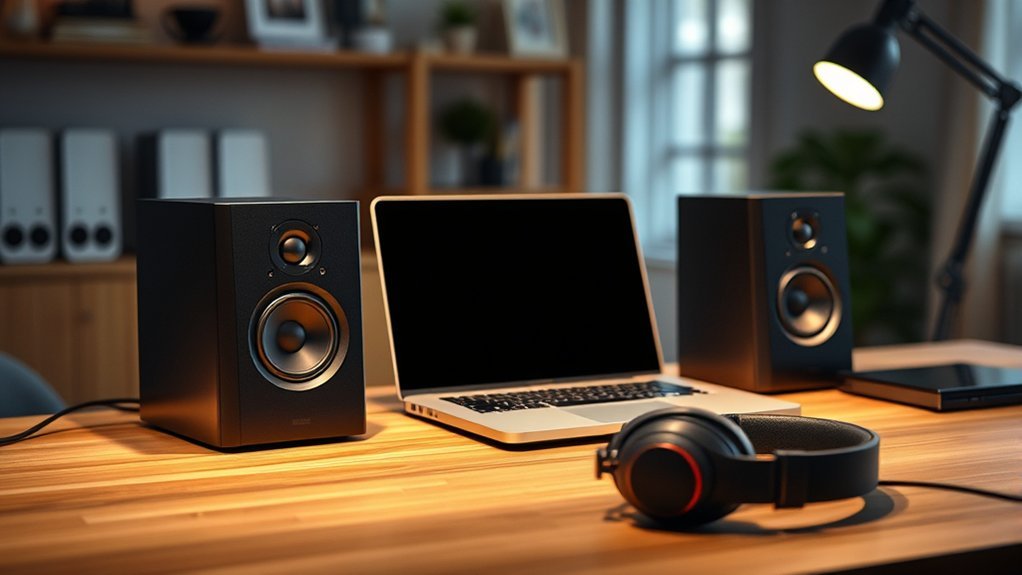
Because space is often limited on desks, implementing nearfield listening guarantees that audio monitoring remains accurate and detailed without requiring extensive room treatment or large speaker setups. The proximity of nearfield monitors minimizes the impact of ambient noise and room reflections, enhancing sound isolation directly at the source. This setup reduces the need for elaborate acoustic treatment, as the reduced reflection path prevents sound distortions and reverberations. Nearfield listening ensures that sound reproduction is precise and consistent, critical for mixing and critical listening tasks in confined spaces. By focusing on direct sound, nearfield monitors optimize clarity and detail, making them ideal for desk setups where space constraints limit traditional acoustic solutions. This approach offers a practical, high-fidelity audio environment with minimal spatial adjustments.
Choosing the Right Nearfield Monitors or Headphones for Your Desk
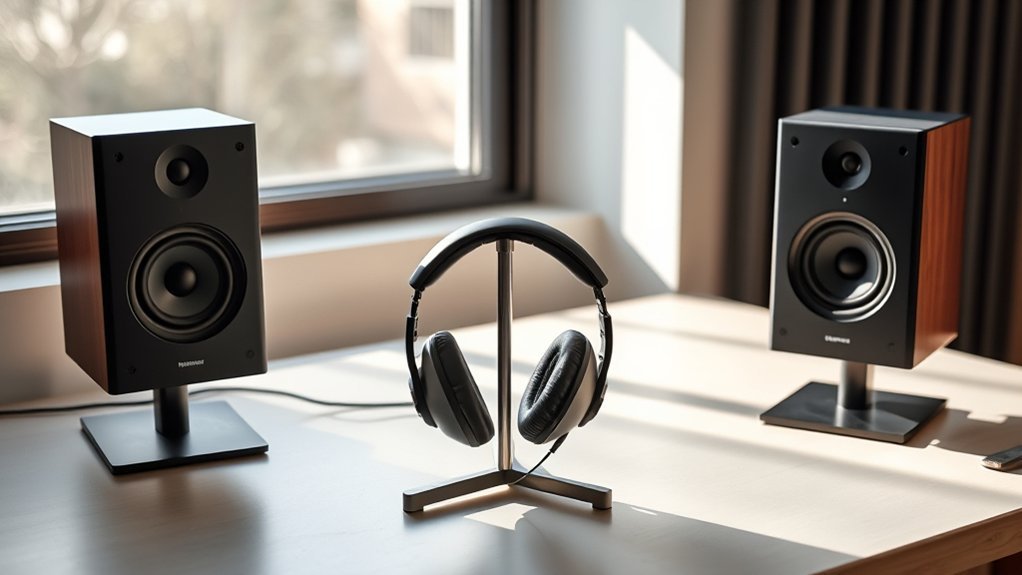
Selecting the appropriate nearfield monitors or headphones is a critical decision that directly impacts the accuracy and clarity of your audio monitoring in a confined workspace. To enhance performance, consider factors like room acoustics and speaker placement, which influence sound clarity and frequency response.
Key considerations include:
- Frequency response range for detailed sound reproduction
- Room acoustics to minimize reflections and standing waves
- Speaker placement ensuring equal distance and angling toward your listening position
- Build quality and driver size for consistent performance
- Headphone impedance for compatibility with your audio interface
Choosing gear suited to your environment ensures precise monitoring, allowing for accurate mixing and editing. Properly addressing room acoustics and speaker placement is essential for ideal nearfield listening.
Tips to Optimize Your Desk Space for Better Nearfield Audio
Optimizing your desk space is essential for achieving accurate nearfield audio, as clutter and poor organization can introduce unwanted reflections and vibrations that compromise sound clarity. An ergonomic workspace promotes better monitor placement and reduces fatigue, enhancing listening accuracy. Effective cable management minimizes electromagnetic interference and prevents accidental disconnections, ensuring signal integrity. To optimize your setup, consider positioning monitors at ear level with equal distance from each other, maintaining a dedicated, vibration-free surface. Use cable clips or sleeves to organize cords neatly, reducing clutter. Incorporating acoustic treatments like foam panels in strategic locations can further diminish reflections. The following table summarizes key strategies:
| Strategy | Implementation |
|---|---|
| Ergonomic monitor placement | Ear level, equidistant from listeners |
| Cable management | Clips, sleeves, and routing cables neatly |
| Vibration isolation | Use pads or stands beneath monitors |
| Acoustic treatment | Foam panels at reflection points |
| Workspace organization | Clear, clutter-free surface |
Common Mistakes to Avoid With Nearfield Listening at Your Desk
One common mistake in nearfield listening at a desk is neglecting proper monitor placement, which can lead to inaccurate sound imaging and compromised stereo balance. Poor speaker placement disrupts the relationship between speakers and room acoustics, causing phase issues and uneven frequency response. To maximize your setup, avoid these errors:
- Placing monitors too close to walls or corners
- Ignoring the ideal equilateral triangle between speakers and your ears
- Overlooking room acoustics that cause reflections and standing waves
- Neglecting to calibrate speaker height and angle
- Using inconsistent speaker distances or unequal speaker positioning
Addressing these issues ensures accurate sound reproduction, minimizes acoustic distortions, and enhances stereo imaging, making nearfield listening more precise and effective. Proper speaker placement and room treatment are essential for supreme audio clarity.
Frequently Asked Questions
How Does Room Acoustics Affect Nearfield Listening Quality?
Room acoustics greatly influence nearfield listening; effective room treatment minimizes acoustic reflection, reducing unwanted echoes, and guarantees clearer sound quality, allowing us to accurately perceive audio details in a controlled environment.
Can Nearfield Listening Improve Audio for Video Conferencing?
Yes, nearfield listening enhances video conferencing audio by optimizing speaker placement for direct sound, reducing reflections, and improving sound isolation, which results in clearer voice clarity and minimizes background noise for a more professional communication experience.
What Budget Options Are Available for Nearfield Monitors or Headphones?
We find budget speakers like the PreSonus Eris E3.5 and headphones such as the Audio-Technica ATH-M20x offer precise, clear sound without breaking the bank, making your nearfield setup a sharp, affordable listening station.
How Often Should I Calibrate My Nearfield Audio Setup?
We recommend calibrating your nearfield audio setup every 1 to 3 months, depending on usage and environment. Regular calibration guarantees ideal sound quality, allowing precise equipment adjustment and maintaining accurate audio reproduction for consistent, professional-grade performance.
Are There Specific Brands Recommended for Nearfield Listening Equipment?
We recommend brands like Adam Audio, Focal, and Yamaha for nearfield listening equipment, as their product comparisons show superior accuracy and reliability. For precise desk setups, these manufacturers provide equipment recommendations that meet professional audio standards effectively.
Conclusion
Ultimately, mastering nearfield listening on our desks sharpens our audio accuracy and detail. With proper setup and equipment, we can minimize room reflections and phase issues that compromise sound clarity. Are we fully leveraging our workspace’s potential for critical listening? By applying these principles, we guarantee our environment supports precise monitoring—crucial for mixing, mastering, or enjoying high-fidelity audio. Precision in placement, calibration, and space optimization is the key to revealing nearfield listening’s full benefits.