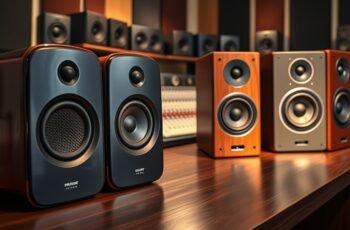
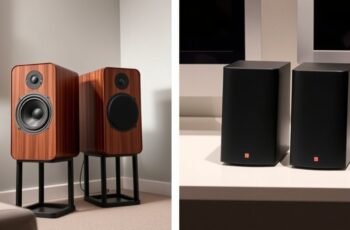
Studies show that small speakers typically produce less than 50% of the bass frequencies found in larger models, highlighting inherent limitations. These constraints stem from factors like driver size, enclosure design, and material choices, which directly influence low-frequency reproduction. Understanding how these technical elements interact is essential. By examining what impacts bass response in small speakers, we can identify ways to optimize their performance—an exploration that reveals nuanced engineering challenges and solutions.
Key Takeaways
- The design and materials of the speaker’s driver and cone influence low-frequency reproduction and bass extension.
- Enclosure size, shape, and internal damping affect resonance and the ability to produce deep bass.
- Room acoustics, including reflections and furniture, can enhance or diminish bass response.
- Proper wiring, phase alignment, and impedance matching ensure efficient power transfer and clear bass.
- Adequate amplifier power and damping materials help control vibrations, improving bass depth and accuracy.
How Do Small Speakers Generate Bass Frequencies?
How do small speakers produce bass frequencies despite their limited size? They achieve this by extending their frequency range through precise driver design and materials that enhance low-frequency response. Small drivers can generate bass by optimizing motor strength and cone movement, effectively translating electrical signals into sound pressure waves. Although their physical size restricts the maximum travel of the cone, engineering techniques like resonance tuning and damping improve the sound perception of lower frequencies. While small speakers’ frequency range may not encompass the full spectrum of deep bass, they can still produce audible bass notes that our ears perceive as bass. This is possible because sound perception relies on the brain interpreting specific low-frequency signals, even if the actual physical output is limited.
How Do Size and Enclosure Design Impact Bass Response?
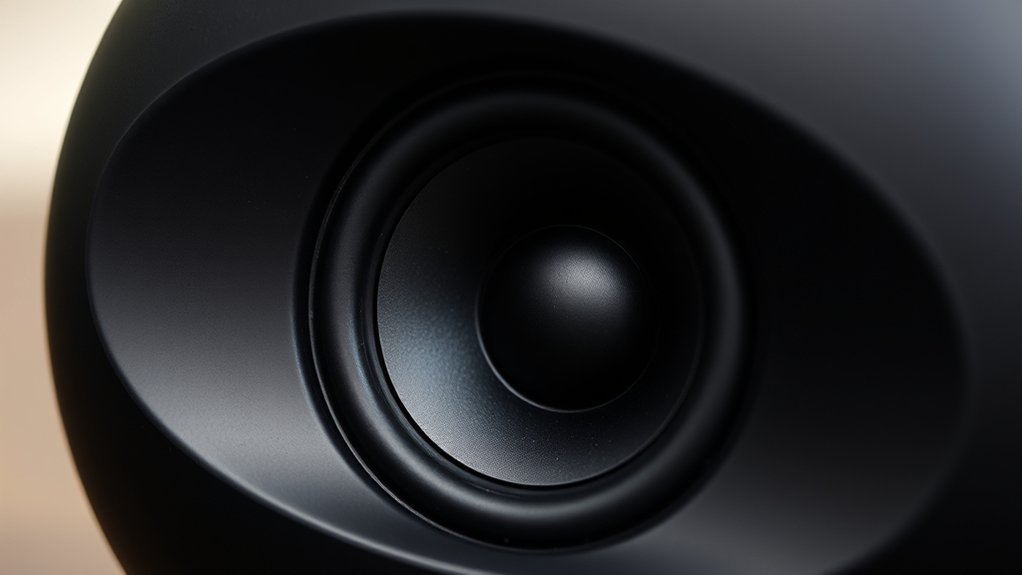
The physical dimensions of a speaker and the design of its enclosure directly influence its ability to reproduce bass frequencies effectively. Larger enclosures generally support lower resonant frequencies, enhancing bass response, but they also increase susceptibility to enclosure resonance, which can distort sound. Material damping within the enclosure plays a pivotal role by absorbing vibrations and reducing resonance effects, leading to clearer bass. Precise enclosure design, including internal bracing and damping materials, minimizes unwanted resonance that can muddy low-frequency output. The interplay between size, damping, and resonance management determines the speaker’s capacity to deliver deep, accurate bass. Effective design balances these factors, ensuring the enclosure supports the speaker’s physical capabilities without introducing resonant artifacts that compromise bass clarity.
What Materials Are Used in Small Speakers and How Do They Affect Bass?
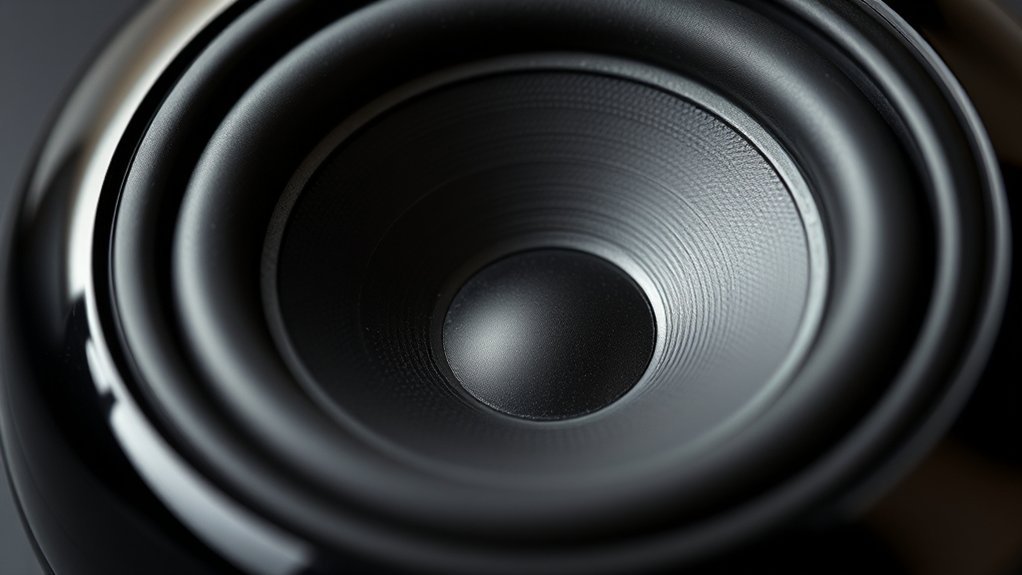
Materials used in small speakers considerably influence their ability to produce accurate bass, as each material’s acoustic properties affect sound transmission and vibration control. Material composition determines the cone’s stiffness, damping, and weight, which directly impacts low-frequency response. Common materials include paper, polypropylene, and composites, each offering unique damping characteristics and rigidity. Cone design also plays a vital role; a well-engineered cone maximizes efficiency and minimizes unwanted resonances. For example, lightweight yet stiff materials enhance cone acceleration, improving bass extension and clarity. Conversely, less suitable materials may cause distortion or diminish bass depth. Ultimately, the combination of material composition and cone design determines how effectively a small speaker can reproduce bass, balancing durability, vibrational control, and sound fidelity.
How Does Room Acoustics Influence Small Speaker Bass Performance?
Room acoustics markedly shape the way small speakers reproduce bass, influencing both the perceived depth and clarity of low-frequency sounds. Room reflections can cause constructive or destructive interference, altering bass response by amplifying or attenuating specific frequencies. Furniture interference further disrupts bass performance by absorbing or scattering low-frequency energy, leading to uneven sound distribution. These interactions create peaks and nulls in the frequency spectrum, impacting the listener’s perception of bass fullness and tightness. The placement of speakers relative to walls and furniture significantly affects these acoustic phenomena. Proper room treatment, such as strategic positioning and acoustic panels, minimizes undesirable reflections and interference, resulting in a more accurate and consistent bass response from small speakers.
What Role Does Amplifier Power Play in Small Speaker Bass Output?
Amplifier power directly influences a small speaker’s ability to produce deep bass, especially at higher volumes. Sufficient power handling capacity guarantees the speaker can handle dynamic peaks without distortion, while inadequate headroom can lead to clipping and compromised sound quality. Understanding these factors helps optimize bass response and avoid damage to the system.
Power Handling Capabilities
The power handling capabilities of small speakers directly influence their bass output, especially when paired with amplifiers that deliver higher wattage. Insufficient power handling can lead to distortion or damage at high bass frequencies, limiting the effective bass response. When an amplifier exceeds a speaker’s power limitations, it risks overdriving the driver, causing mechanical stress and reduced clarity.
- Maximum wattage: Ensures the speaker can accommodate the amplifier’s power without distortion.
- Thermal limits: Prevent overheating of voice coils during prolonged deep bass reproduction.
- Mechanical limits: Protect against cone excursion that can damage the driver.
- Power compression: Loss in bass output due to excessive power, reducing overall bass frequency response.
Headroom and Clipping
When an amplifier provides more headroom than a small speaker can utilize, it offers a crucial buffer that helps maintain clean bass output under demanding conditions. Adequate headroom management prevents clipping effects, which occur when an amplifier is driven beyond its capacity, resulting in distorted audio signals. Clipping effects can considerably degrade sound quality and potentially damage the speaker. Small speakers, due to their limited driver excursion and enclosure volume, are more susceptible to these distortions if the amplifier lacks sufficient headroom. Consequently, selecting an amplifier with appropriate power and headroom capacity ensures that bass signals remain clean and undistorted, especially at high volumes. Proper headroom management is essential to optimize bass response and prevent the nonlinearities associated with clipping effects.
How Can You Improve Bass Response in Small Speakers?
Optimizing speaker placement can considerably enhance bass response by reducing sound interference and maximizing low-frequency output. Adjusting equalizer settings allows for targeted frequency boosting, improving perceived bass depth. Implementing these strategies can produce a more balanced and fuller bass experience in small speakers.
Enhance Speaker Placement
Have you considered how speaker placement substantially influences bass response in small speakers? Proper speaker placement optimizes direct sound waves and minimizes interference from room acoustics, enhancing bass clarity. To improve this:
- Position speakers near walls or corners to reinforce bass via boundary effects, but avoid placing them directly in corners to prevent excessive boominess.
- Maintain a consistent distance from reflective surfaces to reduce sound distortion caused by room reflections.
- Use isolation pads or stands to decouple speakers from furniture, reducing unwanted vibrations that can muddle bass.
- Experiment with angling speakers slightly upward or downward to direct sound toward listening zones, optimizing sound projection and bass response.
Attention to speaker placement can substantially improve bass precision by managing room acoustics and boundary interactions.
Use Equalizer Settings
Adjusting equalizer settings offers a direct method to enhance bass response in small speakers by tailoring the audio output to better suit their capabilities. Through precise equalizer customization, we can emphasize lower frequencies, improving perceived bass without overwhelming the speaker’s limitations. Effective frequency balancing involves boosting the bass range, typically between 60Hz and 250Hz, while maintaining clarity in mid and high ranges. Fine-tuning these settings allows us to optimize the speaker’s inherent strengths, reducing distortion and enhancing overall sound quality. Digital or hardware equalizers enable detailed adjustments, providing control over individual frequency bands. By systematically calibrating these parameters, we can markedly improve bass response in small speakers, resulting in a richer, more balanced listening experience tailored to the speaker’s acoustic profile.
What Are Common Mistakes That Limit Small Speaker Bass Quality?
One of the most common mistakes that limits small speaker bass quality is neglecting proper enclosure design. Poor enclosure integrity can cause resonances and reduce bass clarity. Additionally, incorrect wiring can lead to phase cancellation, diminishing low-frequency output. Improper sealing allows air leaks, which dampen the speaker’s movement and distort bass response. Other frequent errors include using inadequate damping materials that fail to control resonances, and ignoring the speaker’s impedance matching, which can overload the driver and limit bass extension. Ensuring correct wiring, airtight enclosures, suitable damping, and proper impedance matching are essential for ideal bass performance in small speakers. Addressing these issues improves efficiency, response accuracy, and overall sound quality.
Frequently Asked Questions
Can Adding a Subwoofer Enhance Small Speaker Bass Performance?
Adding a subwoofer enhances small speaker bass performance through effective subwoofer integration, providing bass amplification. This setup delivers deeper, more accurate low frequencies, improving overall sound clarity and ensuring a richer listening experience.
How Does Speaker Placement Affect Bass Response in Small Speakers?
Speaker placement considerably impacts bass response; ideal positioning considers room acoustics and speaker orientation, minimizing reflections and standing waves. Proper placement enhances low-frequency clarity, ensuring small speakers deliver balanced, accurate bass within various room environments.
Do Electronic Equalizers Improve Bass in Small Speakers?
Electronic equalizers can improve bass in small speakers by tailoring frequency response and acoustic tuning, precisely enhancing lower frequencies. They optimize sound output, but effectiveness depends on accurate settings and the speaker’s inherent limitations.
What Is the Impact of Speaker Crossover Settings on Bass Quality?
Adjusting the crossover frequency and filter slope considerably impacts bass quality; a lower crossover frequency emphasizes sub-bass, while a steeper filter slope enhances separation, reducing midrange bleed and improving overall bass clarity in small speakers.
Are There Specific Genres of Music That Benefit More From Small Speaker Bass?
Like a finely tuned compass, small speakers excel with genres favoring clarity over depth, such as vocal-centric or acoustic music, especially in controlled listening environments, where precise genre preferences enhance bass perception despite size limitations.
Conclusion
Ultimately, optimizing bass in small speakers is a delicate dance of engineering and environment—like trying to fit a symphony into a shoebox. While design tweaks and room treatments help, they can’t defy physics. Ironically, the tiniest adjustments often make the biggest difference, proving that even in compact spaces, achieving deep, clear bass is less about size and more about strategic precision. It’s a reminder that good sound isn’t just about the equipment, but how we use it.