Choosing between bookshelf and tower speakers for small rooms isn’t as straightforward as it might seem; it involves balancing space constraints, sound quality, and aesthetic preferences in a nuanced way. While bookshelf speakers often seem ideal due to their compact size and ease of placement, tower speakers can deliver richer sound that might be tempting for those seeking more potency. Understanding the subtle trade-offs can help us make a more informed choice, but what factors truly matter most in this decision?
Key Takeaways
- Bookshelf speakers are compact and versatile, ideal for small spaces with limited placement options.
- Tower speakers offer fuller sound but may be visually overpowering in small rooms.
- Proper placement and acoustic treatment enhance sound quality regardless of speaker type.
- Bookshelves are more affordable and easier to upgrade or move around.
- Choose based on balancing aesthetic preferences, room size, and desired sound performance.
How Do Bookshelf and Tower Speakers Differ in Small Rooms?
How do bookshelf and tower speakers differ when placed in small rooms? In small spaces, tower speakers often dominate visually, offering a commanding aesthetic appeal that can complement modern decor. However, their larger size raises concerns about speaker durability, especially if placement isn’t ideal, risking damage over time. Bookshelf speakers, on the other hand, tend to be more compact and unobtrusive, blending seamlessly into limited spaces while maintaining solid speaker durability with proper handling. Acoustic performance in small rooms varies: towers can fill the space with richer sound, but their size may cause sound reflections, affecting clarity. Conversely, bookshelf speakers excel at localized sound, but their durability hinges on quality build and careful positioning. Ultimately, both styles’ durability and aesthetic appeal influence their suitability in small rooms.
What Are the Key Advantages of Bookshelf Speakers for Limited Spaces?
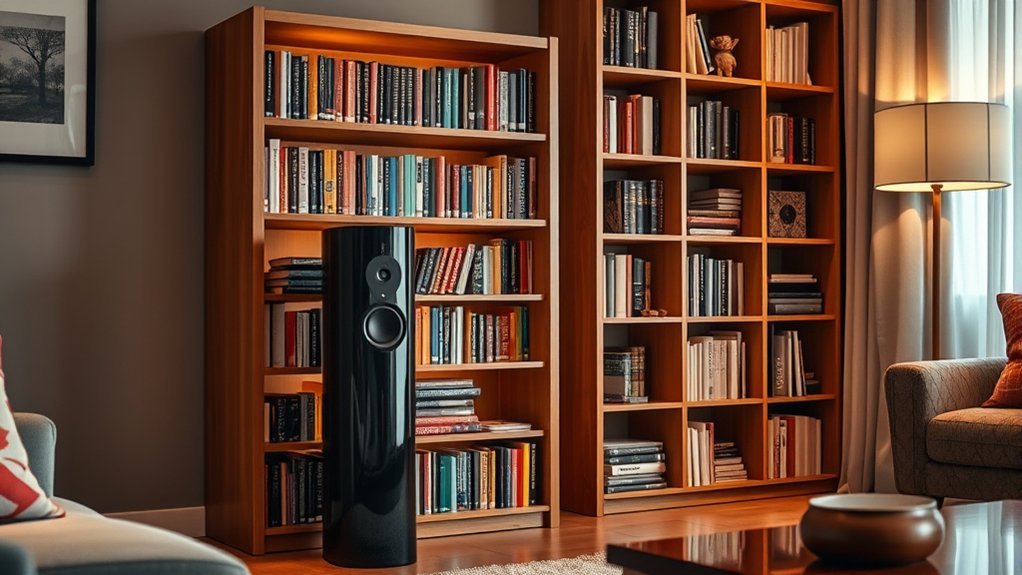
Bookshelf speakers are ideal for limited spaces because their compact, space-saving design allows them to fit easily into small rooms without sacrificing performance. Their flexible placement options enable us to optimize sound quality while maintaining a clutter-free environment. Additionally, these speakers often deliver clear, detailed sound that enhances the listening experience even in confined areas.
Space-Saving Design
The compact footprint of bookshelf speakers presents a significant advantage for small rooms where space is at a premium. Their space-saving design enables users to position them conveniently without sacrificing valuable floor space, making them ideal for cluttered or limited environments. Aesthetic appeal is another key factor; their smaller size allows for versatile placement options that blend seamlessly with various interior styles, enhancing room decor rather than detracting from it. Additionally, cost considerations favor bookshelf speakers, as they often come at a lower price point than tower models, making quality sound more accessible within limited budgets. Their size and design facilitate easy integration into existing setups, offering a practical solution that balances performance with the spatial constraints typical of small rooms.
Easy Placement Flexibility
Because space is often a limiting factor in small rooms, the flexible placement options of bookshelf speakers stand out as a major advantage. Their compact size allows for versatile positioning—on shelves, desks, or stands—adapting easily to room constraints. This flexibility enhances aesthetic appeal, as they can be integrated seamlessly into various decor styles without overwhelming the space. Additionally, their portability simplifies adjustments, enabling users to optimize sound dispersion effortlessly. Cost considerations also favor bookshelf speakers, as their smaller footprint typically correlates with lower prices and fewer installation requirements. Overall, their adaptable placement not only maximizes limited space but also maintains visual harmony, making them a practical choice for those seeking effective audio without sacrificing room aesthetics.
Clear Sound Clarity
In small rooms, achieving clear and accurate sound becomes essential, and bookshelf speakers excel in delivering this quality. Their design allows for precise speaker placement, which directly impacts sound clarity by minimizing reflections and standing waves. Proper positioning ensures that sound waves reach your ears directly, enhancing detail and tonal balance. Additionally, bookshelf speakers benefit from easier acoustic treatment integration, allowing us to fine-tune the room’s acoustics without overwhelming the space. Their smaller size enables strategic placement near walls or corners, maximizing sound dispersion. This flexibility results in a more focused stereo image and clearer dialogue or instrument separation. Overall, the combination of ideal speaker placement and room acoustic considerations makes bookshelf speakers particularly effective in small rooms, delivering sharp, precise sound that’s hard to achieve with larger tower models.
Why Choose Tower Speakers Despite Their Size in Small Rooms?
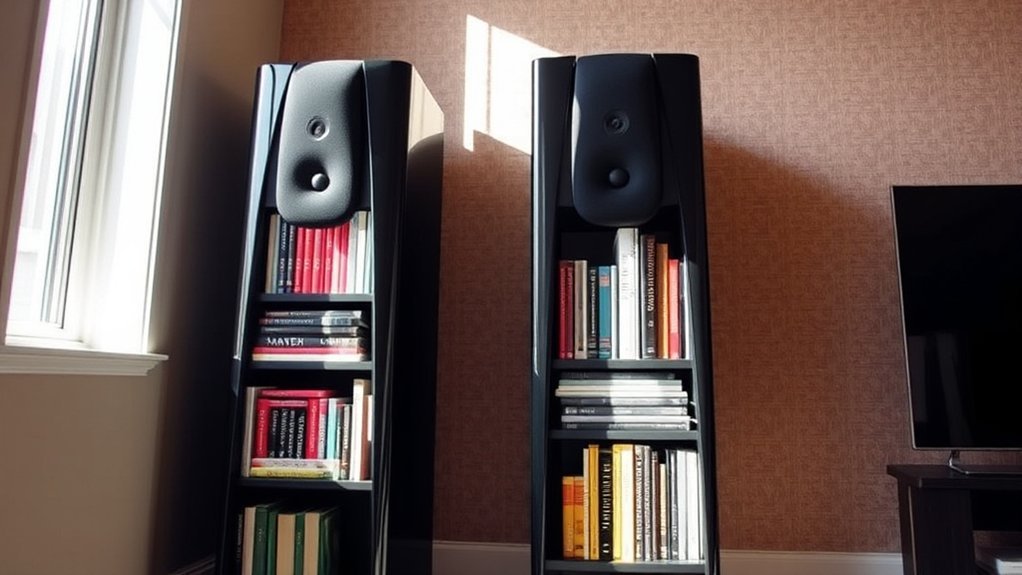
While it may seem counterintuitive to opt for tower speakers in a small room, their design and performance capabilities often justify the choice. Tower speakers generally offer greater speaker durability due to their robust construction, ensuring longevity even with frequent use. Their aesthetic appeal is also a significant advantage; their commanding presence can enhance the room’s decor, making them an attractive focal point. Additionally, tower speakers tend to deliver richer, fuller sound across a broader frequency spectrum, which compensates for their size disadvantages. Despite their larger footprint, these speakers maximize sound output and clarity, making them suitable for small rooms where high performance is desired. Ultimately, their durability and visual impact can outweigh concerns about space, providing both functional and aesthetic benefits.
How to Assess Your Room Size and Layout for Speaker Placement?
To optimize speaker placement, we first need to measure your room dimensions with precision, noting any irregularities that could affect sound. Next, identifying the primary listening area helps determine the best positioning for balanced audio, considering proximity and angles. Finally, understanding room acoustics—like furniture placement and wall materials—enables us to anticipate reflections and absorption that influence sound quality.
Measure Room Dimensions Precisely
Accurately measuring your room dimensions is a critical first step in optimizing speaker placement, as it provides the foundational data necessary to make informed decisions about speaker type and positioning. Precise measurements help identify spatial constraints and potential acoustic challenges, guiding choices for aesthetic integration and speaker maintenance. To do this effectively:
- Measure length, width, and height at multiple points to account for irregularities.
- Note the positions of windows, doors, and architectural features that could influence sound.
- Use a laser distance meter for accuracy rather than relying solely on a tape measure.
- Record these dimensions systematically, creating a detailed room map for reference.
This process guarantees your speakers fit well within the space, minimizing sound distortion and enhancing overall audio quality.
Identify Listening Area Focus
Understanding the specific location where you’ll primarily listen is essential for ideal speaker placement, as it directly influences how sound interacts with your room’s acoustics. To assess your listening area, consider its size, shape, and furniture layout—these factors shape sound focus and clarity. Visualize your space with this table:
| Dimensions | Shape | Furniture Placement |
|---|---|---|
| Small, tight | Rectangular | Central seating, corners |
| Narrow | Irregular | Walls, corners, open areas |
| Wide | Symmetrical | Multiple seating zones |
Consider Room Acoustics Factors
Evaluating your room’s acoustics begins with a clear understanding of its size and layout, as these elements considerably influence how sound travels and interacts within the space. Small rooms tend to amplify room echo, which can muddy clarity, especially with larger speakers. To optimize placement, consider how furniture placement affects sound absorption and diffusion; bulky furniture can reduce echo but might also block sound paths.
Key points include:
- Measuring the distance between walls and the ceiling for sound reflection insights
- Identifying open areas versus cluttered zones affecting sound dispersion
- Adjusting speaker position relative to walls to minimize unwanted echo
- Using soft furnishings to absorb excess reverberation and improve clarity
A thoughtful assessment of these factors ensures better speaker placement tailored to your room’s unique acoustics.
Which Factors Should You Consider When Deciding Between Bookshelf and Tower Speakers?
When deciding between bookshelf and tower speakers for a small room, we need to carefully consider several key factors that influence both sound quality and practicality. Design aesthetics play a significant role, as the visual footprint and style of the speakers should complement the room’s decor without overwhelming it. Tower speakers often provide a commanding presence, but may clash with a minimalist aesthetic, whereas bookshelves tend to blend seamlessly into compact spaces. Budget considerations are equally important; towers generally cost more due to additional drivers and larger enclosures, while bookshelves are typically more affordable and easier to upgrade over time. Evaluating these factors helps guarantee that we select speakers that best suit both our acoustic needs and room environment, maximizing both function and visual harmony.
How Can You Maximize Sound Quality With Your Chosen Speakers in a Small Room?
To get the most out of your chosen speakers in a small room, refining placement and setup is essential. Proper speaker placement ensures balanced sound and minimizes reflections that can muddy clarity. Position speakers at ear level, equidistant from walls, and avoid placing them directly against surfaces that cause sound reflections. Incorporating acoustic treatment—like bass traps, diffusers, or soft furnishings—reduces echo and diffuses sound waves, enhancing clarity. Focus on these key aspects:
- Adjust speaker positioning to prevent sound shadows
- Use acoustic panels to absorb unwanted reflections
- Keep a safe distance from walls to reduce bass boom
- Experiment with slight angles for ideal stereo imaging
These steps help create a controlled listening environment, maximizing sound quality regardless of room size.
Frequently Asked Questions
Do Bookshelf or Tower Speakers Consume More Power in Small Rooms?
In small rooms, tower speakers typically consume more power due to their larger size and greater speaker efficiency, which requires more energy to produce higher volumes, whereas bookshelf speakers are more energy-efficient and consume less power overall.
Can Tower Speakers Fit Into Tight or Awkward Small Room Corners?
Tower speakers can fit into tight or awkward small room corners with careful placement, aiding space maximization. However, they often require more precise corner positioning to avoid sound distortion, making detailed analysis essential for ideal acoustic performance.
Are Wireless Options Available for Both Bookshelf and Tower Speakers?
Yes, wireless options with streaming capabilities are available for both bookshelf and tower speakers. We analyze their wireless connectivity features, noting how seamless integration and high-quality streaming enhance user experience, making them versatile choices for small room setups.
How Do Aesthetic Designs Influence Speaker Choice in Small Rooms?
Aesthetic designs greatly influence our speaker choices in small rooms, as visual appeal and seamless design integration enhance room harmony. We prioritize sleek, unobtrusive aesthetics that complement decor, ensuring both sound quality and visual cohesion.
What Maintenance or Setup Differences Exist Between Bookshelf and Tower Speakers?
We find that bookshelf speakers require careful speaker placement to optimize room acoustics, often needing minimal setup, while tower speakers demand more attention to positioning and calibration to manage their larger size and sound dispersion effectively.
Conclusion
Ultimately, choosing between bookshelf and tower speakers in a small room isn’t just a decision—it’s a quest for audio perfection that can transform your space into a sonic sanctuary. With the right choice, you’ll experience sound so immersive and precise, it’s like having a concert hall in your pocket. By carefully weighing your room’s size, layout, and aesthetic, you’ll discover a level of audio clarity that could make even the most discerning audiophile speechless—so gear up for that next-level listening experience!