Few realize that the fundamental difference between studio monitors and bookshelf speakers lies in their design focus—one prioritizes accuracy, the other aesthetic appeal. While studio monitors aim for precise, flat frequency responses suitable for professional audio production, bookshelf speakers balance sound quality with visual integration into living spaces. Understanding this distinction is essential, yet many overlook how these technical differences influence performance and placement. Let’s explore what sets them apart and how to choose the right option for your needs.
Key Takeaways
- Studio monitors prioritize flat frequency response and minimal distortion for accurate audio reproduction, ideal for production environments.
- Bookshelf speakers focus on aesthetic design and moderate performance, suitable for casual listening and home decor.
- Studio monitors are built for durability, high power handling, and precise sound analysis, while bookshelf speakers have varied finishes and aesthetic appeal.
- The placement and room acoustics significantly impact studio monitors’ accuracy, whereas bookshelf speakers are more adaptable to home spaces.
- Choose studio monitors for professional audio work, and bookshelf speakers for versatile, aesthetic home listening.
How Do Studio Monitors and Bookshelf Speakers Differ in Design and Purpose?
While both studio monitors and bookshelf speakers serve the purpose of audio reproduction, their designs reflect distinct functional priorities. Studio monitors emphasize a neutral aesthetic design, minimizing visual distraction to focus on accurate sound reproduction. They are constructed with robust components capable of high power handling, ensuring consistent performance at elevated volumes without distortion. Conversely, bookshelf speakers often feature aesthetic designs aimed at complementing home decor, with varied finishes and stylistic elements. Their power handling capacity is generally lower, optimized for typical room environments rather than professional mixing. This distinction in design philosophy impacts their durability, usability, and application scope. Ultimately, studio monitors prioritize precision and durability, while bookshelf speakers balance visual appeal with moderate performance capacity.
Which Sound Qualities Make Studio Monitors Ideal for Production?
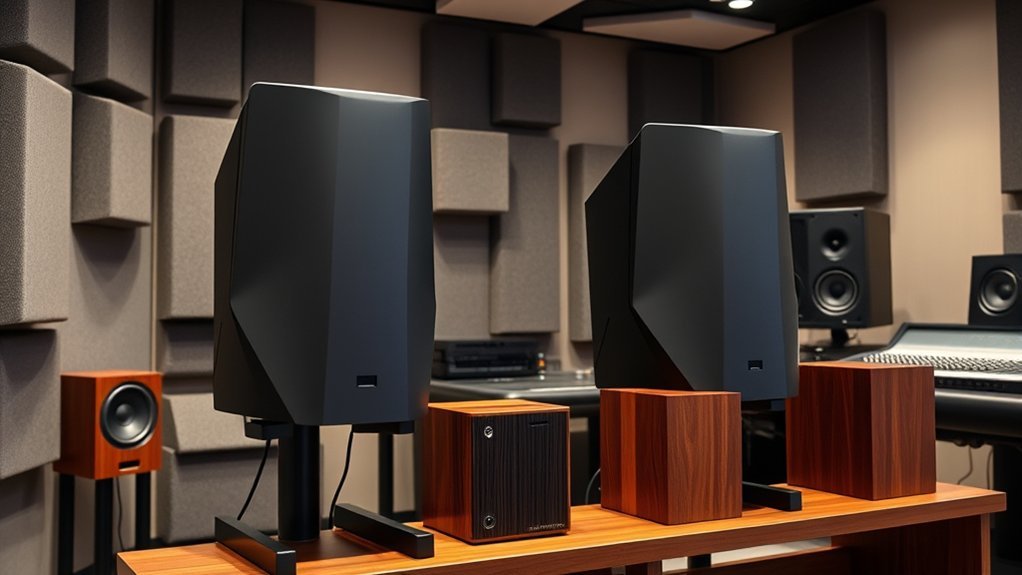
Studio monitors are engineered with specific sound qualities that make them indispensable for production work. They deliver a flat frequency response, ensuring accurate and uncolored audio reproduction essential for mixing and mastering. Critical to their performance are considerations like room acoustics and speaker placement, which influence how sound waves interact within a space.
Key qualities include:
- Minimal harmonic distortion to preserve audio integrity
- Wide, consistent frequency response for detailed sound analysis
- High transient response for precise detection of audio nuances
These qualities enable producers to hear true sound representations, unaffected by coloration or exaggeration. Proper speaker placement and optimized room acoustics are crucial to maximizing these qualities, ensuring that the monitors provide reliable, transparent feedback during critical listening sessions.
What Benefits Do Bookshelf Speakers Offer for Casual Listening?
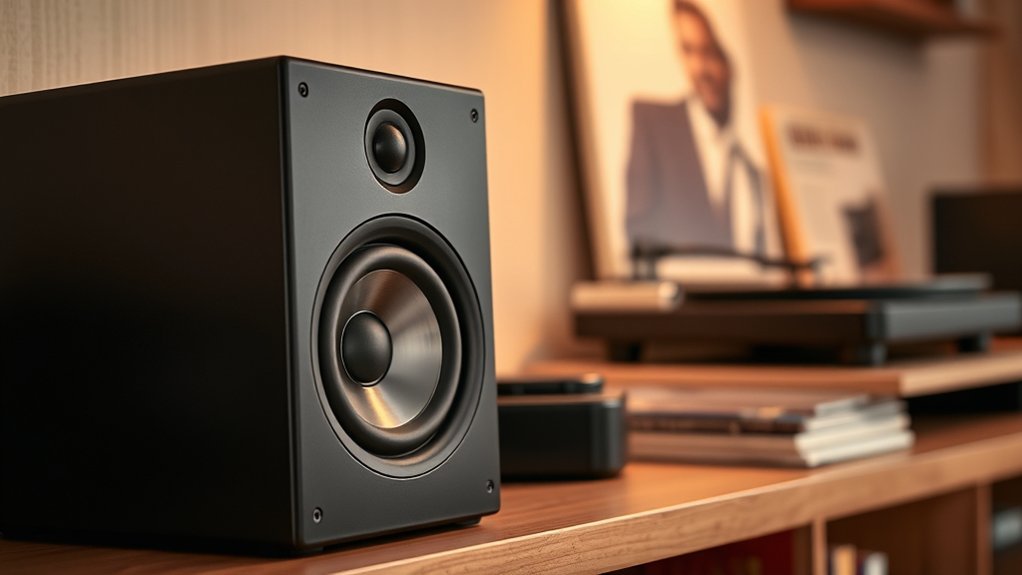
Bookshelf speakers offer several advantages for casual listening due to their balanced design and versatile performance. Their aesthetic appeal enhances any environment, blending seamlessly with various interior styles while providing high-quality sound. Space efficiency is a key benefit; these speakers fit comfortably on shelves, desks, or stands, making them ideal for smaller rooms or multi-purpose spaces. Their compact size allows for flexible placement, optimizing acoustic performance without sacrificing room aesthetics. The design naturally encourages closer listening proximity, resulting in an intimate audio experience suitable for relaxed, everyday use. Additionally, bookshelf speakers typically deliver a broad frequency response, ensuring clarity across different genres and media types. This combination of aesthetic appeal, space efficiency, and sound versatility makes them well-suited for casual listening environments.
How to Decide Between Studio Monitors and Bookshelf Speakers for Your Setup?
Choosing between studio monitors and bookshelf speakers hinges on understanding their distinct design philosophies and how those differences align with your specific audio needs. Studio monitors are engineered for accuracy, emphasizing flat frequency response and minimal coloration, which makes acoustic treatments critical for peak performance. Bookshelf speakers tend to prioritize sound warmth and aesthetic appeal, often with higher power handling capacities suitable for casual listening environments.
To decide effectively, consider:
- The importance of precise audio reproduction versus musical enhancement
- Your room’s acoustic treatments and how they influence sound clarity
- Power handling capacity, especially if you need higher volume levels without distortion
Evaluating these factors ensures your choice matches your environment and listening goals, resulting in a balanced, accurate setup.
Key Factors to Consider When Choosing Between Studio Monitors and Bookshelf Speakers
When selecting between studio monitors and bookshelf speakers, it’s crucial to evaluate a combination of technical specifications and acoustic performance factors that align with your specific audio objectives. Room acoustics play a critical role, influencing how sound waves interact within your space and affecting clarity, frequency response, and imaging. Proper speaker placement is equally important; positioning affects sound dispersion and minimizes reflections that can distort audio perception. Consider the size and shape of your room, as well as the proximity to walls and corners, which can cause bass buildup or absorption. Additionally, assess the monitors’ or speakers’ frequency response, power handling, and dispersion characteristics to ensure they complement your environment and listening goals. This detailed analysis helps optimize sound accuracy and overall performance.
Frequently Asked Questions
Are Studio Monitors Better for Mixing Than Bookshelf Speakers?
We believe studio monitors are better for mixing because they provide superior audio clarity and sound accuracy, making it easier to detect nuances and guarantee consistent, professional-quality mixes, unlike bookshelf speakers which often color the sound.
Do Bookshelf Speakers Require More Space Than Studio Monitors?
Bookshelf speakers generally require more space than studio monitors, as their aesthetic design often emphasizes larger cabinets for richer sound. Proper speaker placement is vital; insufficient space can impair sound quality and aesthetic integration in your setup.
Can Bookshelf Speakers Be Used for Professional Audio Production?
We believe bookshelf speakers can be used for professional audio production, but their sound accuracy often falls short compared to studio monitors. While they offer aesthetic appeal, for critical mixing, studio monitors guarantee precise, reliable sound reproduction essential for professional work.
How Does Room Acoustics Affect the Performance of Each Speaker Type?
Like a mirror reflecting clarity, room acoustics critically influence speaker performance; improper acoustic treatment amplifies room reflections, muddying sound quality, whether using studio monitors or bookshelf speakers, ultimately impairing accurate audio reproduction and mixing precision.
Which Speaker Type Is More Suitable for Home Theater Setups?
We believe bookshelf speakers suit home theater setups best, offering superior sound quality and appealing design aesthetics, which enhance immersive experiences. Their compact design allows flexible placement, optimizing acoustics and maximizing audiovisual synergy in diverse room environments.
Conclusion
Ultimately, choosing between studio monitors and bookshelf speakers hinges on evaluating our priorities: accuracy versus aesthetics, precision versus comfort. We must evaluate our environment, our sound quality needs, and our listening goals to make an informed decision. By analyzing design, purpose, and performance, we guarantee that our audio setup aligns with our technical requirements and personal preferences. In doing so, we optimize our listening experience—whether for professional production or casual enjoyment.