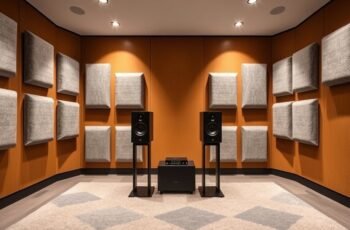
Studies show that over 60% of audiophiles prioritize sound quality and space efficiency when selecting speakers. This decision often hinges on technical considerations like room size, acoustic performance, and installation complexity. As we examine the differences between bookshelf and floorstanding models, we find that each offers distinct advantages and potential limitations. To determine which suits your environment and listening preferences best, it’s essential to analyze their design, performance, and integration into your space.
Key Takeaways
- Room size and space constraints determine whether compact bookshelf speakers or larger floorstanding models are more suitable.
- Sound preferences, such as bass depth and soundstage width, influence the choice between detailed bookshelf and full-range floorstanding speakers.
- Aesthetic and decor compatibility can sway selection, with bookshelf speakers offering minimalist designs and floorstanders making a visual statement.
- Portability and ease of setup favor bookshelf speakers for flexible placement and temporary use.
- Budget considerations and room acoustics impact performance potential and ease of calibration for each speaker type.
How Do Bookshelf and Floorstanding Speakers Differ in Design and Size?
While both bookshelf and floorstanding speakers serve to deliver high-quality sound, their design and size differences are fundamental to their performance and placement. A design comparison reveals that bookshelf speakers are compact, typically enclosed in smaller cabinets, making them ideal for limited spaces. Their size considerations focus on balance—miniaturization without sacrificing audio clarity. Floorstanding speakers, however, feature taller, larger enclosures that house multiple drivers, allowing for enhanced bass response and wider sound dispersion. This size difference directly impacts sound projection, with floorstanding units providing greater volume and depth. The structural design of each type influences their acoustic properties and integration into various environments, emphasizing the importance of matching size and design to specific listening needs and spatial constraints.
Which Rooms Are Best Suited for Bookshelf vs Floorstanding Speakers?
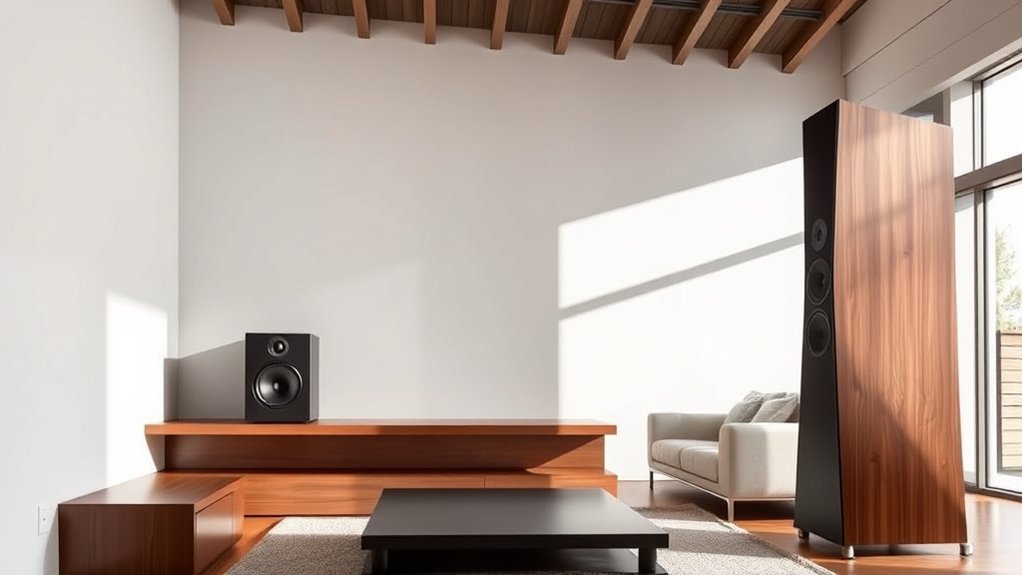
Choosing the appropriate speakers for a room depends heavily on its size, acoustics, and intended use. Bookshelf speakers excel in smaller, acoustically controlled environments where tight furniture placement minimizes sound reflection issues. Floorstanding speakers suit larger spaces with open layouts, where their broader sound dispersion can fill the room effectively. Room acoustics considerably influence clarity; reflective surfaces may benefit from bookshelf speakers placed closer to walls, while floorstanding models require strategic positioning to avoid sound muddiness. Proper furniture placement is essential to optimize soundstage and minimize acoustic interference.
| Room Size | Acoustics | Recommended Speakers | Furniture Placement |
|---|---|---|---|
| Small | Reflective | Bookshelf | Near walls, away from corners |
| Large | Diffuse | Floorstanding | Centered, away from reflective surfaces |
| Medium | Balanced | Either (depends on use) | Flexible, based on layout |
| Open | Reverberant | Floorstanding | Spaced for even dispersion |
How Do Sound Quality and Performance Compare Between the Two Types?
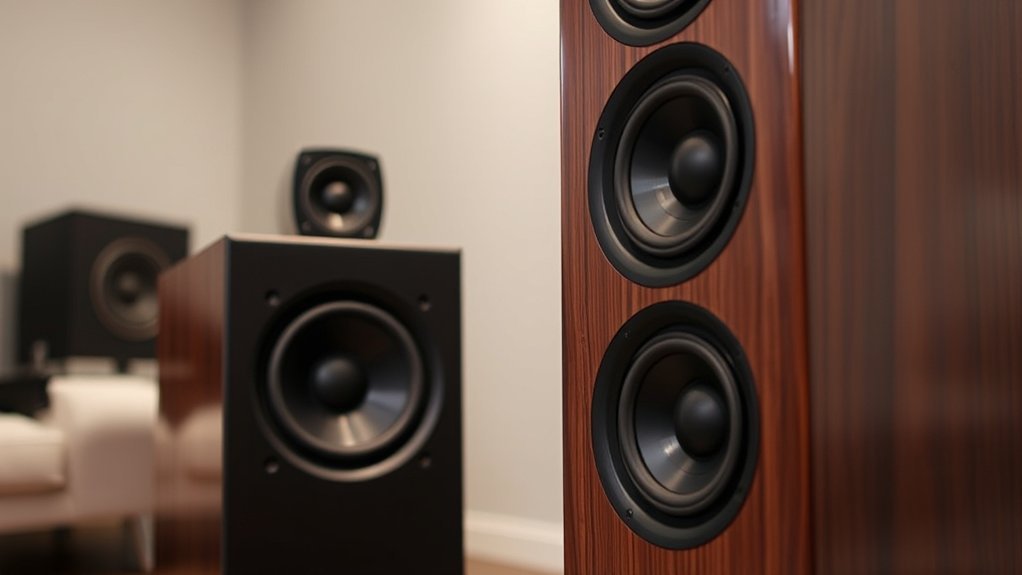
Sound quality and performance characteristics differ remarkably between bookshelf and floorstanding speakers, influencing their suitability for various listening environments. Bookshelf speakers typically offer excellent sound clarity within their compact size, excelling in detail and vocal reproduction, but they often lack robust bass response due to limited driver size and cabinet volume. Conversely, floorstanding speakers generally provide superior bass response, thanks to larger drivers and cabinet dimensions, delivering fuller, richer low frequencies. However, they can sometimes compromise sound clarity if not properly designed or positioned, resulting in muddiness at higher volumes. The choice hinges on balancing these factors: bookshelf speakers excel in clarity and precise imaging in smaller spaces, while floorstanding models emphasize deep bass and broader soundstage, suitable for larger rooms.
What Should Your Budget Influence When Choosing Speakers?
Budget constraints profoundly shape the range and quality of speakers available to consumers, directly influencing the selection process. Lower budgets often limit options to entry-level models, affecting speaker placement flexibility and the precision of audio calibration. For example, budget-friendly speakers might require more careful positioning to optimize sound, while high-end models typically allow for more adaptive placement. When selecting within a limited budget, it’s essential to weigh how speaker design impacts calibration procedures and room acoustics. A detailed comparison table illustrates this:
| Budget Level | Placement Flexibility | Calibration Ease | Sound Quality Potential |
|---|---|---|---|
| Low | Limited | Challenging | Basic |
| Mid | Moderate | Manageable | Improved |
| High | Extensive | Simplified | Superior |
Which Speakers Are Easier to Set Up and Maintain?
When comparing ease of setup, bookshelf speakers generally require less effort due to their smaller size and straightforward positioning, whereas floorstanding speakers often demand more precise placement for ideal sound. Maintenance considerations also differ, with bookshelf models typically needing less frequent cleaning and fewer adjustments. Analyzing these factors helps us determine which type aligns best with user convenience and system longevity.
Ease of Placement
Floorstanding speakers typically require more extensive placement considerations due to their size and weight, making them less straightforward to set up and reposition. Proper speaker positioning is essential for superior sound quality, and their larger footprint demands careful attention to room acoustics. Achieving ideal placement involves balancing proximity to walls and corners to enhance bass response while avoiding reflections that can muddy clarity. In contrast, bookshelf speakers are more flexible, easily moved to adjust for optimal acoustics and aesthetic preferences. Their smaller size simplifies repositioning, enabling quick iterative adjustments. Overall, bookshelf speakers generally offer a more accessible and adaptable placement process, while floorstanding models necessitate a more deliberate approach to speaker positioning and room acoustics to maximize performance.
Maintenance Requirements
Bookshelf speakers generally require less ongoing maintenance and are easier to set up compared to floorstanding models. Their compact design reduces exposure to dust and physical damage, enhancing speaker durability. Additionally, their aesthetic appeal often means they blend seamlessly into various environments, minimizing the need for frequent repositioning or aesthetic adjustments. Floorstanding speakers, with larger enclosures, demand more rigorous upkeep to maintain prime performance and appearance.
| Aspect | Shelf Life & Maintenance |
|---|---|
| Durability | Less vulnerable to damage, longer lifespan |
| Aesthetic Appeal | Less intrusive, easier to match decor |
| Setup | Quicker, less complex |
| Upkeep | Minimal cleaning, fewer adjustments |
How Do Your Listening Preferences Impact the Best Choice?
Your listening preferences considerably influence the ideal speaker choice, as different audio qualities cater to varied acoustic priorities. For example, if you prioritize detailed, immersive sound, a floorstanding speaker’s broader frequency response may be preferable, especially in larger listening environments. Conversely, if your focus is on clarity and less intrusive aesthetics, bookshelf speakers offer a compact solution that can adapt well to smaller spaces. The listening environment also plays a vital role; open or acoustically reflective spaces may benefit from speakers with controlled dispersion, while enclosed areas might require different sound profiles. Additionally, speaker aesthetics can influence your selection, as visual integration within your space affects long-term satisfaction. Ultimately, aligning your preferences with the acoustic characteristics of the speakers ensures a more satisfying and personalized listening experience.
What Are the Pros and Cons of Bookshelf Speakers?
Bookshelf speakers offer a space-saving design that suits smaller rooms and setups, but this often limits their sound quality compared to larger floorstanding models. Their portability makes them ideal for flexible placement and easy transport, yet they may struggle to produce deep bass or high volume levels. Evaluating these trade-offs helps determine if their benefits align with your acoustic and spatial requirements.
Space-Saving Design
A key advantage of bookshelf speakers lies in their compact, space-efficient design, making them ideal for rooms with limited space or multiple audio setups. Their small footprint allows for flexible placement, reducing clutter and maximizing functional room area. Additionally, their aesthetic appeal can be enhanced with decorative accents, allowing them to blend seamlessly into various interior styles. This design approach enables users to maintain a clean, minimalist look without sacrificing audio quality. The ability to position these speakers on shelves or stands offers versatility, but it also makes them vulnerable to placement issues impacting sound dispersion. Overall, their space-saving nature is a significant benefit, particularly for those prioritizing efficient use of space while maintaining a stylish environment.
| Aspect | Benefit | Limitation |
|---|---|---|
| Size & Placement | Fits small spaces; flexible positioning | May require careful placement for optimal sound |
| Aesthetic Appeal | Enhances decor with decorative accents | Limited size restricts visual impact |
| Clutter Reduction | Minimizes room clutter | Less prominent presence in room design |
| Functional Versatility | Suitable for multiple setups | Placement constraints can affect sound quality |
Sound Quality Limits
While their compact size offers flexibility, bookshelf speakers often face limitations in sound quality compared to larger, floorstanding counterparts. Their smaller enclosures inherently restrict low-frequency extension, impacting overall sound clarity and depth. This results in a narrower soundstage and less immersive listening experience, especially at higher volumes. Volume limitations are also a concern; as volume increases, these speakers tend to exhibit distortion due to limited driver excursion and less robust amplification capabilities. While advanced driver design and cabinet engineering can mitigate some issues, the fundamental physical constraints remain. Consequently, bookshelf speakers excel in delivering detailed, accurate sound at moderate levels but may struggle to provide the full-range, high-volume performance that larger speakers can sustain without compromising sound quality.
Portability Advantages
Because of their smaller size, bookshelf speakers offer significant portability advantages that can enhance flexibility in various listening environments. Their compact design facilitates easy transportation, making them ideal for mobile audio setups and temporary installations. This portable convenience allows users to quickly relocate speakers without requiring extensive equipment adjustments, supporting diverse environments such as bedrooms, offices, or outdoor gatherings. Additionally, their lightweight nature reduces strain during transport, enabling more spontaneous or on-the-go listening experiences. However, this portability can come with trade-offs, such as less robust build quality or limited bass response compared to larger models. Overall, bookshelf speakers provide a practical solution for those prioritizing mobility and adaptable audio systems, but they may sacrifice some sound depth and power that larger speakers typically deliver.
What Are the Advantages and Disadvantages of Floorstanding Speakers?
Floorstanding speakers offer significant advantages in delivering deep bass response and higher overall volume levels, making them ideal for immersive listening experiences. Their larger cabinet size allows for more substantial drivers, contributing to superior low-frequency performance. However, this size can impact speaker durability, as taller structures may be more susceptible to physical damage if not properly protected. Aesthetically, floorstanding models often provide a sleek, commanding presence that enhances a room’s decor, but their size may not suit every space. Additionally, their weight and bulk can pose installation challenges. While they excel in sound output, their size and construction require careful placement to optimize performance and maintain structural integrity. Overall, their advantages are balanced by considerations of durability and aesthetic integration.
How Can You Decide Which Speaker Type Fits Your Space and Needs?
Choosing the right speaker type depends heavily on evaluating your space’s size, layout, and acoustic requirements. For smaller rooms, bookshelf speakers often provide a balanced sound without overwhelming the space, while larger rooms may benefit from floorstanding speakers that deliver higher volume and deeper bass. Consider decorating aesthetics; compact bookshelf speakers can blend seamlessly with various interior styles, whereas floorstanding models command visual presence. Speaker materials also influence your decision—rigid, dense materials like MDF or composite enhance sound clarity, while aesthetic finishes impact decor harmony. Evaluating your equipment placement, listening position, and acoustic environment helps determine which type offers ideal sound dispersion and integration. Ultimately, matching speaker size, materials, and aesthetics to your space’s characteristics ensures a functional and visually pleasing setup.
Frequently Asked Questions
Can Bookshelf Speakers Handle High-Volume Listening Without Distortion?
Bookshelf speakers can handle high-volume listening, but their volume capacity is limited, increasing distortion risk at higher levels. We recommend considering their power ratings and room acoustics to guarantee peak performance without sacrificing audio clarity.
Are Floorstanding Speakers Suitable for Small Rooms?
Floorstanding speakers can be suitable for small rooms if we optimize room size and speaker placement carefully, ensuring sound absorption and minimizing bass issues. Proper positioning enhances clarity, but space constraints might limit full potential in tight environments.
How Do Wiring and Connectivity Options Differ Between the Two?
We find that bookshelf speakers often feature simpler wiring configurations and may support wireless connectivity, while floorstanding speakers typically require more complex wiring setups, offering fewer wireless options but potentially stronger, more stable connections for high-power audio applications.
Do Certain Genres of Music Benefit More From One Speaker Type?
Music genres with intricate details, like classical or jazz, benefit more from bookshelf speakers due to their precise genre-specific sound and musical clarity, ensuring each nuance is crystal clear, whereas larger speakers may overwhelm delicate compositions.
What Is the Typical Lifespan of Bookshelf Versus Floorstanding Speakers?
We find that bookshelf speakers typically last 5-10 years, while floorstanding speakers can reach 10-15 years, thanks to their higher durability and lower maintenance needs, making them more suitable for long-term, intensive use.
Conclusion
Ultimately, choosing between bookshelf and floorstanding speakers hinges on your space, budget, and listening preferences. Did you know that nearly 60% of audiophiles prioritize sound quality over size? By analyzing your room dimensions, acoustic needs, and financial constraints, you can make an informed decision. Both options have unique advantages; understanding these nuances guarantees you select a system that delivers peak performance tailored to your environment and auditory expectations.