Consider a case where two speakers with identical drivers produce vastly different sound clarity; this often boils down to design choices. Each element, from material selection to internal layout, influences the speaker’s performance and the listener’s experience. Understanding these technical nuances reveals how subtle adjustments can markedly enhance sound quality, but the full impact of design factors remains complex. Exploring these details can uncover what truly makes a speaker perform at its best.
Key Takeaways
- Material choice and enclosure design influence resonance, vibrations, and overall tone clarity in speakers.
- Internal components like drivers and crossovers determine sound accuracy and frequency response.
- Proper porting, venting, and damping optimize bass response and reduce internal resonances.
- Shape and size of the enclosure affect frequency balance and environmental sound interaction.
- Acoustic treatments inside the cabinet minimize reflections and vibrations, enhancing fidelity.
How Different Materials Affect Sound Clarity and Tone
Different materials used in speaker construction considerably influence sound clarity and tone by affecting the vibration properties of the driver components. Material resonance plays a critical role, as materials with high resonance can introduce unwanted vibrations, distorting sound quality. Conversely, low-resonance materials minimize these effects, ensuring cleaner audio output. Acoustic absorption within the cabinet also impacts clarity; materials that absorb excess vibrations reduce acoustic feedback and resonance artifacts. For example, dense woods or composites dampen vibrations effectively, enhancing tone fidelity. Understanding these material properties allows us to optimize speaker design, balancing resonance and absorption to achieve precise, clear sound reproduction. Careful selection of materials directly correlates with improved sound clarity and a more accurate tonal profile.
The Impact of Speaker Shape and Size on Sound Projection

The shape and size of a speaker fundamentally influence how sound waves are projected and perceived in a given space. Larger enclosures typically produce deeper bass responses due to increased internal volume, while smaller designs favor higher frequencies. The geometry affects directivity, shaping how sound disperses and interacts with the environment. Aesthetic appeal plays a critical role, as innovative shapes can enhance visual integration without compromising acoustic performance. However, complex geometries often increase manufacturing complexity, raising production costs and potentially affecting durability. Precise engineering ensures that these physical attributes optimize sound projection while aligning with aesthetic and practical considerations. Ultimately, the interplay between shape, size, and design complexity determines a speaker’s ability to deliver accurate and immersive audio experiences in various settings.
How Internal Components Influence Audio Performance
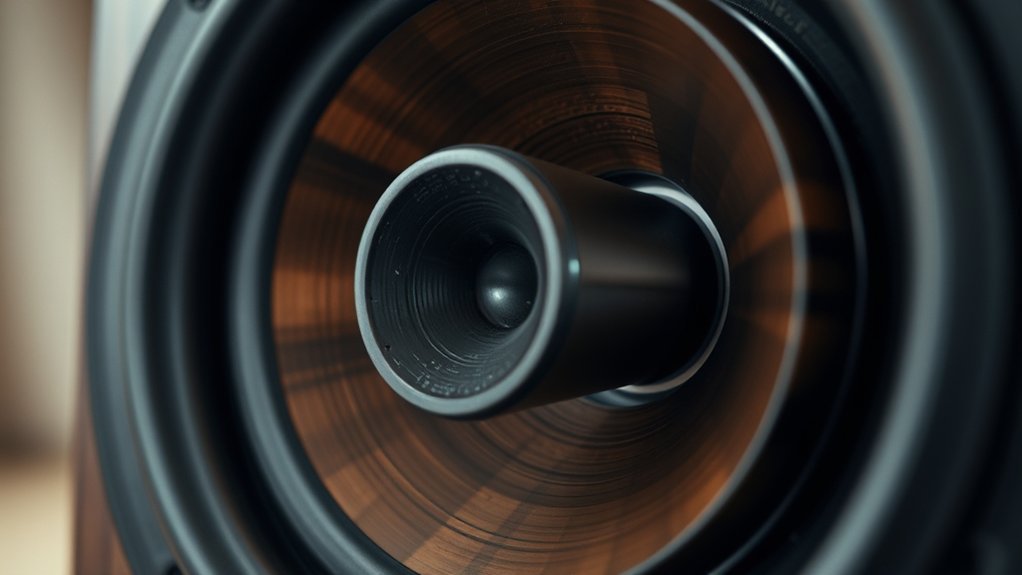
The quality of drivers directly affects the accuracy and clarity of sound reproduction, making their design and materials vital. Similarly, the crossover network’s configuration determines how frequencies are distributed to each driver, impacting overall coherence and tonal balance. Understanding how these internal components interact is essential for optimizing speaker performance.
Quality of Drivers
High-quality drivers are fundamental to achieving accurate and detailed sound reproduction in speakers. The durability of drivers ensures consistent performance over time, resisting wear and maintaining fidelity. Manufacturing precision is critical; tightly controlled tolerances in cone materials, voice coils, and magnet assemblies minimize distortions and optimize linearity. Precise assembly reduces unwanted resonances, enabling clearer audio output. Variations or imperfections in driver components can introduce coloration or reduce frequency response, negatively impacting overall sound quality. Consequently, selecting drivers manufactured with stringent quality standards guarantees reliability and performance longevity. Ultimately, the combination of durable materials and meticulous manufacturing processes results in drivers capable of delivering pristine, uncolored sound, forming the core of high-fidelity speaker systems.
Crossover Network Design
Internal components within a speaker, particularly the crossover network, directly influence how accurately and efficiently different frequency ranges are directed to their respective drivers. A well-designed crossover ensures minimal signal loss and phase coherence, which enhances overall sound clarity. Bi amplification techniques can optimize this process by separately powering high and low-frequency drivers, reducing distortion and improving dynamic response. Additionally, crossover components’ quality and configuration impact how smoothly the shift occurs between drivers. Proper speaker placement complements this design by reducing interference and optimizing the perceived frequency response. When both crossover network design and speaker placement are carefully considered, the result is improved sound fidelity, greater detail retrieval, and a more balanced audio experience across the entire frequency spectrum.
The Role of Enclosure Design in Sound Quality
The enclosure design considerably impacts sound quality through material selection, which affects resonance and damping properties. Its shape and size influence the internal air volume and boundary interactions, shaping the frequency response and transient response. Understanding these technical factors allows for optimized enclosure configurations tailored to specific audio performance goals.
Enclosure Material Effects
The choice of enclosure material considerably impacts a speaker’s sound quality by influencing resonance, durability, and acoustic transparency. Material durability ensures long-term stability, preventing deformation or vibrations that distort sound. For example, high-density materials like MDF or plywood resist warping and minimize unwanted resonance, maintaining sound clarity. Aesthetic appeal also plays a role, as visually appealing enclosures enhance user experience and integration into various environments. Materials such as real wood or composite composites offer both durability and a refined appearance, aligning with high-end design expectations. Conversely, lightweight plastics may reduce cost but can compromise durability and acoustic integrity. Ultimately, selecting the appropriate enclosure material involves balancing material resilience with visual appeal to optimize both sound performance and aesthetic integration.
Shape and Size Influence
Shape and size are critical factors that directly influence a speaker’s sound quality by affecting its resonance, frequency response, and overall clarity. The enclosure’s dimensions determine how sound waves interact within, shaping the bass response and minimizing unwanted resonances. Larger enclosures generally enhance low-frequency output, but may compromise portability considerations. Conversely, compact designs prioritize portability but often sacrifice deep bass extension and acoustic richness. The enclosure’s shape also impacts aesthetic appeal, which influences consumer preference and integration into different environments. Precise engineering of size and form ensures ideal internal volume and structural stability, resulting in clearer, more accurate sound reproduction. Balancing these factors is essential for designing speakers that meet both aesthetic and functional demands without degrading sound quality.
Why Driver Quality and Configuration Matter
Since driver quality directly influences sound reproduction accuracy, selecting high-grade components is essential for achieving peak audio fidelity. High-quality drivers offer improved durability, maintaining consistent performance over time without distortion or degradation. Manufacturing precision guarantees tight tolerances in cone alignment, magnet strength, and voice coil winding, which directly impacts linearity and clarity. Precise manufacturing minimizes unwanted resonance and non-linear behavior, resulting in cleaner, more accurate sound reproduction. Additionally, durable drivers withstand thermal and mechanical stresses, preventing performance drops during prolonged use. Properly configured drivers—considering size, shape, and material—further optimize frequency response and transient response. Overall, investing in superior driver quality and meticulous manufacturing processes guarantees a robust foundation for high-fidelity audio, assuring clarity, detail, and long-term reliability.
How Crossover Design Shapes Sound Balance
How does crossover design influence the overall sound balance in a speaker system? Crossover networks precisely direct frequency bands to appropriate drivers, shaping tonal balance and clarity. Proper crossover slopes and crossover points prevent frequency overlap or gaps, ensuring seamless integration between drivers. This impacts how sound disperses based on speaker placement and listener position, optimizing stereo imaging and frequency response.
| Crossover Parameter | Effect on Sound Balance | Practical Consideration |
|---|---|---|
| Crossover Frequency | Defines driver transition | Must match driver capabilities |
| Crossover Slope | Controls frequency blending | Steeper slopes reduce overlap |
| Component Quality | Affects signal integrity | Use high-quality capacitors and inductors |
| Speaker Placement | Influences perceived balance | Adjust to optimize crossover performance |
This precise design enhances clarity and maintains balanced sound across different listening environments.
The Effect of Damping and Insulation on Audio Precision
Effective crossover design plays a pivotal role in achieving balanced sound, but it must be complemented by proper damping and insulation within the speaker enclosure. Damping techniques, such as using constrained-layer damping materials or internal foam, reduce unwanted resonances and vibrations that can distort audio signals. Insulation methods, including mineral wool or fiberglass battings, absorb internal reflections and minimize acoustic interference. These measures enhance sound clarity by controlling internal acoustic environments, preventing energy from transferring into cabinet walls and causing coloration. Precise application of damping and insulation directly influences the speaker’s transient response, frequency accuracy, and overall fidelity. Together, they create a stable enclosure environment that preserves the integrity of the audio signal from driver to listener.
How Porting and Venting Enhance or Harm Sound Fidelity
Porting and venting are critical design elements that can profoundly influence a speaker’s sound fidelity. Proper port tuning ensures that the port resonates at a specific frequency, enhancing bass response without introducing distortion. Incorrect port tuning can cause port noise or “chuffing,” degrading sound clarity. Vent placement also plays a crucial role; ideal placement minimizes turbulence and unwanted resonances, maintaining clean audio output. Strategic vent positioning can reduce port interference with other speaker components, improving overall fidelity. Conversely, poorly positioned vents can create acoustic anomalies, muddying the sound. Precise engineering of port dimensions, tuning parameters, and vent placement is essential to strike a balance between bass extension and sound accuracy, ultimately guaranteeing the speaker delivers clear, balanced, and dynamic audio performance.
Frequently Asked Questions
How Does Speaker Placement Affect Overall Sound Quality?
We find that ideal speaker placement, considering room acoustics and listener positioning, minimizes reflections and standing waves. Precise positioning guarantees balanced sound dispersion, enhancing clarity, frequency response, and overall sound quality for an immersive listening experience.
What Is the Importance of Impedance in Speaker Design?
Impedance is vital in speaker design because it guarantees proper impedance matching, optimizing signal transfer and preventing loss or distortion. We focus on this to maintain clarity, efficiency, and harmony between amplifiers and speakers for superior sound delivery.
How Do Wireless Features Influence Sound Performance?
Wireless features like Bluetooth connectivity enable seamless audio transmission, while noise cancellation technology enhances sound clarity by reducing ambient interference, resulting in a more precise and immersive listening experience. These advancements greatly influence overall sound performance.
Can Aesthetic Design Compromise Audio Quality?
Aesthetic design can compromise audio quality when visual appeal and material selection prioritize appearance over acoustic performance, leading to suboptimal internal components or enclosure materials that negatively affect sound clarity, resonance, and overall fidelity.
How Does Amplifier Compatibility Impact Speaker Sound?
Amplifier compatibility shapes speaker sound like a tailor fits a suit, ensuring ideal acoustic tuning and power matching. Proper matching prevents distortion and maximizes clarity, making your audio experience seamless and precise, with every note perfectly in place.
Conclusion
Just like tuning a fine instrument, optimizing each component of speaker design guarantees clarity and fidelity. We’ve seen how small adjustments—like selecting the right materials or positioning ports—can dramatically improve sound quality. When all elements align, it’s akin to a symphony orchestra performing flawlessly, each part contributing to a precise, immersive experience. By understanding these technical nuances, we can craft speakers that deliver authentic, transparent audio—transforming mere sound into an art form.