The difference between an expertly calibrated crossover and a poorly set one can be indistinguishable from a complete audio failure. Precise crossover settings are critical for achieving ideal sound clarity, bass response, and system harmony, yet many overlook the intricacies involved. Understanding how to fine-tune these parameters can dramatically improve your listening experience, but it’s not as simple as setting a fixed frequency. Let’s explore the key factors that influence the best crossover configuration for your system.
Key Takeaways
- Set the crossover frequency to match your main speakers’ upper limit and subwoofer’s optimal range, typically between 80-120Hz.
- Use adjustable crossover controls to fine-tune the transition for seamless bass integration and minimal overlap.
- Consider room acoustics and speaker placement, adjusting crossover points to reduce bass muddiness or gaps.
- For music, opt for tighter filters; for movies, broader filters can enhance bass impact.
- Regularly test and adjust crossover settings with frequency sweeps and phase checks for optimal sound clarity.
How Do Crossovers Affect Your Audio Quality?
Crossovers play a essential role in shaping audio quality by directing specific frequency ranges to the appropriate speakers, thereby enhancing clarity and overall sound balance. Proper speaker placement guarantees that the crossover can optimize how frequencies are distributed, minimizing phase issues and distortions. Additionally, amplifier compatibility is key; the crossover must match the amplifier’s power output to prevent distortion or damage. When correctly configured, crossovers prevent low frequencies from overloading tweeters and high frequencies from overwhelming woofers, resulting in cleaner sound reproduction. Precise crossover settings improve the overall coherence of audio signals, making sure each component receives the appropriate frequency range. This synergy between speaker placement and amplifier compatibility ultimately produces a more accurate, balanced, and dynamic listening experience.
Choosing the Right Crossover Frequency for Your Main Speakers
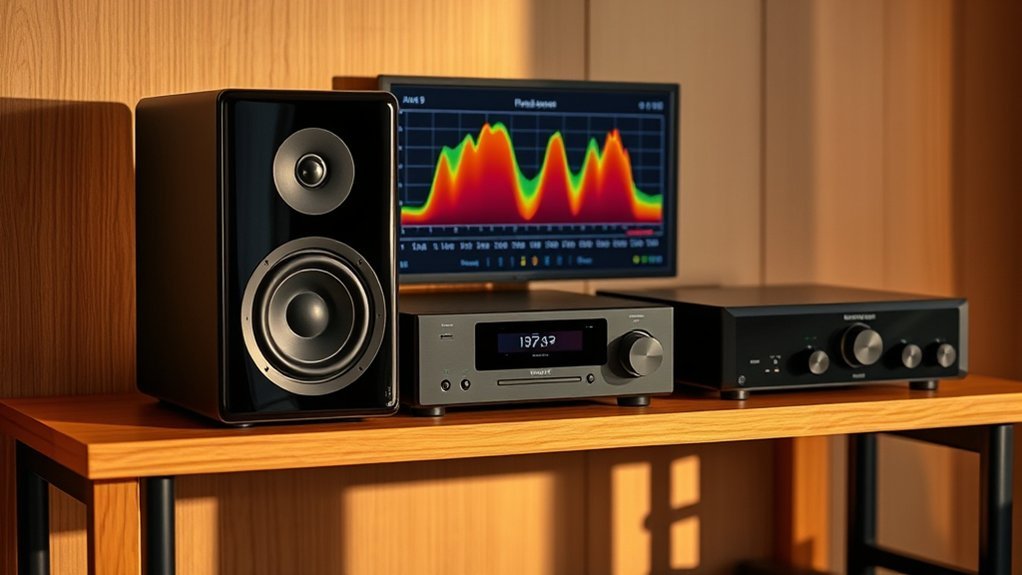
Selecting the correct crossover frequency depends on understanding your main speakers’ frequency range and ensuring compatibility with your subwoofer. We must consider the speaker’s design and the listening environment, as these factors influence ideal settings. Precise calibration enhances audio clarity and minimizes distortion, making this choice critical for sound accuracy.
Frequency Range Considerations
Choosing the appropriate crossover frequency for your main speakers is crucial to achieving ideal sound quality and system efficiency. Proper frequency range considerations ensure seamless integration with the subwoofer while preserving speaker integrity. When setting the crossover, consider:
- Speaker placement, which influences perceived frequency response and directivity, affecting how the crossover interacts with room acoustics.
- Power handling, ensuring the speakers can safely operate at the chosen frequency range without distortion or damage.
- The natural roll-off points of your main speakers, typically specified in manufacturer data.
- The intended listening environment, which impacts how frequencies propagate and are perceived.
Aligning the crossover frequency with these factors minimizes frequency overlap, reduces distortion, and optimizes overall system coherence, delivering a balanced and precise soundstage.
Speaker Compatibility Factors
The compatibility between your main speakers and the selected crossover frequency hinges on their specific design and capabilities. To optimize performance, consider their speaker durability and wiring compatibility. Main speakers with limited durability may struggle at higher crossover points, risking distortion or damage. Wiring compatibility ensures seamless signal transfer, preventing impedance mismatches that can degrade sound quality.
| Factor | Consideration | Impact |
|---|---|---|
| Speaker durability | Mechanical resilience | Prevents damage at higher frequencies |
| Wiring compatibility | Connector type and impedance match | Ensures clean signal transfer |
| Frequency responsiveness | Range of the main speakers | Determines suitable crossover point |
| Power handling capacity | Max wattage rating | Avoids distortion or overload |
| Driver configuration | Number and type of drivers | Influences crossover setting precision |
Listening Environment Impact
How does your listening environment influence the ideal crossover frequency for your main speakers? The room’s characteristics, speaker placement, and acoustic treatments notably affect sound integration. Reflective surfaces or untreated spaces can cause frequency distortions, requiring adjustments to crossover points. Proper speaker placement minimizes boundary effects and standing waves, enabling a more accurate crossover setting. Acoustic treatments, such as diffusers and absorbers, help control room resonances, allowing for clearer separation of frequencies. A less reflective environment may permit a higher crossover frequency, while a reflective one might necessitate lowering it to prevent distortion. Ultimately, understanding your room’s acoustic properties enables precise tuning for maximum integration between speakers and subwoofer, ensuring balanced sound reproduction.
Setting the Subwoofer Crossover: Balancing Bass and Clarity
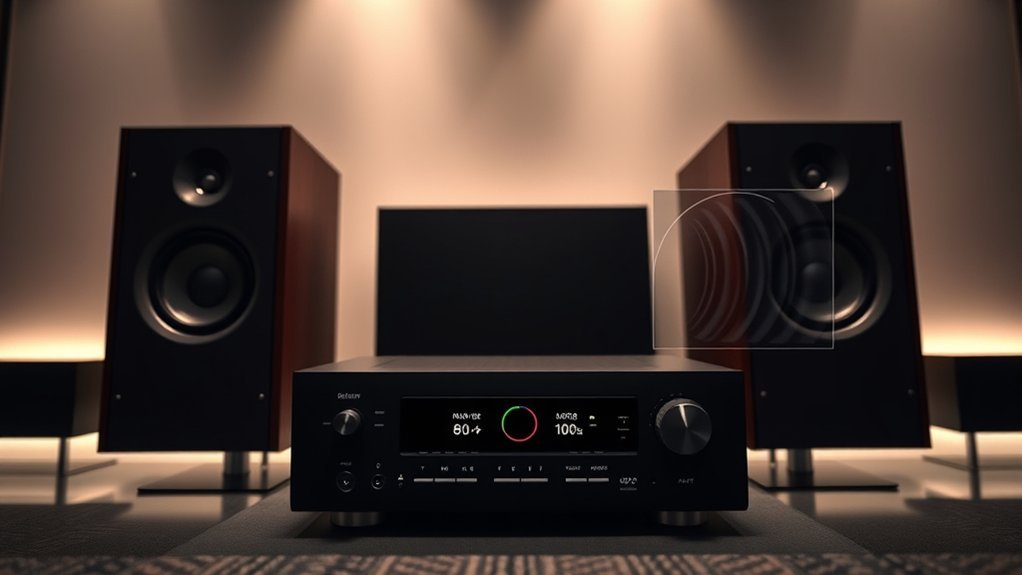
We focus on selecting an ideal crossover frequency that guarantees seamless integration between the subwoofer and main speakers. Adjustments must account for room acoustics, as reflections and placement influence perceived bass response. Fine-tuning these settings enhances clarity without sacrificing the depth of bass.
Optimal Crossover Frequency
Setting the ideal crossover frequency for your subwoofer is essential for achieving a seamless blend between bass and clarity in your audio system. It ensures a smooth transition between the main speakers and subwoofer, preventing frequency overlap or gaps. To optimize this setting, consider the subwoofer placement, as positioning affects perceived bass response. Proper crossover calibration involves fine-tuning the cutoff point to avoid muddy or thin sound. Typically, the recommended crossover frequency ranges from 80 to 120 Hz, depending on the speaker capabilities. Key considerations include:
- Matching the subwoofer’s low-frequency response with main speakers
- Avoiding frequencies that cause phase cancellation
- Ensuring clear separation of bass and midrange
- Adjusting based on room acoustics and listening preferences
Adjusting for Room Acoustics
Adjusting the subwoofer crossover for room acoustics requires careful attention to how sound interacts with the environment. In room placement, positioning the subwoofer near walls or corners can amplify bass, but may cause boomy or uneven response. Proper speaker orientation and placement help *guarantee* sound waves integrate seamlessly, reducing phase issues and null points. We recommend starting with in room placement that minimizes boundary reinforcement, then fine-tuning the crossover setting to balance bass extension with clarity. Use test tones or measurement tools to identify problematic resonances or dips. Adjustments should aim for a smooth frequency response, avoiding overemphasis of low frequencies that can muddy sound. Precise placement and crossover calibration are essential for achieving a natural, cohesive listening experience.
Should You Use Fixed or Variable Crossover Settings?
Choosing between fixed and variable crossover settings hinges on the desired level of control and system flexibility. Fixed crossovers offer consistent performance, relying on a set crossover frequency based on crossover design and signal processing parameters. They simplify calibration and guarantee repeatability, ideal for stable environments. Variable crossovers, however, provide precise control over the cutoff frequency, allowing real-time adjustments based on content or room acoustics. This flexibility is essential when tailoring sound for different genres or listening conditions.
Fixed crossovers ensure consistent performance, while variable crossovers offer real-time tuning for adaptable sound.
- Fixed crossovers prioritize stability and simplicity.
- Variable crossovers enable dynamic tuning.
- Signal processing capabilities determine adjustment range.
- Crossover design influences the effectiveness of each type.
Ultimately, the choice depends on whether you value consistency or adaptability in your audio system.
How to Fine-Tune Your Crossover for Different Genres and Content
To optimize your crossover settings for different genres and content, we need to take into account the unique frequency ranges and dynamic characteristics of each audio type. Genre specific calibration involves adjusting crossover points to accommodate the typical spectral content of each genre—e.g., tighter filters for classical music to preserve detail, or broader settings for action films to enhance bass impact. Content based adjustments require analyzing the dynamic range and prominence of low-frequency elements, ensuring that the subwoofer complements the speakers without overpowering or under-delivering. By tailoring these settings, we improve clarity and balance across audio types, ensuring each genre’s sonic nuances are accurately reproduced. This approach results in a more immersive listening experience, optimized for the specific content you’re consuming.
Common Mistakes to Avoid When Setting Your Crossover Frequencies
Setting your crossover frequencies incorrectly can profoundly compromise sound quality, so it’s essential to recognize common pitfalls early on. Many fall prey to crossover myths, believing that higher or lower frequencies will always improve clarity, but this oversimplifies complex acoustics. Avoid these mistakes:
- Assuming a universal frequency setting works for all setups.
- Relying on frequency myths that suggest extremely high or low cutoffs are always better.
- Neglecting to measure the actual response of your speakers and subwoofers.
- Setting crossover points based solely on aesthetic preferences rather than technical performance.
Understanding the technical basis behind crossover design prevents misconceptions and ensures optimal integration. Remember, precise adjustments grounded in acoustic science outperform assumptions driven by crossover myths and frequency myths, leading to a more accurate and balanced sound profile.
Using Room Acoustics to Optimize Crossover Performance
Room acoustics play a critical role in how crossover settings influence overall sound quality; by understanding and adapting to these characteristics, we can optimize speaker and subwoofer integration. Proper speaker placement minimizes reflections and standing waves, ensuring a more accurate frequency response. Incorporating soundproofing techniques reduces external noise and internal echo, allowing the crossover points to function more effectively. Strategic positioning of speakers and subwoofers helps balance direct sound with room reverberations, preventing frequency overlaps or gaps. Room dimensions, surface materials, and furniture placement all impact acoustic behavior, which in turn affects the perceived integration of audio components. Fine-tuning these factors improves phase coherence and crossover performance, leading to cleaner, more precise sound reproduction within the listening environment.
How to Test and Verify Your Crossover Settings Effectively
Accurately testing and verifying your crossover settings is essential to guarantee ideal integration between speakers and subwoofers. Proper testing involves evaluating subwoofer placement and phase alignment to ensure seamless sound transition.
- Use a frequency sweep or pink noise to identify overlaps or gaps in the bass spectrum.
- Adjust subwoofer placement to minimize localization and phase issues.
- Employ a phase test tone to confirm phase alignment, ensuring coherent sound waves.
- Verify that crossover points produce smooth, consistent bass without abrupt dips or peaks.
Expert Tips for Maintaining the Perfect Crossover Balance
Maintaining the perfect crossover balance requires ongoing attention to detail and precise adjustments, as even minor deviations can affect sound quality. To maximize this balance, focus on crossover harmonics and phase alignment. Regularly verify phase consistency between speakers and subwoofers to prevent cancellations or reinforcements at specific frequencies. Adjust crossover slopes carefully to control harmonic overlaps, ensuring seamless blending. Use the following table as a guide:
| Adjustment Focus | Key Consideration | Impact on Sound |
|---|---|---|
| Phase Alignment | Ensure signals are synchronized | Reduces phase cancellation |
| Crossover Slope | Fine-tune harmonic overlap | Prevents muddy or harsh sound |
| Harmonics Matching | Match harmonic content | Achieves tonal coherence |
| Regular Verification | Use measurement tools | Maintains maximum balance |
Frequently Asked Questions
Can I Use Different Crossover Settings for Different Listening Environments?
Yes, we can use different crossover settings for varied environments, adjusting for speaker placement and acoustic treatment. These factors influence frequency response, so tailoring crossover points optimizes sound quality by compensating for room acoustics and speaker positioning.
How Do Crossover Settings Impact Speaker Lifespan and Durability?
Did you know improper crossover settings can reduce speaker lifespan by 20%? Proper settings protect speakers from distortion and overload, ensuring sound quality while enhancing durability through effective speaker protection, ultimately extending their operational life.
Are There Specific Crossover Settings Recommended for Home Theater Systems?
For home theaters, we recommend setting the crossover around 80Hz, optimizing subwoofer placement, and performing precise speaker calibration. These steps guarantee balanced sound, minimize distortion, and enhance overall audio clarity within your system’s ideal crossover range.
What Role Does Amplifier Power Play in Crossover Configuration?
Amplifier power influences crossover configuration by ensuring compatibility and ideal power distribution. Adequate amplifier wattage prevents distortion and damage, allowing precise control of frequencies sent to speakers and subwoofers, maximizing sound clarity and system efficiency.
How Often Should I Revisit and Adjust My Crossover Settings?
We revisit our crossover settings every few months, as studies show speaker placement impacts sound. Regular equalization adjustments guarantee ideal audio clarity; consequently, tuning periodically keeps your system balanced against room acoustics and positional changes.
Conclusion
In summary, optimizing crossover settings is vital for achieving balanced, immersive sound. Did you know that improper crossover calibration can reduce audio clarity by up to 50%? By carefully selecting the right frequencies, considering room acoustics, and conducting thorough testing, we guarantee seamless integration between speakers and subwoofers. Precise adjustments not only enhance audio fidelity but also prevent distortion and phase issues, ultimately delivering a superior listening experience tailored to your environment and content preferences.