Like a finely tuned instrument, a sound system relies on precise impedance matching to perform at its best. Ensuring that your speaker impedance aligns with your amplifier’s rated load is essential for maximizing power transfer and safeguarding equipment. Without proper matching, you risk reduced sound quality or potential damage. Understanding the intricacies of impedance compatibility is fundamental to achieving high-fidelity audio and system longevity—an area that demands careful attention as we explore the finer points of speaker and amplifier integration.
Key Takeaways
- Proper impedance matching ensures maximum power transfer and prevents damage to both speakers and amplifiers.
- Most speakers have an impedance of 4-8 ohms, which should align with the amplifier’s rated load for optimal performance.
- Use multimeters or impedance analyzers to verify component impedance before connecting.
- Impedance mismatch can cause overheating, distortion, reduced sound quality, and equipment damage.
- Upgrading or replacing components requires matching their impedance ratings to maintain system integrity.
What Is Speaker Impedance and Why Does It Matter?
Although often overlooked, speaker impedance is a critical factor in audio system performance because it directly affects how efficiently an amplifier can deliver power to the speakers. Speaker impedance is influenced by the speaker material and design, which impact electrical characteristics. Variations in impedance occur due to the speaker’s construction, especially across different frequencies, leading to impedance fluctuations or impedance variations. These fluctuations can challenge amplifier stability and efficiency if not properly matched. Understanding the impedance of a speaker, typically rated at 4, 8, or 16 ohms, helps guarantee proper amplifier compatibility. Precise consideration of speaker material and impedance variations is essential for optimizing power transfer, minimizing distortion, and achieving high-fidelity sound reproduction.
How Amplifier Impedance Ratings Affect Your Sound System
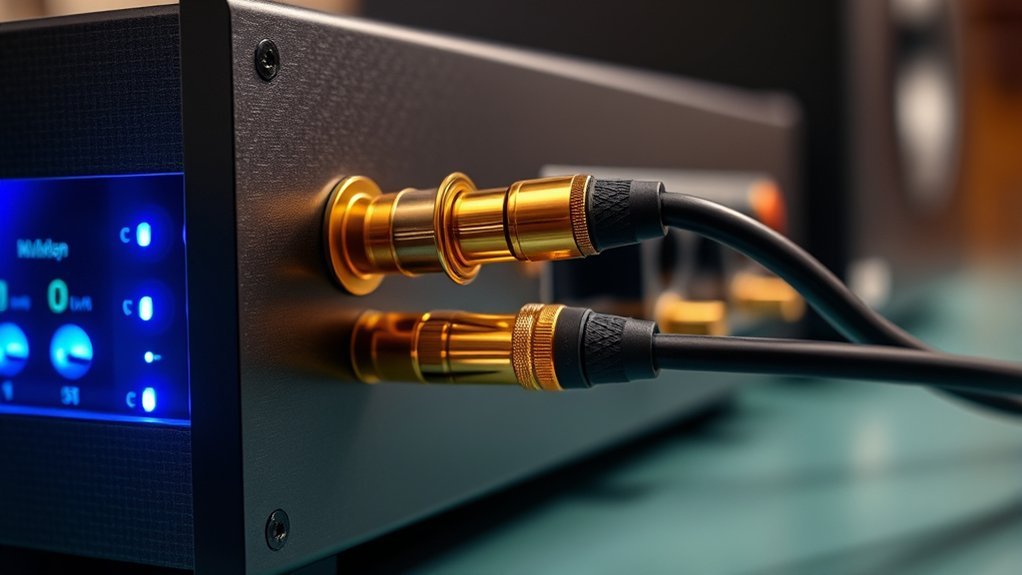
The impedance ratings of amplifiers play a crucial role in ensuring maximum power transfer and system stability. Accurate impedance measurement is essential for matching amplifiers with speakers, preventing distortion and potential damage. When an amplifier’s impedance aligns with speaker impedance, it optimizes speaker efficiency, allowing the system to operate at its intended performance level. Mismatched impedance can lead to reduced power delivery, diminished sound clarity, and increased thermal stress on components. Understanding how amplifier impedance ratings influence these factors helps us select compatible equipment and achieve clearer, more dynamic sound. Proper impedance matching also minimizes signal loss and enhances overall system reliability. Ultimately, paying close attention to impedance ratings ensures that your sound system performs at peak efficiency and longevity.
Recognizing Typical Impedance Values for Speakers and Amplifiers
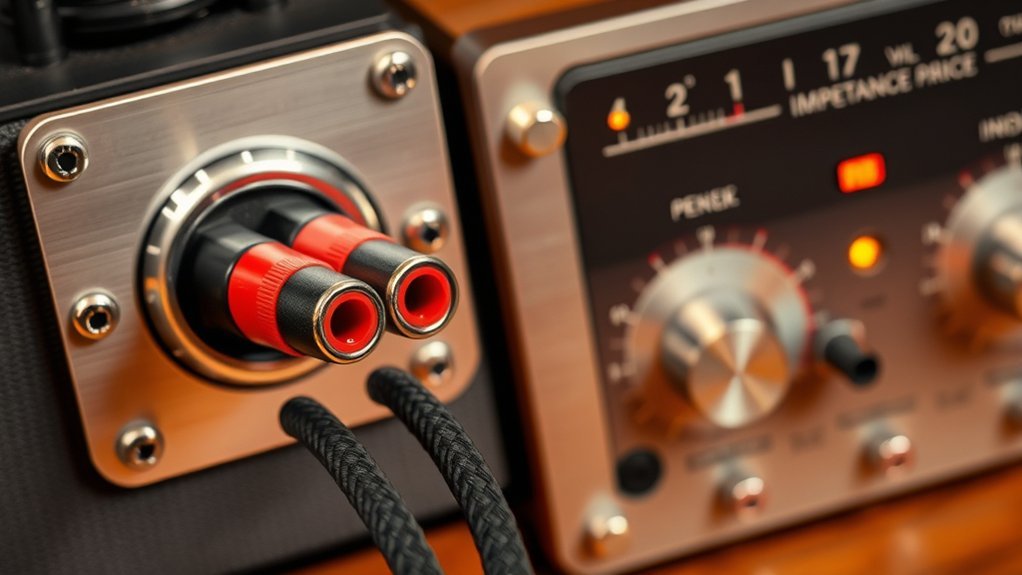
Most speakers have impedance ratings between 4 and 8 ohms, which is the standard range for consumer audio equipment. Amplifiers are typically designed to operate efficiently within this range, ensuring ideal power transfer and minimal distortion. Recognizing these typical values helps us select compatible components and avoid potential damage.
Standard Speaker Impedance Range
Understanding the standard speaker impedance range is vital for proper audio system design and compatibility. Most speakers operate within a range of 4 to 8 ohms, with 8 ohms being the most common. This range guarantees compatibility with a wide variety of amplifiers, which are designed to handle these impedance levels. Speaker efficiency, influenced by the impedance, affects how much power is required for ideal sound output. Impedance curves, which show how impedance varies with frequency, are essential for evaluating a speaker’s performance across the audio spectrum. While 8 ohms is standard, some high-efficiency speakers may have lower impedance, and certain specialty speakers may exceed this range. Recognizing these typical values helps in selecting the right amplifier and achieving balanced sound reproduction.
Typical Amplifier Compatibility
Recognizing typical impedance values for speakers and amplifiers is essential for guaranteeing compatibility and ideal performance. Most consumer amplifiers are designed to operate with speakers in the 4 to 8 ohm range, with some professional models supporting 2 ohms for higher power output. Amplifier gain, which influences how effectively it amplifies signals, must align with speaker sensitivity ratings to optimize sound clarity and volume. A mismatch can lead to distortion or amplifier strain, especially if the speaker impedance falls outside the amplifier’s best range. Understanding these typical impedance values helps prevent damage and ensures efficient power transfer. Proper compatibility between amplifier gain settings and speaker impedance, combined with awareness of speaker sensitivity, guarantees reliable operation and superior audio performance.
The Risks of Mismatched Impedance Between Speakers and Amplifiers
When speaker impedance does not match an amplifier’s rated output, it can lead to significant technical issues that compromise sound quality and equipment safety. Impedance theory explains this mismatch through electrical resistance variations affecting current flow. A low impedance load causes the amplifier to deliver excessive current, risking overheating and potential damage. Conversely, a high impedance load limits current, resulting in reduced volume and distortion. Mismatched impedance can also distort the electrical signal, degrading sound fidelity. Specific risks include:
- Overheating of amplifier components
- Reduced power efficiency
- Increased distortion and noise
- Potential speaker damage
- Shortened equipment lifespan
Understanding impedance theory and electrical resistance helps prevent these issues by ensuring proper matching between speakers and amplifiers, safeguarding both performance and longevity.
How to Match Your Speaker Impedance With Your Amplifier
To effectively match your speaker impedance with your amplifier, it’s essential to start by checking the specifications of both components. Confirm that the speaker’s impedance aligns with the amplifier’s rated load to prevent distortion or damage. Proper speaker placement influences impedance perception; placing speakers too close to walls can alter acoustic characteristics, affecting impedance interactions. Acoustic treatment also plays a role by optimizing sound absorption and reflection, ensuring consistent impedance load and minimizing reactive effects. When selecting speakers, ensure their impedance matches the amplifier’s output stage, and consider how placement and room acoustics might influence impedance stability. Maintaining this balance ensures ideal power transfer, reduces distortion, and creates a clearer, more accurate sound reproduction environment.
Step-by-Step Guide to Checking and Matching Impedance
Verifying and matching impedance involves a systematic approach to guarantee compatibility between your speakers and amplifier. Begin by measuring your speaker’s impedance with a multimeter or impedance analyzer, noting the nominal value. Next, verify your amplifier’s rated input impedance to ensure alignment. Consider ideal speaker placement and acoustic treatment, which influence load requirements and frequency response.
Ensure proper speaker and amplifier compatibility through systematic impedance verification and optimal placement.
- Use a multimeter to confirm speaker impedance at terminals
- Cross-reference with amplifier specifications for compatibility
- Adjust speaker placement to minimize impedance fluctuations
- Evaluate acoustic treatment to reduce reflections affecting load
- Confirm that the system’s combined load matches the amplifier’s output capacity
This process ensures proper impedance matching, preventing distortion, and maximizing sound quality. Proper setup reduces risks and enhances overall system performance.
Common Impedance Matching Scenarios and Solutions
Are you aware of the most common scenarios where impedance mismatches occur in audio systems? One frequent situation involves connecting speakers with unknown impedance to amplifiers lacking proper impedance measurement or compatibility testing. This can lead to inefficient power transfer or potential damage. Another scenario involves upgrading components without verifying impedance compatibility, resulting in distorted sound or reduced system lifespan. Engineers often perform impedance measurement during setup to verify matching levels and prevent overloads. Compatibility testing is essential when integrating different brands or models, especially in multi-channel systems. Addressing these issues requires understanding typical impedance ranges, performing precise measurements, and confirming that all components meet specified impedance criteria. Properly managing these scenarios guarantees peak performance and system durability.
Troubleshooting Sound Quality Issues Caused by Impedance Mismatch
When sound quality issues arise, we first check for impedance mismatch between the amplifier and speakers. Such mismatches can cause distortion, reduced clarity, or volume inconsistencies. We then identify the mismatch and apply targeted corrections to restore peak sound performance.
Identifying Impedance Mismatch
How can we effectively detect impedance mismatch that causes sound quality issues? The key lies in analyzing signal behavior and system response. Indicators include fluctuating volume levels, distorted audio, or sudden speaker failures. To diagnose accurately, consider these signs:
- Inconsistent sound output across channels
- Unexpected heating or reduced speaker durability
- Visible physical damage or wear on the speaker components
- Amplifier clipping or thermal shutdown
- Discrepancies between expected and actual impedance scaling
These symptoms often point to impedance mismatch, which can strain system components and compromise speaker durability. Precise measurement of impedance with a multimeter or impedance analyzer helps confirm mismatches. Recognizing these signs early ensures proper impedance matching, preserving system integrity and extending speaker lifespan.
Effects on Sound Quality
Impedance mismatch directly impacts sound quality by introducing distortions and inconsistencies that compromise audio fidelity. When speakers are mismatched with amplifiers, it can cause uneven frequency response, resulting in muddiness or harshness. The speaker enclosure design may exacerbate these issues, amplifying vibrations or resonances caused by impedance irregularities. Acoustic treatment, such as damping materials, can help mitigate some effects by reducing unwanted resonances, but it doesn’t address the core impedance incompatibility. This mismatch can also lead to reduced dynamic range and clarity, making music sound less natural. Troubleshooting sound quality problems requires careful assessment of impedance compatibility, along with consideration of the speaker enclosure and acoustic environment, to guarantee ideal audio performance.
Correcting Impedance Issues
Addressing impedance mismatch requires systematic troubleshooting to restore ideal sound quality. First, we perform impedance calculation to identify discrepancies between amplifier output and speaker resistance. Common issues include overly low impedance causing amplifier strain or high impedance resulting in weak sound. To correct these problems, we:
- Verify speaker resistance using a multimeter
- Match speaker impedance with appropriate amplifier settings
- Adjust or replace speakers with compatible impedance ratings
- Check and replace damaged or faulty cables
- Use impedance matching devices, such as transformers, when necessary
These steps ensure proper impedance alignment, preventing distortion and damage. Accurate impedance calculation and understanding speaker resistance are essential for effective troubleshooting, ultimately restoring perfect sound performance and prolonging system lifespan.
Tips for Upgrading Your Audio System Without Impedance Problems
Upgrading your audio system can considerably enhance sound quality, but doing so without considering impedance matching risks damaging components and degrading performance. Understanding impedance theory, which relates to electrical resistance in the circuit, is essential. When selecting new components, guarantee the speaker impedance aligns with the amplifier’s rated load to prevent excessive electrical resistance that can cause overheating or distortion. Use precise measurements of your existing system’s impedance, and verify the impedance ratings of new speakers or amplifiers. Proper impedance matching minimizes reflections and voltage drops, optimizing power transfer and sound clarity. Avoid assumptions based solely on wattage; always confirm the impedance compatibility. This disciplined approach ensures each upgrade maintains system integrity, prolongs component lifespan, and delivers consistent, high-fidelity audio performance.
Do You Need an Impedance Matching Transformer or Crossover?
Do you need an impedance matching transformer or crossover? If you’re working with microphones, headphone impedance, or speaker systems, these components ensure proper signal transfer. An impedance matching transformer is essential when microphone impedance or headphone impedance differs significantly from the input or output device, preventing signal loss and distortion. A crossover, on the other hand, directs specific frequency ranges to appropriate drivers, optimizing sound quality. Consider these points:
- Microphone impedance mismatch can cause weak or distorted audio signals
- Headphone impedance affects volume levels and clarity
- Transformers match impedance levels between devices
- Crossovers split frequencies for better speaker performance
- Proper matching minimizes power loss and prevents equipment damage
Determining whether you need a transformer or crossover depends on your system’s impedance characteristics and desired sound fidelity.
Frequently Asked Questions
Can Impedance Mismatches Damage My Amplifier or Speakers?
Impedance mismatches can harm your equipment if not properly managed, risking amplifier overload or speaker damage. Ensuring impedance compatibility promotes speaker safety and prevents potential damage, emphasizing the importance of matching impedance levels for ideal, safe audio performance.
How Does Impedance Affect the Overall Volume and Clarity of Sound?
Impedance influences volume and clarity by affecting audio frequency response and impedance balancing; mismatched impedance can cause distortion or loss of detail. Proper matching guarantees ideal signal transfer, maintaining consistent sound quality across varying audio frequencies.
Are There Specific Brands Known for Better Impedance Compatibility?
We find brands like JBL, Bose, and Klipsch excel in impedance compatibility, driven by their strong reputation and adherence to compatibility standards; their precision engineering guarantees ideal speaker and amplifier matching for superior sound quality.
What Tools or Equipment Are Needed to Measure Impedance Accurately?
For accurate impedance testing, we use specialized calibration tools like impedance analyzers and multimeters, ensuring precise measurements. These tools help us verify speaker impedance, maximize matching, and prevent potential damage, ensuring optimal audio performance and system longevity.
Is It Necessary to Re-Match Impedance When Upgrading Speakers or Amplifiers?
We believe re-matching impedance isn’t always necessary when upgrading, but proper speaker placement and acoustic treatment optimize performance. Investigating impedance compatibility guarantees clarity, preventing damage, and achieving accurate sound reproduction in your upgraded setup.
Conclusion
In conclusion, maintaining proper impedance matching is essential for ideal audio performance and equipment longevity. While it may seem a subtle detail, ensuring compatibility prevents potential issues and enhances sound clarity. By carefully selecting and matching components, we can create a resilient, high-fidelity system that performs reliably over time. Paying attention to these technical nuances allows us to enjoy superior sound quality without unintended complications, ultimately elevating our overall listening experience.