When comparing bookshelf and floor speakers for music, we recognize that each type offers distinct advantages rooted in their design and acoustic performance. Their size and placement influence how they reproduce sound across different genres and room configurations. To evaluate which suits your needs, it’s essential to contemplate technical aspects like frequency response and spatial dynamics. Understanding these nuances can substantially impact your listening experience, prompting us to explore the core differences and practical considerations further.
Key Takeaways
- Bookshelf speakers excel in detailed midrange and treble, providing clarity for music listening in smaller spaces.
- Floor speakers deliver deeper bass and fuller sound due to larger drivers, enhancing music experience in larger rooms.
- Proper placement and room size influence effectiveness; bookshelf speakers suit compact spaces, while floor speakers suit bigger rooms.
- Sound quality varies with material and design; high-quality bookshelf speakers can rival or surpass floor models in detail.
- Setup and maintenance are easier with bookshelf speakers, making them a convenient option for quality music playback.
How Do Bookshelf and Floor Speakers Differ in Design and Size?
How do bookshelf and floor speakers differ in design and size? Bookshelf speakers are compact, typically fitting on shelves or stands, emphasizing aesthetic versatility through sleek, unobtrusive designs. Their smaller size allows for easier integration into various environments, offering portability options for users who may relocate or adjust their setup. In contrast, floor speakers are larger, designed to stand independently on the floor, often providing a more commanding presence. Their size enables housing of larger drivers and enhanced bass response, but reduces portability. The design distinctions impact functionality: bookshelf models prioritize versatility and space efficiency, while floor models focus on delivering robust sound with a permanent, visually impactful presence. These differences are essential in selecting speakers aligned with spatial constraints and aesthetic preferences.
Which Speakers Offer Better Sound Quality for Music?
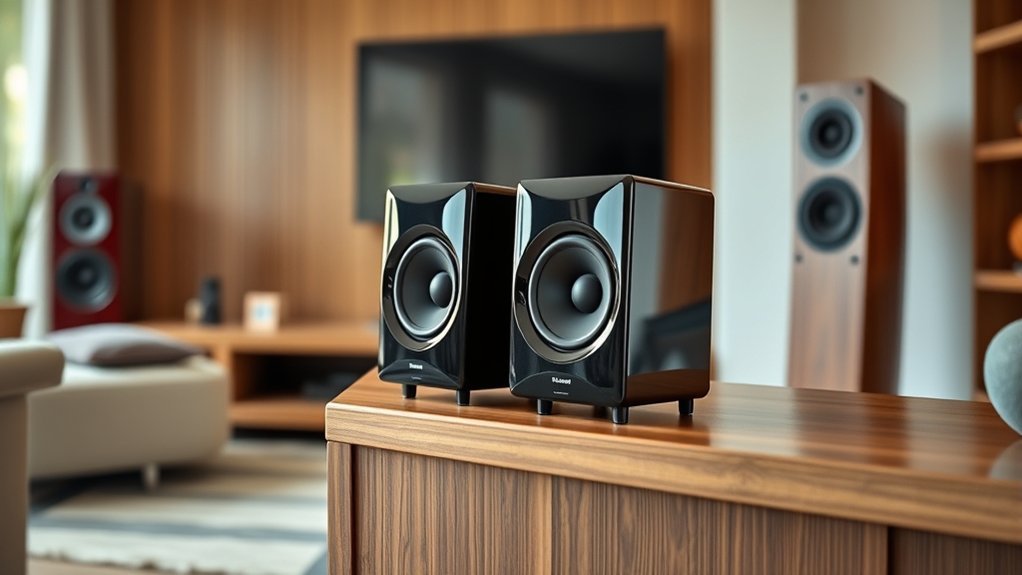
When evaluating which speakers deliver superior sound quality for music, it’s important to take into account how their design and size influence audio performance. Speaker material considerably impacts sound clarity, tonal accuracy, and durability. For example, materials like kevlar or aluminum cones provide tighter, more precise sound reproduction, while paper or fabric cones often produce warmer tones but less control. Sound dispersion also plays a vital role; speakers with well-designed waveguides and driver placement promote even sound distribution, reducing audio dead spots and ensuring consistent listening experiences. Floor speakers typically offer larger drivers, resulting in deeper bass and fuller sound, whereas bookshelf speakers excel in detailed midrange and treble. Ultimately, the choice hinges on balancing speaker material quality and effective sound dispersion for ideal music reproduction.
How Space and Room Size Influence Your Speaker Choice
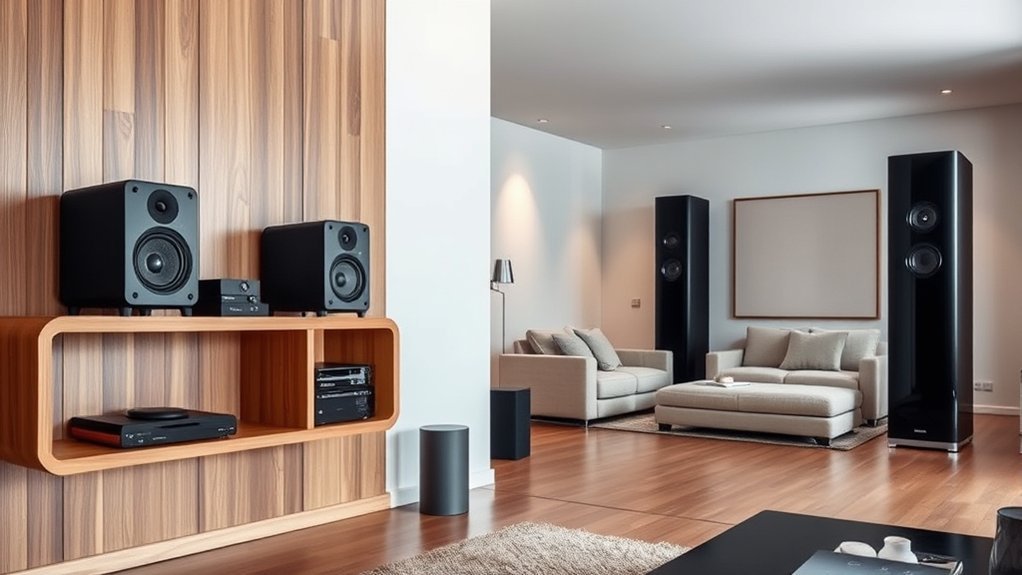
The size and dimensions of a room considerably impact the effectiveness of different speaker types, as they influence sound projection, resonance, and overall clarity. Larger spaces often require floor speakers to fill the area, but room acoustics can cause unwanted resonance or echo. Proper decor placement, such as positioning furniture and acoustic treatment, helps manage sound reflection and absorption, maximizing clarity. Smaller rooms benefit from bookshelf speakers, which are less likely to overwhelm the space and can be strategically placed for balanced sound. Adjusting decor placement and applying acoustic treatment, like diffusers or panels, enhances sound quality regardless of room size. Understanding these factors allows us to select speakers that complement the room’s acoustic environment, ensuring ideal music reproduction.
What Budget Should You Consider for Bookshelf Versus Floor Speakers?
Budget considerations play a crucial role in selecting between bookshelf and floor speakers, as the cost directly influences the quality, features, and brand options available. For bookshelf speakers, budgets typically range from $100 to $1,000, with higher-end models offering superior aesthetic appeal and refined sound performance. Floor speakers generally require a larger investment, often starting at $300 and reaching upwards of several thousand dollars for premium builds. Brand reputation considerably impacts perceived value; established brands tend to deliver consistent quality and better aesthetic appeal, justifying higher prices. While affordability guides initial choices, balancing budget with desired sound fidelity, aesthetic appeal, and reliable brand reputation helps ensure a purchase that aligns with both financial constraints and long-term satisfaction.
Which Speakers Are Easier to Set Up and Maintain?
Choosing between bookshelf and floor speakers often hinges on setup and maintenance complexity, as these factors directly impact user convenience and ongoing usability. Bookshelf speakers generally require minimal speaker placement adjustments due to their size, making installation straightforward and less time-consuming. They are easier to maintain because they are accessible for cleaning and component checks. In contrast, floor speakers demand more careful placement to enhance sound quality, especially considering proximity to walls and furniture. Aesthetic considerations also influence maintenance; bookshelf speakers often blend seamlessly into a room’s decor, simplifying aesthetic upkeep. Overall, bookshelf speakers tend to be easier to set up and maintain, owing to their compact size and flexible placement options, whereas floor speakers require more deliberate arrangement to ensure top performance and visual harmony.
Frequently Asked Questions
Can Bookshelf Speakers Replace Floor Speakers for Large Rooms?
In large rooms, bookshelf speakers generally can’t replace floor speakers due to limited volume and bass output; acoustic treatment and room size considerably influence their effectiveness, making floor speakers preferable for achieving full-range sound with ample coverage.
Are Bookshelf Speakers More Portable Than Floor Speakers?
Like a pocket-sized smartphone revolutionized communication, bookshelf speakers are more portable than floor speakers, offering compact speaker size and efficient sound dispersion, making them ideal for versatile setups without sacrificing sound quality.
How Do Speaker Materials Affect Sound Quality?
Speaker materials critically influence sound quality through their resonance and acoustic properties, affecting clarity and timbre. We analyze how materials like wood, metal, or composite optimize resonance control, enhancing overall audio fidelity and listening experience.
Do Floor Speakers Require More Power Than Bookshelf Speakers?
Floor speakers generally require more power consumption than bookshelf speakers due to their larger drivers and increased energy demands for higher volume and bass output, but their energy efficiency depends on design quality, making careful selection essential for best sound performance.
Which Speaker Type Is Better for Home Theater Systems?
We find bookshelf speakers ideal for home theater systems due to flexible speaker placement that adapts to various acoustic environments, providing balanced sound. Floor speakers excel in large spaces but require strategic placement for best acoustic performance.
Conclusion
In the end, choosing between bookshelf and floor speakers isn’t just about size or price—it’s about prioritizing what truly matters to our listening experience. Ironically, the more compact bookshelf speakers often deliver detailed clarity, while larger floor models emphasize depth. So, while bigger might seem better, sometimes the nuanced sound you seek is hidden in the smaller package. Ultimately, it’s a calculated decision balancing room dynamics, sound preferences, and aesthetic preferences—nothing more, nothing less.