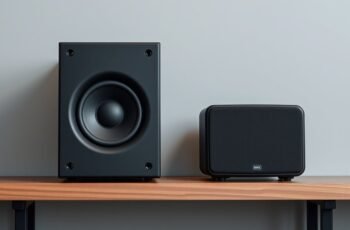
When selecting audio solutions for TV, we recognize that the decision hinges on technical performance, room dynamics, and user priorities. Bookshelf speakers and soundbars each offer distinct advantages and limitations that influence overall audio quality and usability. Understanding these differences is essential to making an informed choice, especially when considering factors like sound clarity, setup complexity, and acoustic environment. Let’s explore how these options compare across various criteria to determine which better suits different viewing scenarios.
Key Takeaways
- Bookshelf speakers generally deliver richer, more detailed sound with better stereo imaging for an immersive TV audio experience.
- Soundbars are more space-efficient, easier to set up, and provide clear dialogue with a broader soundstage.
- Bookshelf speakers require external amplifiers and proper placement for optimal performance, while soundbars have simplified connectivity.
- Budget models of either system may compromise on sound quality and durability; higher-end options offer superior materials and longevity.
- Room size and acoustics significantly influence performance; larger rooms often benefit from bookshelf speakers or immersive multi-speaker setups.
How Do Bookshelf Speakers Improve TV Audio Quality?
While soundbars often deliver a convenient audio upgrade, bookshelf speakers can substantially enhance TV sound quality by providing more detailed and accurate audio reproduction. Proper speaker placement critically influences sound clarity and stereo imaging, allowing us to optimize the listening experience. Placing bookshelf speakers at ear level and aligning them with the TV screen ensures balanced sound dispersion and prevents audio blurring. Acoustic treatment also plays a crucial role; by adding elements like diffusers and absorbers, we minimize reflections and standing waves that can distort audio. This controlled environment enhances direct sound clarity, enabling the speakers to deliver precise dialogue and immersive effects. Overall, strategic placement combined with acoustic optimization allows bookshelf speakers to outperform soundbars in delivering high-fidelity TV audio.
What Are the Main Advantages and Limitations of Soundbars?
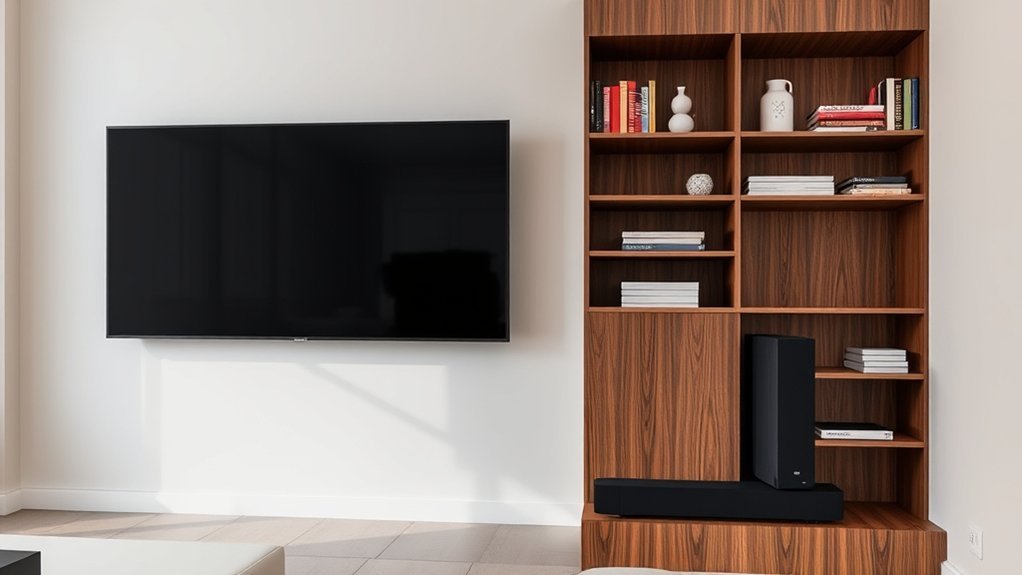
Soundbars offer a streamlined and space-efficient solution for enhancing TV audio, making them attractive for modern living environments. Their main advantages include:
- Aesthetic Design: Slim profiles and clean lines integrate seamlessly into contemporary decor, reducing visual clutter.
- Wireless Connectivity: Most models support Bluetooth or Wi-Fi, enabling easy, cable-free streaming from various devices.
- Ease of Installation: Compact form factors simplify setup, often requiring only a single power outlet and minimal calibration.
- Enhanced Audio Experience: Despite their size, soundbars provide clearer dialogue and broader soundstage compared to built-in TV speakers.
However, limitations exist: they may lack the depth and immersive quality of traditional speakers, especially in larger rooms, and their audio performance is often constrained by the form factor’s physical limitations.
Which Setup Fits Different Room Sizes and Spaces?
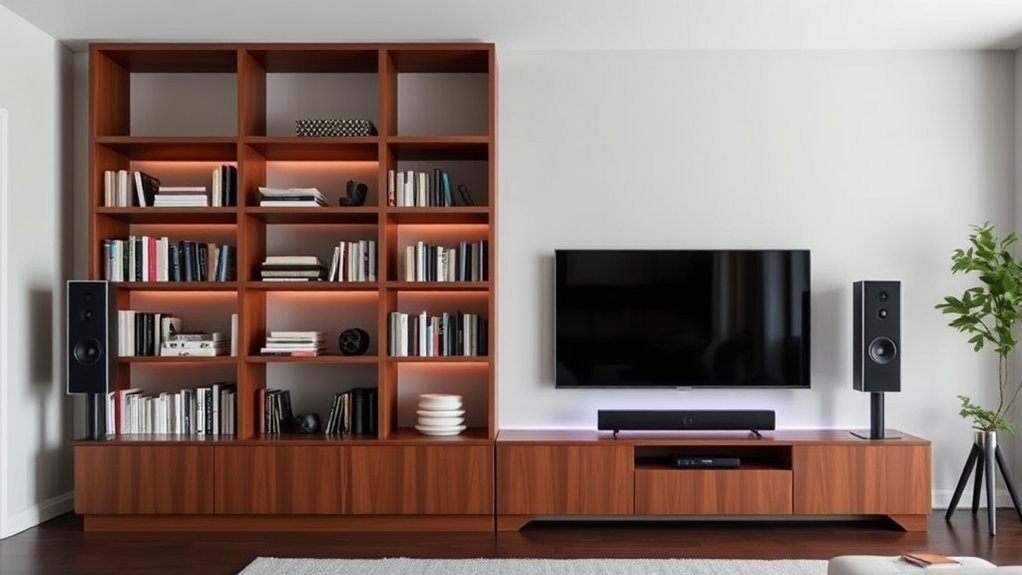
Room size considerably influences the ideal audio setup, with small spaces favoring compact solutions like soundbars for minimal clutter and ease of installation. Medium rooms benefit from bookshelf speakers that deliver balanced sound throughout the area, while large spaces require more immersive configurations to maintain audio clarity and depth. Understanding these spatial parameters helps us select the right system to guarantee sound quality aligns with room dimensions.
Small Rooms, Compact Setups
Choosing the right audio setup for small rooms requires careful consideration of space constraints and acoustic dynamics. In compact environments, decor placement impacts both sound quality and aesthetic appeal. To optimize, consider:
- Speaker placement—position bookshelf speakers near walls or corners to enhance sound projection without cluttering space.
- Aesthetic integration—select sleek, minimalistic designs that blend with decor, maintaining room openness.
- Size compatibility—opt for compact soundbars that fit seamlessly beneath TVs, reducing visual clutter.
- Acoustic treatment—use furniture and soft materials to improve sound dispersion and minimize echo, maximizing audio clarity.
These elements guarantee the setup remains unobtrusive while delivering quality sound, balancing decor and functionality in small rooms.
Medium Spaces, Balanced Sound
When selecting the ideal audio setup for medium-sized spaces, it’s essential to balance sound quality with spatial efficiency. Bookshelf speakers excel here due to their ability to deliver detailed audio without overwhelming the room. Proper speaker placement is critical; positioning them at ear level and forming an equilateral triangle with the seating area optimizes sound dispersion. For those seeking vintage aesthetics, bookshelf speakers can be chosen with classic design elements, blending form and function seamlessly. Soundbars, while space-efficient, may struggle to produce the nuanced stereo imaging required for balanced sound in medium rooms. Ultimately, a well-placed pair of bookshelf speakers provides a more immersive and accurate audio experience, making them a preferred choice for spaces that demand both style and sound precision.
Large Rooms, Immersive Audio
In large rooms, achieving immersive audio requires a setup capable of filling expansive spaces with clarity and depth. The choice hinges on several factors:
- Speaker Power and Size: Larger bookshelf speakers with high wattage output deliver better coverage and dynamic range, essential for large spaces.
- Room Acoustics and Layout: Proper placement minimizes sound loss and echoes, maximizing audio fidelity.
- Vintage Aesthetics: For those seeking a classic look, vintage-inspired bookshelf speakers can blend style with performance, fitting spacious interiors.
- Wireless Connectivity: Wireless setups, especially with soundbars, reduce clutter and enable flexible positioning, vital for large or irregularly shaped rooms.
Both options can be tailored to space requirements, but bookshelf speakers generally provide superior immersive sound when paired with the right room treatment.
How Do Price and Budget Affect Your Choice?
Budget constraints directly limit the range of options available, often dictating the quality and features of the audio setup. Higher-priced models generally offer superior sound fidelity and durability, but may exceed typical budgets. Consequently, affordability shapes both the selection process and the trade-offs between cost and performance.
Budget Constraints Influence Options
Since budget constraints directly limit available options, determining whether to choose bookshelf speakers or soundbars hinges on cost-effectiveness and performance trade-offs. Our analysis reveals key factors:
- Aesthetic appeal: Soundbars often offer a sleek, minimal look, fitting budget or space constraints, whereas bookshelf speakers may enhance aesthetic appeal but can be bulkier.
- Installation complexity: Soundbars typically involve straightforward setup, reducing labor costs, while bookshelf speakers demand more complex placement and wiring, increasing installation expenses.
- Cost-performance ratio: Budget-friendly soundbars deliver decent audio for lower prices, but bookshelf speakers may provide superior sound quality if investment allows.
- Long-term value: Although initial costs differ, choosing between these options depends on balancing aesthetic preferences, installation ease, and expected performance within a limited budget.
Higher Cost Means Better Quality
Higher expenditure on audio equipment generally correlates with improved sound quality, as increased budgets enable purchasing components with superior materials, advanced technology, and craftsmanship. Luxury brands often leverage premium materials like hardwood enclosures and high-grade crossover components, resulting in clearer, more accurate audio reproduction. Price tiers reflect not only brand prestige but also the quality of internal components and build integrity.
| Price Range | Typical Features | Material Quality |
|---|---|---|
| Budget | Basic drivers, plastic enclosures | Standard plastics |
| Mid-range | Better drivers, some premium materials | MDF, composite materials |
| High-end | Luxury brands, premium materials, advanced engineering | Hardwood, metal alloys |
Higher costs generally translate into superior audio fidelity, especially when investing in premium materials used by luxury brands.
Affordability Limits Features
While increased affordability can expand access to better sound quality and features, it also imposes limitations on available options. Budget constraints often restrict the quality of components, affecting room acoustics and speaker placement flexibility. Lower-cost bookshelf speakers may lack advanced driver materials, reducing sound clarity, while entry-level soundbars typically have fewer channels, impacting immersive audio.
- Limited driver quality constrains sound precision, especially in challenging room acoustics.
- Reduced budget restricts speaker placement options, affecting stereo imaging and soundstage.
- Fewer built-in features, like room calibration or multiple inputs, limit customization.
- Compact, affordable models often have less effective passive or active room treatment, influencing overall sound quality.
Budget directly impacts the ability to optimize speaker positioning and adapt to room acoustics, ultimately affecting listening experience.
What Factors Should You Consider for Ease of Use and Compatibility?
When evaluating bookshelf speakers and soundbars, considering ease of use and compatibility is essential to guarantee seamless integration into your existing setup. Connection flexibility is a critical factor, as it determines how easily the device interfaces with your TV, gaming console, or streaming devices. Soundbars often feature multiple input options, such as HDMI ARC, Bluetooth, or optical, enhancing device compatibility and simplifying setup. Bookshelf speakers typically require an external receiver or amplifier, which can complicate installation but offers greater customization. Assessing your current equipment and future expansion plans helps determine which system provides the best connection flexibility. Ensuring compatibility with your devices minimizes setup hurdles, reduces potential technical issues, and guarantees a cohesive, user-friendly audio system.
How Do Sound Quality and Listening Experience Compare?
Sound quality and listening experience are critical factors that differentiate bookshelf speakers from soundbars, and understanding their comparative performance helps inform our choice.
- Bookshelf speakers generally deliver superior audio clarity due to larger drivers, providing richer, more detailed sound across frequencies.
- Soundbars often optimize spatial sound, but may sacrifice some precision, impacting overall audio clarity.
- Listening comfort varies; bookshelf speakers offer a more natural, immersive experience, while soundbars provide consistent sound at ear level, reducing fatigue.
- The listening experience hinges on room acoustics; bookshelf speakers require proper placement for optimal audio, whereas soundbars are more adaptable but might lack depth.
Frequently Asked Questions
Can Bookshelf Speakers Connect Wirelessly to a TV?
Yes, bookshelf speakers can connect wirelessly to a TV using wireless compatibility features like Bluetooth connectivity. We analyze their setup, noting that Bluetooth allows seamless, cable-free audio transfer, but may introduce latency, affecting synchronization with video content.
Do Soundbars Require Additional Components for Surround Sound?
Like assembling a puzzle, soundbars often need additional audio components for true surround sound compatibility. Most come with a subwoofer and satellite speakers, but some setups require extra amplification or wireless modules for immersive, multi-channel audio experiences.
Which Option Is More Suitable for Small Apartments?
For small apartments, we find soundbars more suitable due to their compact design, better room acoustics integration, and minimal speaker placement requirements, which optimize space and acoustic performance without overwhelming limited room areas.
How Does Installation Complexity Differ Between the Two?
Installing bookshelf speakers requires careful speaker placement and cable management, often involving more steps, while soundbars are plug-and-play, making setup straightforward. Think of it as comparing a detailed blueprint to a ready-made kit.
Are There Hybrid Systems Combining Both Options?
Yes, hybrid systems combining bookshelf speakers and soundbars exist, offering integrated hybrid audio solutions that leverage the strengths of both, providing immersive sound with flexible installation, ideal for customized home theater setups and enhanced TV audio experiences.
Conclusion
Ultimately, choosing between bookshelf speakers and soundbars isn’t about finding a clear winner, but about matching technology to our specific needs. It’s amusing how the most sophisticated audio setup can be rendered irrelevant if it doesn’t suit our space or lifestyle. So, whether we prioritize depth or simplicity, our decision reflects a blend of technical preference and practical reality—proof that, sometimes, the best audio is the one that fits just right, not necessarily the most advanced.