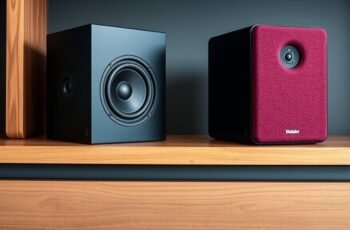
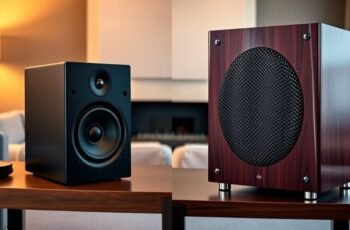
When comparing wireless and wired bookshelf speakers, we recognize that each offers distinct advantages in sound quality, setup, and reliability. While wired speakers often deliver superior clarity and stability, wireless options emphasize convenience and flexibility. Determining which truly sounds better depends on specific needs and environments, but understanding these differences is essential. The decision ultimately hinges on balancing technical performance with practical considerations—an area that warrants close examination as we explore further.
Key Takeaways
- Wired speakers typically deliver clearer, more stable sound due to direct connections and minimal signal loss.
- Wireless speakers can match wired sound quality with high-quality hardware and proper setup.
- Wired systems offer consistent performance unaffected by interference, enhancing sound reliability.
- Wireless speakers provide flexible placement, but may experience latency or interference affecting sound clarity.
- Overall, wired speakers often sound better for audiophile quality, while wireless offers convenience and versatile placement.
How Do Wireless and Wired Bookshelf Speakers Differ in Sound Quality?
When comparing wireless and wired bookshelf speakers, the primary distinction lies in their sound quality, which is influenced by the transmission method and signal integrity. Wired speakers generally deliver superior sound clarity due to direct, stable connections that minimize signal loss. This stability results in a more accurate reproduction of audio, particularly in the high and low-frequency ranges. Wireless speakers, on the other hand, rely on digital transmission, which can introduce latency and interference, potentially impacting sound clarity. Additionally, wired speakers often have a broader and more consistent frequency response, ensuring a balanced and detailed audio experience. While wireless options offer convenience, their sound quality may be constrained by transmission quality, making wired speakers preferable for applications demanding precise audio fidelity.
What Are the Key Convenience Factors for Wireless vs. Wired Speakers?
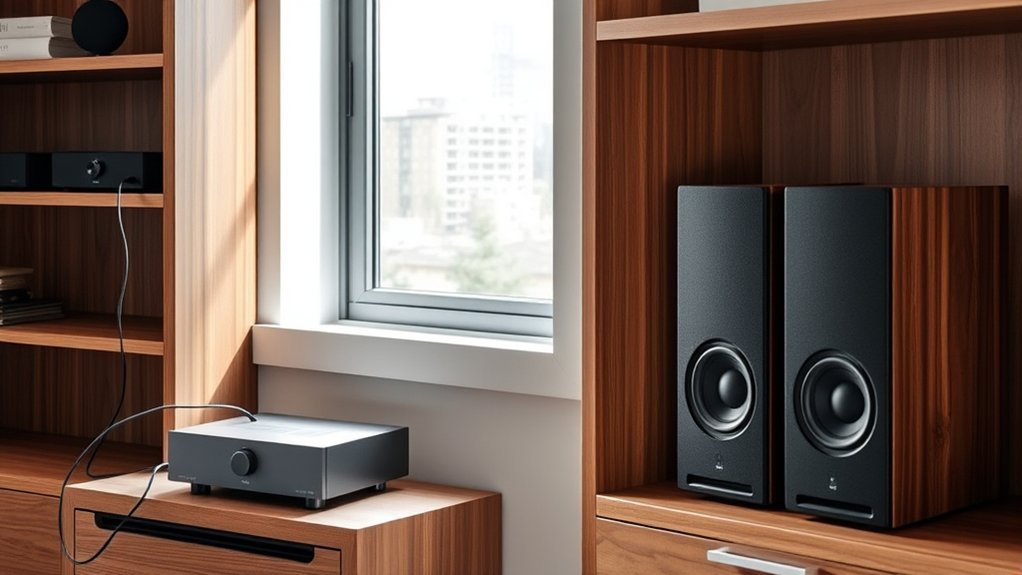
The primary convenience factors distinguishing wireless from wired bookshelf speakers revolve around setup, mobility, and connectivity flexibility. Wireless speakers eliminate the need for physical cables, simplifying setup and allowing for flexible placement. However, their battery life becomes a crucial factor, as limited or inconsistent power sources can hinder continuous use. Signal interference also impacts wireless connectivity; competing wireless devices, Wi-Fi congestion, and physical obstructions can degrade audio quality or cause dropouts. Wired speakers, conversely, require minimal maintenance once installed, offering a stable connection unaffected by interference or battery constraints. While less flexible in placement, wired options provide uninterrupted performance, making them ideal for environments where consistent audio quality is paramount. Overall, these convenience factors markedly influence user experience and system reliability.
How Do Installation and Setup Compare Between Wireless and Wired Options?
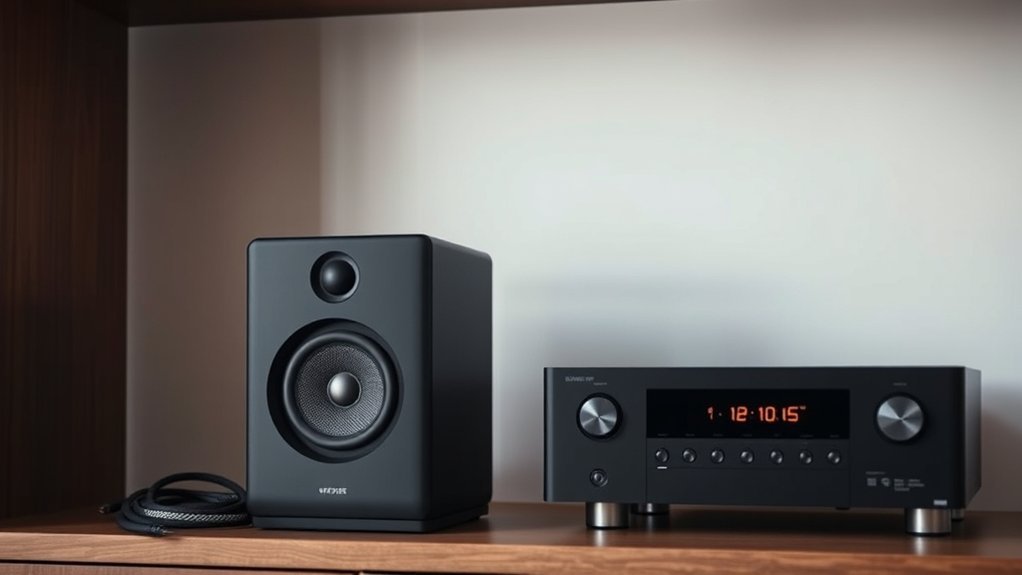
Installing and setting up wireless bookshelf speakers typically involves a streamlined process that emphasizes minimal physical intervention. Unlike wired options, which require careful speaker placement and cable management, wireless systems simplify speaker positioning, allowing for flexible placement without extensive acoustic treatment considerations. Proper speaker placement is vital to enhance sound quality and minimize interference, especially since wireless signals can be affected by environmental factors. Wireless setup often involves connecting to a Wi-Fi network or Bluetooth device, with app-based configuration speeding installation. In contrast, wired systems demand precise cable routing, secure connections, and attention to acoustic treatment to guarantee optimal sound dispersion. Overall, wireless options reduce setup complexity and physical constraints, but still require deliberate placement to achieve the desired acoustic performance.
Which Speakers Offer Better Reliability and Signal Stability?
Wireless speakers generally provide better reliability and signal stability when equipped with robust, modern wireless protocols like Wi-Fi 5 or Wi-Fi 6, which offer higher bandwidth and reduced interference. This technological advantage results in consistent sound clarity, minimizing dropouts and latency issues. Wired speakers, relying on physical connections, inherently deliver stable signals unaffected by environmental interference, ensuring ideal build quality in signal transmission. While wired options excel in reliability, wireless speakers with advanced protocols can match or surpass this stability, provided they are correctly configured. Ultimately, the reliability of either system hinges on the quality of components, with high-grade wireless hardware ensuring sustained sound clarity and consistent performance. This makes well-designed wireless speakers a competitive choice for dependable signal stability.
How Do Price and Budget Considerations Influence Your Choice?
Price and budget considerations profoundly influence the choice between wireless and wired bookshelf speakers, often dictating the range of options available. Effective budget planning involves evaluating the total cost of ownership, including initial investment, installation, and potential upgrades. Pricing strategies differ markedly: wired speakers typically have lower upfront costs but may incur additional expenses for wiring and installation, while wireless options often command higher initial prices due to integrated technology and convenience features. These financial factors shape purchasing decisions, especially when balancing performance expectations against budget constraints. Consequently, understanding the cost implications associated with each type enables informed choices aligned with specific financial limits and long-term value. Ultimately, budget planning must account for not only initial costs but also ongoing expenses related to maintenance, upgrades, and compatibility.
What Are the Versatility and Compatibility Differences?
Wireless and wired bookshelf speakers differ markedly in their connectivity options, with wireless models offering diverse methods like Wi-Fi, Bluetooth, and proprietary protocols, while wired models rely on physical connections such as RCA or speaker wire. Device compatibility varies, as wireless speakers often support multiple platforms and smart home integrations, whereas wired speakers depend on compatible amplifiers and input types. Setup and flexibility also differ, with wireless systems typically providing easier installation and repositioning, though wired setups may offer more stable, high-fidelity connections.
Connectivity Options Available
How do the connectivity options of bookshelf speakers influence their versatility and compatibility? Wired models typically rely on RCA, speaker wire, or optical inputs, offering straightforward power consumption with minimal battery concerns but limited placement flexibility. Wireless options, such as Bluetooth or Wi-Fi, enhance versatility by enabling remote placement and multi-device connectivity; however, they often involve higher power consumption and shorter battery life when battery-powered. Compatibility varies: wired systems require physical ports, while wireless models depend on supported protocols. The following table summarizes these differences:
| Connectivity Type | Power Consumption | Battery Life (if portable) |
|---|---|---|
| Wired (RCA, optical) | Low | N/A |
| Wireless (Bluetooth) | Moderate | Shorter (battery-powered) |
| Wi-Fi | Slightly higher | Variable |
| Auxiliary (3.5mm) | Very low | N/A |
Device Compatibility Range
The compatibility range of bookshelf speakers considerably influences their overall versatility, as it determines how easily they can integrate with various devices and systems. Wireless models often support multiple protocols (Bluetooth, Wi-Fi, aptX), increasing device compatibility but may introduce higher power consumption and reduced battery life in portable options. Wired speakers, on the other hand, typically rely on standard audio outputs, ensuring broad device compatibility with minimal power draw and consistent performance. This limited versatility in wired systems is offset by lower power consumption, resulting in longer operational periods without frequent charging or power supply needs. Conversely, wireless speakers’ compatibility range can vary markedly, affecting device support and energy efficiency. Understanding these differences helps optimize system integration based on intended use, balancing versatility with operational efficiency.
Setup and Flexibility
While setup and flexibility are critical aspects of bookshelf speaker selection, their differences considerably influence user experience and system integration. Wireless speakers offer enhanced versatility through simplified installation, eliminating the need for extensive wiring, and supporting diverse device compatibility. Their acoustic design often incorporates adaptive features that optimize sound quality across various environments. Conversely, wired speakers generally provide greater speaker durability due to fewer electronic components exposed to environmental factors and potential interference. The physical connection allows for more precise calibration, which can improve sound fidelity. However, wired configurations may restrict placement options, reducing overall flexibility. Ultimately, wireless models excel in ease of setup and adaptability, while wired options offer robustness and consistent acoustic performance, shaping user preferences based on system requirements and environmental considerations.
How Do Aesthetic and Space-Saving Aspects Favor Wireless or Wired Speakers?
Wireless speakers inherently offer a more streamlined and unobtrusive aesthetic due to their minimalistic design and absence of physical cables, which enhances space efficiency in various environments. This contributes markedly to aesthetic appeal by reducing visual clutter and creating a cleaner, more modern look. The compact form factor of wireless units allows for flexible placement, maximizing space optimization, especially in tight or cluttered areas. Wired speakers, by contrast, often require cable management solutions that can detract from visual harmony and occupy valuable space. Their physical cables not only limit placement options but also introduce potential hazards or aesthetic disruptions. Overall, wireless speakers favor environments prioritizing minimalism and efficient use of space, making them especially suitable for settings where aesthetic appeal and space optimization are key considerations.
What Are Common Troubleshooting Issues for Both Types?
Both wired and wireless bookshelf speakers can encounter common troubleshooting issues stemming from their connection methods and hardware components. Firmware updates are essential for maintaining peak performance, yet delays or failures in updates can cause compatibility issues or audio dropouts. Power consumption can also impact performance; excessive or insufficient power may lead to distortion or signal loss.
| Issue | Impact |
|---|---|
| Firmware update failure | Outdated features, reduced stability |
| High power consumption | Overheating, audio distortion |
| Connection instability | Signal interruptions |
| Hardware malfunction | Reduced sound quality, no audio |
Addressing these issues requires precise diagnostics, focusing on firmware integrity, power management, and connection stability, ensuring consistent audio performance across both speaker types.
Which Speakers Are Better Suited for Different Listening Environments?
Room size and acoustics considerably influence speaker selection, as larger spaces demand higher power output and broader dispersion. Mobility and placement flexibility become critical in dynamic environments where speakers need to be repositioned frequently. Understanding these factors allows us to determine which type of speaker—wireless or wired—is better suited for specific listening contexts.
Room Size Considerations
Selecting the appropriate bookshelf speakers depends heavily on the size of the listening environment, as room dimensions substantially influence sound quality and dispersion. In smaller rooms, speakers with a controlled frequency response and limited dispersion prevent acoustic clutter, optimizing clarity. Larger spaces benefit from speakers with greater output capacity and wider dispersion, ensuring even sound distribution. Room acoustics play a crucial role; reflective surfaces and furnishings affect sound absorption and diffusion, impacting overall sound fidelity. Proper speaker placement becomes vital in larger rooms to minimize standing waves and echo, whereas in smaller rooms, close placement enhances direct sound. Ultimately, understanding how room size influences acoustics helps determine whether wireless or wired speakers are better suited for achieving the desired sound profile.
Mobility and Placement
When considering speaker placement and mobility, the inherent design differences between wireless and wired bookshelf speakers considerably influence their suitability for various listening environments. Wireless models excel in flexibility due to their portability features, allowing easy repositioning without cabling constraints. Battery life is a critical factor, as limited runtime can restrict placement options in areas without power outlets. Conversely, wired speakers depend on fixed cabling, which constrains mobility but assures uninterrupted power and audio transmission. Wired designs are better suited for permanent setups, particularly in large or acoustically optimized rooms. Wireless speakers are advantageous in dynamic environments, such as outdoor spaces or multi-room systems, where ease of movement and minimal cable clutter are priorities. Ultimately, the choice hinges on the desired level of mobility and the specific acoustical context.
How Can You Decide Which Sounds Better for Your Specific Needs?
Determining which type of bookshelf speaker—wireless or wired—best suits your needs requires careful evaluation of several technical factors. Sound calibration plays a crucial role; wired speakers typically offer more precise calibration through physical connections, ensuring consistent audio quality. Wireless models, however, often depend on software adjustments, which can introduce variability. Power consumption is another essential consideration: wireless speakers generally require more energy due to built-in amplifiers and connectivity modules, impacting long-term efficiency. Additionally, consider your environment’s acoustics and the complexity of your setup. If you prioritize stable sound and minimal calibration effort, wired speakers may be preferable. Conversely, if flexibility and ease of placement are paramount, wireless options might better serve your specific needs, despite potential compromises in calibration precision and power efficiency.
Frequently Asked Questions
Do Wireless Speakers Require an Internet Connection to Function?
Wireless speakers don’t require an internet connection to function; they rely on Bluetooth connectivity, which enables device pairing locally. However, some models may depend on internet access for firmware updates or streaming services, not for basic operation.
Can Wired Speakers Be Used With Bluetooth Devices?
Wired speakers generally can’t connect directly to Bluetooth devices, causing compatibility issues. To use them, we often need Bluetooth adapters, which introduce power source considerations and potential audio latency, impacting overall sound quality and system integration.
Are Wireless Speakers More Susceptible to Interference?
Wireless speakers are more susceptible to interference sources, which can affect signal stability. External devices, Wi-Fi congestion, and physical obstructions introduce variability, making wireless connections less consistently stable compared to wired setups.
How Does Speaker Size Affect Sound Quality?
Speaker size directly influences sound quality; larger enclosures provide richer bass and better sound dispersion, like a vast echo chamber, enhancing clarity and depth. Smaller speakers, while more compact, often sacrifice low-frequency response and sound richness.
Can Both Types Be Used for Outdoor Listening?
Both wireless and wired bookshelf speakers can be used outdoors, but wireless options often offer better portable durability and aesthetic design, making them more suitable for outdoor listening while maintaining sound quality and convenience in varied environments.
Conclusion
Ultimately, choosing between wireless and wired bookshelf speakers hinges on balancing sound fidelity with practical needs. Picture a finely tuned audio landscape—crisp highs, deep lows—crafted either through the stability of wired connections or the convenience of wireless freedom. Each option offers unique advantages and potential drawbacks. By analyzing your environment, budget, and audio expectations, you can select a system that not only delivers precise sound but also seamlessly integrates into your space’s aesthetic and functional flow.