Understanding speaker sensitivity, understanding power efficiency, and understanding sound quality—these are interconnected facets vital to selecting the right bookshelf speakers. We recognize that sensitivity ratings influence how effectively a speaker converts electrical power into audible sound, impacting performance in various environments. Yet, grasping what these ratings mean in practical terms can be complex. Exploring the technical underpinnings and real-world implications can help us make informed decisions—and that’s what makes this guide essential for anyone aiming for peak audio fidelity.
Key Takeaways
- Speaker sensitivity measures how efficiently a speaker converts power into sound, typically rated in decibels (dB) at 1 meter with 1 watt.
- Higher sensitivity (above 90 dB) means louder sound output with less amplifier power needed.
- Sensitivity impacts room performance; high-sensitivity speakers are ideal for smaller or reflective spaces.
- Matching speaker sensitivity with your amplifier ensures optimal volume and prevents distortion.
- Sensitivity alone doesn’t determine sound quality; driver design and enclosure also play crucial roles.
What Is Speaker Sensitivity and Why Does It Matter?
Understanding speaker sensitivity is fundamental to evaluating how efficiently a speaker converts power into sound output. Sensitivity impacts not only volume levels but also overall performance, influencing how well a speaker performs in various environments. High sensitivity speakers require less power to produce loud sound, making them more energy-efficient and suitable for smaller amplifiers. When gauging sensitivity, we consider not just acoustic output but also factors like speaker durability, which affects long-term reliability, and aesthetic design, which influences integration into a space. A well-designed speaker balances these elements, ensuring durability without compromising appearance. Recognizing the importance of sensitivity helps us select speakers that deliver ideal sound while maintaining structural integrity and visual appeal, essential for a satisfying listening experience.
How Is Sensitivity Measured in Bookshelf Speakers?
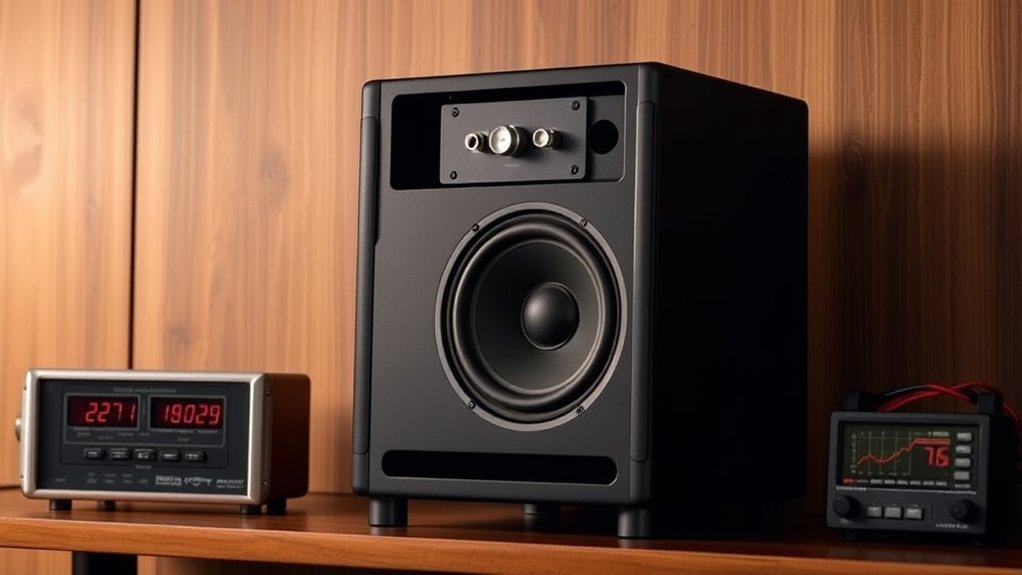
Sensitivity measurement in bookshelf speakers is typically conducted in standardized testing environments to guarantee consistency and accuracy across different models. We focus on specific measurement units, primarily decibels, to quantify how efficiently a speaker converts power into sound at a given distance. Understanding these parameters allows us to compare speakers precisely and evaluate their performance in real-world applications.
Standard Testing Environments
Measuring the sensitivity of bookshelf speakers requires a controlled environment to guarantee consistency and accuracy. This setup minimizes variables such as cabinet resonance, which can distort the measurement by amplifying or damping certain frequencies. Testing is typically conducted in an acoustically treated space to reduce reflections and external noise. Additionally, the influence of cabinet material is critical; rigid, dense materials help suppress unwanted vibrations, ensuring the measured output reflects the speaker’s true sensitivity. Precise placement of the speaker and microphone, often at a fixed distance, further standardizes results. These stringent conditions ensure that variations in sensitivity readings are attributable to the speaker design itself, not external factors like resonance or material-induced distortions, enabling reliable comparisons across different models.
Measurement Units Used
To quantify the loudness output of bookshelf speakers, manufacturers typically measure their sensitivity based on the sound pressure level (SPL) produced at a standardized distance with a specified input signal. The primary measurement units used are decibels (dB), representing the sensitivity ratings. These ratings specify how efficiently a speaker converts power into sound.
| Measurement Unit | Typical Range | Usage Context |
|---|---|---|
| Decibels (dB) | 85–95 dB | Standard sensitivity rating measurement |
| Watts (W) | 1 W, 2.83 W | Power input for SPL measurement |
| Distance (meters) | 1 meter | Standardized measurement distance |
This structured approach guarantees consistent, comparable sensitivity ratings across different bookshelf speakers.
Interpreting Sensitivity Ratings: What Do the Numbers Mean?
Understanding what the sensitivity ratings on bookshelf speakers truly indicate requires a careful examination of the numerical values provided. Sensitivity is typically measured in decibels (dB) and reflects how efficiently a speaker converts power into sound at a given distance, usually 1 meter. Higher sensitivity ratings suggest that less power is needed to produce the same volume. When interpreting these numbers, consider how woofer placement influences the perceived output, especially since placement affects how efficiently sound waves interact with the room. Additionally, the crossover frequency plays a role, as it determines how much power is allocated to the woofer versus other drivers. A detailed understanding of these factors helps in evaluating how a speaker’s sensitivity impacts overall performance and integration within a sound system.
High vs. Low Sensitivity Speakers: Pros and Cons
High sensitivity speakers typically require less power to achieve a given volume level, making them more efficient in converting electrical energy into sound. They excel in environments with limited amplification, often producing cleaner sound at lower wattages. However, their speaker material and crossover design influence their overall performance. For example, lightweight materials like aluminum or silk dome tweeters tend to favor high sensitivity ratings, but may introduce distortion if not properly engineered. Conversely, low sensitivity speakers often demand more power but can offer superior control over the driver, especially with complex crossover designs. The trade-off lies in efficiency versus control: high sensitivity models are more efficient but may lack precision, while low sensitivity designs excel in fidelity but require robust amplification.
| Aspect | Pros | Cons |
|---|---|---|
| Speaker Material | Lightweight, responsive sound | Potential for distortion if poorly designed |
| Crossover Design | Simpler, less demanding on power | Can reduce fidelity if not well-implemented |
| Power Requirements | Low sensitivity needs more power | Less efficient in energy conversion |
| Sound Clarity | High sensitivity can produce clearer highs | May introduce distortion at high volumes |
| Application Suitability | Best for small spaces or low wattage amps | Not ideal for high-power setups |
How Sensitivity Affects Your Listening Experience
Sensitivity directly influences the required amplifier power to achieve desired volume levels, especially in different room sizes, where higher sensitivity speakers can produce sufficient sound at lower wattages. This parameter also impacts clarity and detail, as more sensitive speakers tend to reproduce subtle nuances more effectively in appropriately matched environments. Understanding these effects helps optimize speaker selection to match room acoustics and listening preferences precisely.
Impact on Volume Levels
Ever wondered how the sensitivity rating of a bookshelf speaker directly influences its volume output? Higher sensitivity means the speaker requires less power to produce a given volume, enabling louder sound with less amplification. This directly impacts listening experience, especially in smaller rooms or with limited power sources. Material durability plays a role, as delicate speakers often use lightweight, rigid materials that enhance efficiency but must also withstand prolonged use without degradation. Aesthetic design influences placement and integration, affecting how well the speaker’s volume can be optimized without compromising style. Lower sensitivity speakers demand more power for similar volume levels, which can lead to increased distortion or component stress. Overall, sensitivity considerably shapes the balance between volume capacity, material resilience, and aesthetic considerations in your setup.
Room Size Compatibility
The interaction between speaker sensitivity and room size profoundly influences the overall listening experience by dictating how effectively a speaker can fill a space with sound. Higher sensitivity speakers often produce adequate volume in smaller rooms but may struggle in larger spaces without additional amplification. Conversely, lower sensitivity models require more power to reach comparable levels, which can be challenging in large rooms. Room acoustics and furniture placement further modify sound dispersion, affecting perceived clarity and balance. To optimize performance, consider the following:
| Room Size | Sensitivity Requirements | Furniture Placement Impact |
|---|---|---|
| Small | High sensitivity suitable | Minimal furniture, closer walls |
| Medium | Moderate sensitivity needed | Strategic furniture placement enhances acoustics |
| Large | Lower sensitivity, more power | Open space with careful speaker positioning |
| Very Large | Very low sensitivity | Extensive treatment and placement adjustments |
| Irregular | Custom sensitivity approach | Adjust furniture for sound diffusion |
Clarity and Detail
Higher sensitivity speakers tend to deliver greater clarity and finer detail at lower volume levels, which can considerably enhance the overall listening experience. This benefit stems from their design, where speaker construction—such as the quality of the drivers and cabinet materials—maximizes efficient energy transfer, reducing distortion and improving detail retrieval. Sensitivity influences how well a speaker reproduces subtle audio nuances, especially in complex passages. Additionally, acoustic environments play a critical role; in smaller or acoustically treated rooms, high-sensitivity speakers can produce clearer sound with less power, highlighting fine details like instrument textures and vocal nuances. Conversely, in larger or less controlled spaces, the benefits may diminish, as room reflections and background noise interfere with clarity. Overall, sensitivity impacts the balance between technical precision and environmental adaptability.
Matching Speaker Sensitivity With Your Amplifier or Receiver
Matching your speaker sensitivity with your amplifier or receiver is essential for achieving ideal sound levels and system efficiency. A mismatch can lead to insufficient volume or distortion, which can be mitigated by considering speaker placement and acoustic treatment. Higher sensitivity speakers require less power, making them suitable for lower-powered amplifiers, while lower sensitivity models demand more current for peak performance. Proper speaker placement enhances sensitivity benefits, ensuring direct sound reaches the listener without excessive reflections. Acoustic treatment in the room reduces unwanted sound reflections, helping to maintain consistent sound levels regardless of sensitivity ratings. By aligning speaker sensitivity with your amplifier’s power output and optimizing placement and room acoustics, you ensure a balanced, high-fidelity listening experience.
Common Sensitivity Ratings and What They Indicate
Common sensitivity ratings, typically expressed in decibels (dB) measured at 1 meter with 1 watt input, serve as a key indicator of a speaker’s efficiency. Higher ratings generally suggest louder output with less power, which directly impacts the suitability for different listening environments. Understanding these ratings allows us to predict how well a speaker will perform within a given space and with various amplification levels.
Standard Sensitivity Measurements
Standard sensitivity measurements for bookshelf speakers are typically expressed in decibels (dB) and serve as quantifiable indicators of how efficiently a speaker converts electrical power into acoustic output. These ratings, often measured at 1 meter with 2.83V input, reflect the speaker’s ability to produce sound with minimal power. Variations in woofer placement and crossover settings can influence sensitivity, affecting how loud and detailed the output appears. Recognizing common sensitivity ratings helps us predict performance:
- High sensitivity (above 90 dB): More efficient, louder sound with less power.
- Moderate sensitivity (around 86–90 dB): Balanced performance suitable for most rooms.
- Lower sensitivity (below 86 dB): Requires more power for comparable volume.
- Impact of design: Proper crossover tuning and woofer positioning optimize sensitivity for clarity and dynamic range.
Implications for Listening Space
Understanding the sensitivity ratings of bookshelf speakers is essential for evaluating how they will perform within different listening environments. Higher sensitivity speakers (above 85 dB) require less power, making them suitable for smaller spaces or setups with limited amplification, while lower sensitivity models (below 85 dB) benefit from strategic speaker placement and higher power input. Proper speaker placement enhances sound dispersion, especially in rooms with reflective surfaces, where acoustic treatment—such as diffusers or absorbers—can minimize unwanted reflections and improve clarity. Sensitivity ratings also influence how loud a speaker can get without distortion, impacting the overall listening experience. Recognizing these factors helps us tailor our listening space, ensuring ideal sound performance aligned with the speaker’s sensitivity characteristics.
Does Sensitivity Impact Power Efficiency and Sound Quality?
While higher sensitivity ratings in bookshelf speakers often suggest greater efficiency, their impact on power consumption and sound quality warrants a nuanced examination. Increased sensitivity can reduce the amplifier’s power needs, improving overall power efficiency. However, this does not always guarantee superior sound fidelity, as other factors like driver design and enclosure influence clarity and accuracy.
Consider these points:
- High sensitivity minimizes power draw, reducing energy costs and heat generation.
- Lower sensitivity may require more power for comparable volume, increasing energy use.
- Sensitivity alone doesn’t determine sound quality; driver quality and cabinet design are critical.
- Sound fidelity depends on how well the speaker reproduces accurate, detailed audio, beyond just efficiency metrics.
Understanding these nuances helps us choose speakers that balance power efficiency with sound quality.
Tips for Choosing the Right Sensitivity for Your Room and Use
Selecting the appropriate speaker sensitivity requires careful consideration of your room’s size, acoustics, and typical listening volume. In larger or acoustically reflective spaces, higher sensitivity speakers can deliver sufficient volume with less amplifier power, reducing distortion. Conversely, smaller or acoustically damped rooms benefit from lower sensitivity models, which often require more power but can provide tighter control over sound. Speaker placement critically influences perceived sensitivity; positioning away from walls or reflective surfaces minimizes unwanted resonances, ensuring accurate sound reproduction. Understanding your room’s acoustics allows us to match sensitivity with the amplifier’s power output, avoiding underperformance or distortion. Ultimately, balancing these factors guarantees superior sound quality tailored to your room’s unique characteristics and your listening preferences.
Frequently Asked Questions About Speaker Sensitivity
What exactly does speaker sensitivity measure, and how does it impact your overall audio experience? Sensitivity indicates how efficiently a speaker converts power into sound, affecting volume output with given wattage. Higher sensitivity speakers (measured in dB) typically produce louder sound with less power, ideal for smaller rooms or less powerful amplifiers. Factors like speaker material influence sensitivity, as rigid, dense materials improve efficiency, while crossover design determines how well frequencies are allocated, impacting overall clarity. Understanding these components is crucial for matching speakers to your system.
Speaker sensitivity measures efficiency in converting power to sound, influencing volume and clarity in your audio setup.
- Achieve clearer, more dynamic sound with ideal crossover design
- Experience consistent volume without excessive power demands
- Select speaker materials that enhance efficiency and durability
- Tailor sensitivity to your room’s acoustics for immersive listening
Frequently Asked Questions
Can Two Speakers With Different Sensitivities Sound the Same?
Two speakers with different sensitivities won’t sound the same because their required speaker power varies, affecting sound clarity and volume. Higher sensitivity speakers need less power for the same volume, impacting overall audio performance and perceived sound quality.
How Does Room Size Affect Speaker Sensitivity Requirements?
Room size considerably influences speaker matching and sensitivity needs; larger rooms demand higher sensitivity speakers to overcome room acoustics challenges, ensuring adequate sound pressure levels, while smaller spaces benefit from lower sensitivity models for precise, balanced audio reproduction.
Is Higher Sensitivity Always Better for Home Theater Systems?
Higher sensitivity isn’t always better; it’s like a double-edged sword, often requiring less power handling but potentially sacrificing frequency response detail. We analyze how balancing sensitivity with power handling and frequency response optimizes home theater sound quality effectively.
How Does Sensitivity Influence Speaker Placement Options?
Higher sensitivity allows more flexible speaker positioning, reducing the need for strict placement to achieve desired volume, especially with acoustic treatment. We analyze room acoustics and speaker placement to optimize sound quality based on sensitivity levels.
Are There Any Disadvantages to Very High Sensitivity Speakers?
High sensitivity speakers can reduce power efficiency and sometimes compromise sound clarity due to increased driver movement, leading to potential distortion or reduced fidelity at higher volumes, which we consider when selecting speakers for ideal audio performance.
Conclusion
In the end, understanding sensitivity isn’t just for audiophiles—it’s for anyone who wants their speakers to actually fill the room without draining their wallet or amplifier. So, next time you pick a bookshelf speaker, remember: higher sensitivity means louder sound with less effort, but may sacrifice nuance. It’s a delicate dance of technical specs and personal preference, all to guarantee your listening experience isn’t just loud, but also intelligible—because nobody wants a symphony of distortion, right?

)