Imagine a finely tuned orchestra where each instrument must be precisely placed for harmony; the same principle applies to bookshelf speakers. The correct distance between them influences soundstage, clarity, and stereo imaging, making or breaking your listening experience. Achieving this balance requires understanding key measurements and room considerations. To optimize your setup, it’s essential to explore the factors that determine ideal spacing and how small adjustments can markedly improve audio quality.
Key Takeaways
- Aim for a spacing of 1.0 to 1.2 times the distance from the listening position for optimal stereo imaging.
- Match the speaker distance to the listener to form an equilateral triangle for balanced soundstage.
- Adjust spacing based on room size: closer in small rooms, wider in larger spaces.
- Fine-tune placement using listening tests to improve sound clarity and instrument localization.
- Ensure symmetrical placement and proper height aligned with ear level for accurate sound imaging.
How Do Bookshelf Speakers Affect Sound Quality When Placed Close Together?
When bookshelf speakers are placed too close together, their sound waves can interfere with each other, leading to destructive and constructive interference patterns. This interference causes uneven frequency response and muddled stereo imaging, reducing overall sound clarity. Additionally, tight proximity can negatively impact speaker aesthetics, creating a cluttered appearance that distracts from the listening environment. Proper cable management becomes more critical, as closely spaced speakers often require careful routing to prevent tangling and signal degradation. Excessive proximity may also amplify resonances and reflections, further compromising sound quality. To avoid these issues, ideal spacing ensures minimized interference, preserves speaker aesthetics, and facilitates clean cable management, all contributing to accurate sound reproduction and a more immersive listening experience.
What Is the Recommended Distance Between Bookshelf Speakers for Optimal Stereo Imaging?
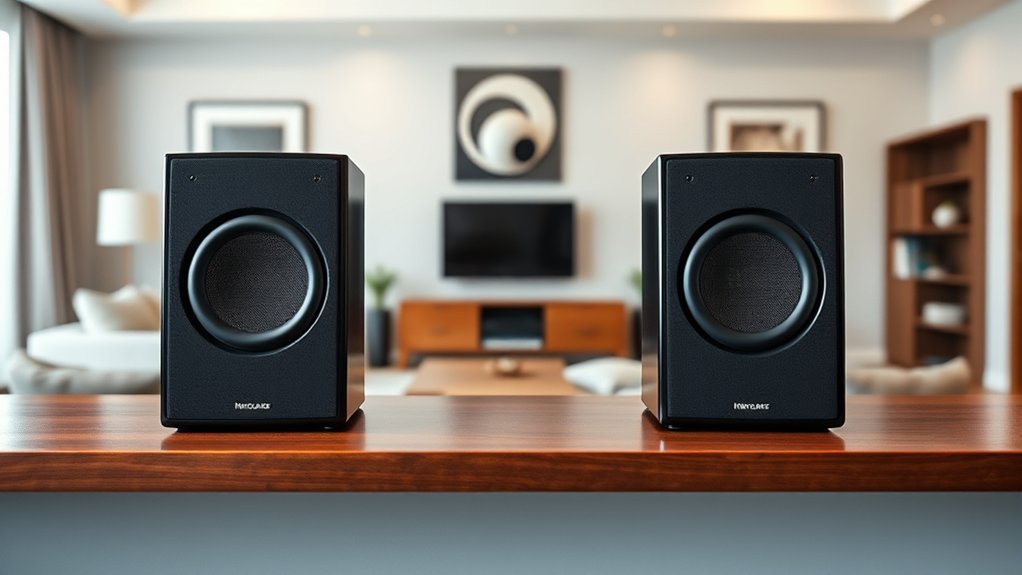
Ideal stereo imaging depends on precise speaker spacing, typically around 1.0 to 1.2 times the distance from the listening position. Room size influences this spacing, as larger rooms may require wider placement to maintain soundstage coherence. Additionally, the listener’s position relative to the speakers critically affects imaging accuracy and should be factored into setup considerations.
Ideal Speaker Spacing
Determining the ideal spacing between bookshelf speakers is essential for achieving accurate stereo imaging, as it directly influences the soundstage and overall listening experience. Proper spacing ensures balanced imaging and minimizes phase issues. Typically, speakers should be placed approximately 1.0 to 1.5 times the distance from the listening position, promoting symmetrical sound dispersion. Consider these factors:
- Use high-quality speaker cable to maintain signal integrity over the chosen distance.
- Ensure amplifier power matches speaker impedance and distance to prevent distortion.
- Maintain consistent spacing to avoid uneven soundstage and phase discrepancies.
Optimal speaker placement balances technical precision with acoustic principles, ensuring that stereo imaging remains precise without overextending cable runs or stressing amplifier capabilities.
Room Size Impact
The size of the room considerably influences the ideal distance between bookshelf speakers for achieving precise stereo imaging. Larger rooms typically require wider speaker placement to guarantee sound waves adequately fill the space, while smaller rooms benefit from closer positioning to avoid sound dispersion issues. Proper spacing enhances stereo imaging accuracy, which can impact speaker durability by reducing unnecessary strain on internal components caused by excessive volume adjustments. Additionally, suitable placement considers bookshelf aesthetics, ensuring speakers are positioned without cluttering or compromising the visual harmony of the space. Accurate speaker distance in relation to room dimensions minimizes acoustic reflections and standing waves, resulting in clearer, more defined audio. Ultimately, adjusting for room size ensures balanced sound and preserves the longevity and appearance of your bookshelf speakers.
Listening Position Factors
To achieve the best stereo imaging, the distance between bookshelf speakers should be carefully aligned with the listener’s seated position. Ideal placement considers factors like speaker height, which should match ear level for accurate sound staging. The perfect distance between speakers generally mirrors the distance to the listening position, creating an equilateral triangle. Good cable management ensures clean, consistent connections, preventing signal degradation that could impact imaging. Additionally, proper speaker height minimizes reflections and phase issues, enhancing clarity. When adjusting, consider these points:
- Speaker height aligned with ear level
- Maintaining equal distance from the listening position
- Securing cables to avoid interference or distortion
Aligning these factors ensures precise stereo imaging, resulting in a balanced, immersive sound experience.
How Room Size and Acoustics Influence Speaker Placement Distance?
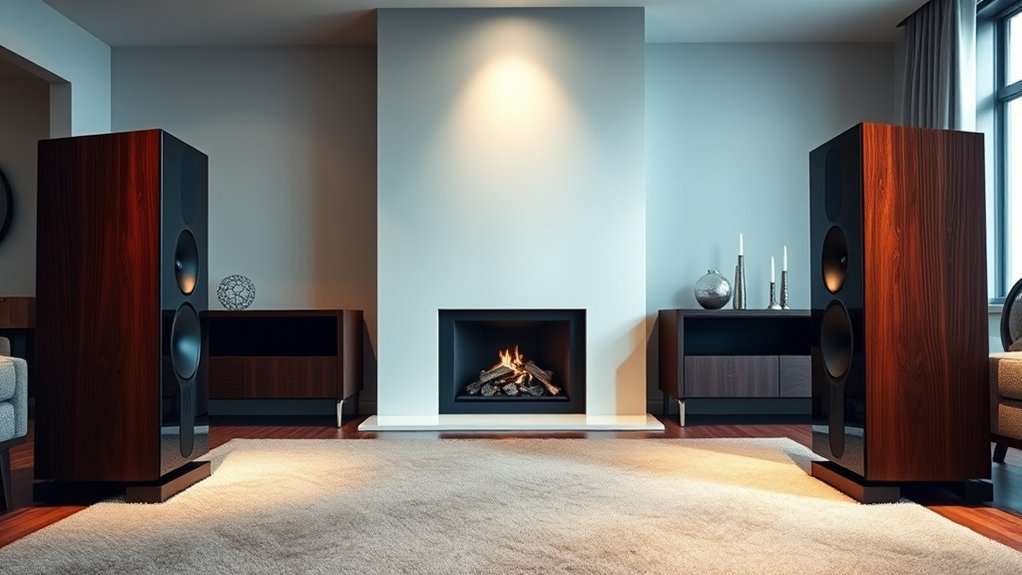
Room dimensions directly influence ideal speaker spacing, as larger spaces require greater distances to maintain proper stereo imaging. Acoustic treatments, such as diffusers and absorbers, modify sound reflections and can necessitate adjustments in placement for clarity and balance. Understanding these factors guarantees precise speaker positioning tailored to the specific room environment.
Room Dimensions Impact Spacing
When considering speaker placement, room dimensions play a essential role in achieving ideal sound quality; larger or irregularly shaped spaces require different spacing strategies than compact, symmetrical rooms. For perfect results, consider how the room’s size influences speaker height, ensuring they are positioned at ear level for clarity. Additionally, larger rooms may necessitate increased spacing to prevent sound cancellation, while smaller spaces might require closer placement to avoid excessive reflections. Proper cable management becomes key in larger setups, preventing interference and maintaining clean signal paths. Key considerations include:
- Adjusting speaker height based on room height and listening position
- Increasing spacing in larger rooms to enhance stereo imaging
- Ensuring cables are organized to reduce noise and facilitate precise placement
Acoustic Treatments Affect Placement
Acoustic treatments profoundly influence how we should position bookshelf speakers, especially considering the room’s size and sound characteristics. Proper placement depends on the room’s reflective and absorptive properties, which directly affect sound clarity and imaging. Acoustic treatments, such as diffusers and absorbers, mitigate reflections that can cause comb filtering and muddiness. They also help establish an ideal balance between direct and reflected sound, making speaker symmetry vital. Symmetrical placement relative to room boundaries ensures balanced soundstage and minimizes phase discrepancies. Adjusting speaker distance based on acoustic treatments allows for more precise calibration, reducing the need for excessive toe-in or distance adjustments. Ultimately, understanding these factors leads to more accurate speaker positioning, resulting in improved stereo imaging and overall sound fidelity.
How to Find the Perfect Speaker Separation Based on Your Listening Position?
Determining the most suitable speaker separation begins with understanding the relationship between your listening position and the speakers themselves. Precise placement enhances stereo imaging and soundstage depth. To optimize this, consider:
- Speaker height: Ensure tweeters are aligned with your ear level when seated, maintaining consistent vertical alignment.
- Cable management: Keep speaker cables organized and taut, avoiding slack that could cause movement or uneven positioning.
- Listener distance: Position speakers so that the distance between them approximates the distance from each speaker to your listening position, forming an equilateral triangle.
Fine-tuning these factors creates a balanced sound environment, reducing phase issues and ensuring accurate stereo imaging. Proper speaker separation based on your listening position maximizes clarity and immersive experience.
What Factors Should You Consider When Adjusting Speaker Distance?
When adjusting speaker distance, we must consider the room’s size and shape, as these directly influence sound reflection and absorption. The coverage area of the listening zone also impacts ideal placement, ensuring consistent sound quality across the space. Proper evaluation of these factors allows for precise speaker positioning to achieve balanced acoustics.
Room Size and Shape
The size and shape of your room greatly influence the ideal placement of bookshelf speakers, as these physical characteristics affect sound propagation and reflection patterns. Larger rooms may require increased speaker separation to prevent sound overlap, while smaller spaces benefit from closer positioning to minimize reflections. Considerations include best speaker height for direct sound delivery and minimizing reflections from surfaces. Proper cable management ensures neatness and reduces signal interference, especially when adjusting speaker placement within irregularly shaped rooms.
- Larger rooms might need wider spacing to maximize soundstage.
- Irregular shapes increase the importance of strategic speaker height adjustment.
- Acoustic treatment and furniture placement can influence effective speaker distance.
Listening Area Coverage
How do we guarantee that our bookshelf speakers effectively cover the listening area? It begins with ideal furniture placement to minimize obstructions that can disrupt sound dispersion. Proper placement ensures a balanced stereo image and consistent sound coverage across the listening zone. Additionally, speaker isolation plays a vital role; isolating speakers from vibrations and external noise sources reduces distortion and maintains clarity. Adjusting speaker distance to achieve a seamless soundstage involves measuring direct sound paths and avoiding reflections from nearby surfaces. We should also consider the height and angle of the speakers relative to the listener’s ear level, which influences sound projection. By carefully managing furniture placement and speaker isolation, we enhance coverage, maintaining an accurate and immersive listening experience.
How to Use Listening Tests to Fine-Tune Your Bookshelf Speaker Spacing?
Utilizing listening tests is an essential step in precisely adjusting your bookshelf speaker spacing to achieve ideal sound staging and clarity. To do this effectively, focus on critical elements such as speaker cable quality and amplifier gain, which influence tonal balance. During testing, listen for the spatial coherence and localization of instruments, adjusting speaker positions incrementally. Use these tips:
- Swap speaker cable connections to confirm consistent sound imaging.
- Fine-tune the distance between speakers to improve stereo image and avoid phase cancellation.
- Adjust amplifier gain to ensure balanced volume levels and prevent distortion.
What Common Placement Mistakes Can Harm Your Audio Experience?
Incorrect placement of bookshelf speakers can substantially degrade audio quality by causing phase issues, uneven sound distribution, and reduced stereo imaging. One common mistake is improper speaker height; positioning speakers too high or low relative to ear level disrupts ideal sound wave alignment, impairing clarity and imaging. Additionally, poor cable management can introduce interference and clutter, affecting signal integrity and accessibility. Ensuring the speaker drivers are at ear level and securely managing cables prevents accidental displacements and minimizes electromagnetic interference. Neglecting these factors results in inconsistent soundstage, diminished detail, and listener fatigue. Precise attention to speaker height and organized cable routing are essential for maintaining accurate stereo separation and overall audio fidelity. Avoiding these placement errors is critical for maximizing your bookshelf speakers’ performance.
How to Balance Aesthetics and Performance in Speaker Arrangement?
Balancing aesthetics with performance involves strategic placement that satisfies both visual harmony and acoustic integrity. Achieving this requires careful consideration of both form and function, guaranteeing the speakers complement the room’s design while enhancing sound quality. To maintain aesthetic harmony, consider these points:
- Align speakers symmetrically for visual balance, avoiding cluttered or asymmetrical arrangements.
- Select finishes and colors that blend seamlessly with the room’s decor, enhancing visual appeal without sacrificing acoustic performance.
- Use discreet mounting or stands that elevate sound clarity while minimizing visual distraction.
This approach guarantees the speaker setup is both visually pleasing and acoustically effective, creating a cohesive environment where form follows function. Proper balance avoids sacrificing sound quality for aesthetics or vice versa, resulting in an ideal listening and viewing experience.
When Is It Time to Experiment With Different Speaker Distances?
Adjusting speaker distances becomes necessary when the initial setup no longer delivers ideal sound quality or immersive experience. Signs include inconsistent speaker isolation, reduced clarity, or uneven soundstage. When these issues persist despite proper cable management, experimenting with distances can optimize performance. Consider rearranging the speakers closer or farther apart, ensuring they form equilateral triangles with the listening position. Use the following visualization:
| Distance Adjustment | Effect on Sound | Key Focus |
|---|---|---|
| Closer speakers | Increased direct sound | Speaker isolation |
| Farther apart | Broader soundstage | Cable management |
| Slight inward tilt | Improved imaging | Precise positioning |
| Slight outward tilt | Reduced comb filtering | Alignment accuracy |
These adjustments refine sound clarity and spatial coherence, ultimately enhancing listening experience.
How Can You Improve Soundstage and Clarity by Adjusting Speaker Placement?
Optimizing speaker placement is essential for achieving a precise soundstage and clear audio reproduction. To improve soundstage and clarity, focus on achieving proper speaker symmetry, ensuring both speakers are equidistant from the listening position. Adjusting placement to minimize sound reflection from nearby surfaces reduces acoustic interference, enhancing clarity. Consider the following:
Proper speaker placement enhances sound clarity and stereo imaging through symmetry and reflection minimization.
- Position speakers at ear level and equidistant from the listening area to maintain symmetry.
- Avoid placing speakers near reflective surfaces like glass or bare walls to reduce sound reflection.
- Fine-tune toe-in angles to direct sound toward the listening position, improving stereo imaging.
Frequently Asked Questions
How Does Speaker Height Influence Sound Quality and Stereo Imaging?
Speaker height critically impacts sound clarity and stereo imaging, as aligning the tweeters with ear level guarantees ideal frequency response and precise soundstage, helping us achieve balanced, immersive audio experiences with accurate stereo separation.
Can Furniture or Obstacles Affect Optimal Speaker Placement?
Studies show that furniture or obstacle interference can reduce sound clarity by up to 30%. We find that furniture interference and obstacle interference markedly impact speaker placement, requiring careful positioning to maintain ideal acoustics and stereo imaging.
What Is the Impact of Speaker Angle on Sound Dispersion?
The speaker angle considerably influences sound dispersion and diffusion, as angling speakers towards the listening position narrows dispersion for focused sound, while wider angles promote broader diffusion, creating a more immersive, natural audio experience for you.
How Do Different Music Genres Influence Ideal Speaker Spacing?
Imagine a balanced symphony; for genres emphasizing bass like hip-hop, closer spacing enhances bass response, maintaining speaker symmetry. For acoustic or classical music, wider spacing improves soundstage, ensuring precise imaging and detailed clarity.
Should Speaker Placement Change for Different Room Acoustics?
Yes, speaker placement should adapt to room dimensions and guarantee speaker symmetry, optimizing sound reflection and absorption. We adjust positioning based on these factors to achieve balanced, accurate audio performance tailored to each unique acoustic environment.
Conclusion
In essence, fine-tuning the distance between your bookshelf speakers can subtly elevate your listening experience, much like adjusting a finely crafted instrument. While the recommended spacing aligns with an equilateral triangle based on your seating position, room acoustics and personal preferences may invite gentle experimentation. By attentively refining placement, you optimize soundstage and clarity, ensuring your audio environment remains an elegant blend of precision and immersive quality—an artful balance worth exploring.