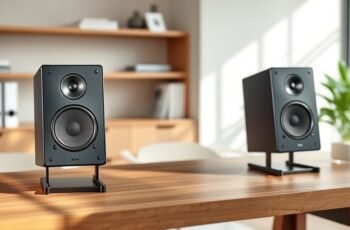
Understanding how bookshelf speaker crossovers work is essential for anyone looking to optimize sound quality. These circuits direct specific frequency ranges to the appropriate drivers, ensuring clarity and balance. While the concepts can seem complex, grasping the basics of component roles and design choices provides a solid foundation. As we explore the key elements involved, you’ll see how precise tuning can markedly improve your listening experience—something worth considering for any audio enthusiast or DIYer.
Key Takeaways
- Crossovers split audio signals into different frequency ranges for tweeters and woofers, ensuring clear, balanced sound.
- Passive crossovers are built inside the speaker, while active ones operate externally with separate amplification.
- Components like inductors and capacitors filter frequencies; their quality impacts sound clarity and durability.
- Proper speaker placement and room treatment improve crossover performance by reducing reflections and resonances.
- Adjusting crossover points and slopes helps achieve seamless blending and optimal sound quality across all frequencies.
How Do Bookhelf Speaker Crossovers Work?
Have you ever wondered how bookshelf speakers produce clear, balanced sound across different frequencies? The answer lies in the crossover network, a vital component that directs specific frequency ranges to the appropriate drivers within the speaker enclosure. Essentially, the crossover acts as a filter, ensuring high frequencies go to the tweeter and lower ones to the woofer. This division allows for precise sound reproduction. The effectiveness of this process depends on the design of the crossover and the quality of the amplification system, which powers each driver efficiently. Together, these elements maximize the speaker’s performance, ensuring that each driver operates within its ideal frequency range, resulting in a cohesive, detailed soundstage. This technical coordination is fundamental to achieving accurate audio reproduction in bookshelf speakers.
Types of Crossover Designs for Bookshelf Speakers
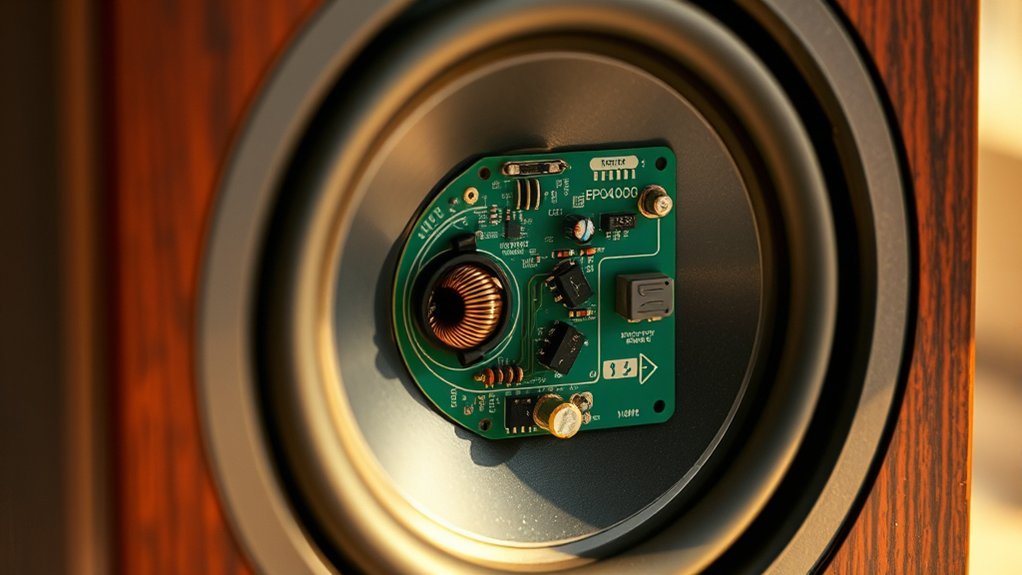
Different crossover designs employ distinct electrical configurations to filter and direct frequency ranges to the appropriate drivers. The most common types include passive, active, and series crossovers. Passive crossovers are integrated within the speaker cabinet, often optimized with cabinet damping materials to reduce internal reflections and resonances, enhancing sound clarity. Active crossovers operate externally and require separate amplification for each driver, offering precise control over crossover points and slopes. Series crossovers connect drivers in a single circuit, simplifying design but limiting flexibility. Speaker placement influences crossover effectiveness; proper positioning minimizes boundary effects and guarantees the intended frequency response. Each design choice impacts overall sound quality, cabinet damping requirements, and installation considerations, making understanding these types essential for peak bookshelf speaker performance.
Key Components Inside a Crossover Circuit
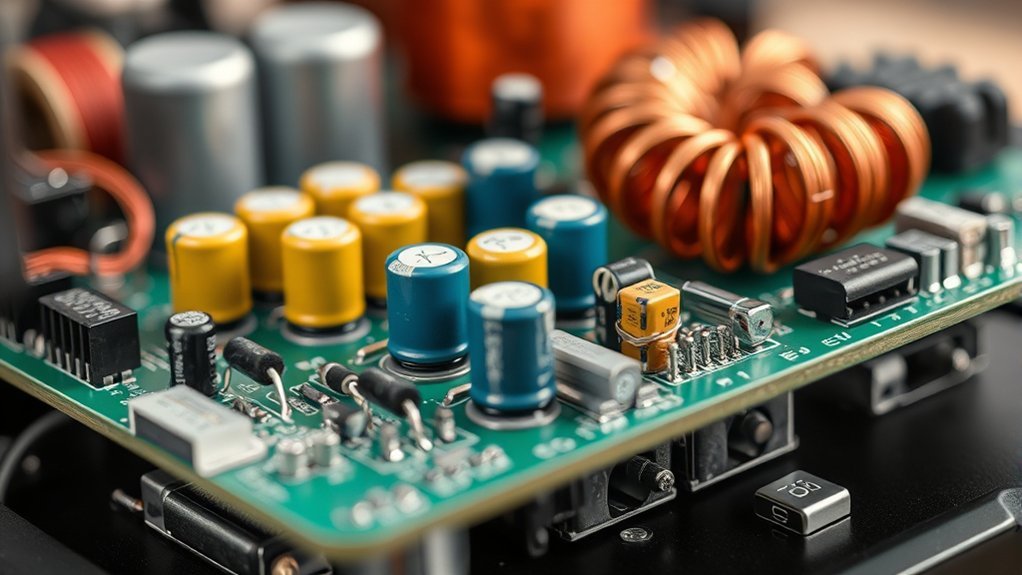
Inside a crossover circuit, several key components work together to filter and direct audio signals efficiently. The primary components include inductors, capacitors, and resistors, each selected based on specific material properties that influence their electrical behavior and durability. Material properties such as dielectric constant for capacitors or core material for inductors determine their performance and frequency response. Manufacturing techniques also play a critical role, guaranteeing precise component tolerances and reliable construction. High-quality components minimize signal loss and distortion, maintaining accurate sound reproduction. Properly designed crossovers leverage these components’ material properties and manufacturing precision to achieve the desired filtering characteristics. This meticulous selection guarantees the crossover functions effectively, directing appropriate frequencies to each driver while preserving sound integrity throughout the speaker system.
How to Determine the Right Crossover Frequency
To determine the appropriate crossover frequency, we must analyze the characteristics of each speaker driver and how they interact within the system. Key factors include the driver’s frequency response, power handling, and directivity. Additionally, the speaker enclosure influences acoustic damping, which affects the driver’s resonance and damping of unwanted frequencies.
Consider these points:
- Match the driver’s natural roll-off point to the crossover frequency.
- Guarantee the enclosure provides sufficient acoustic damping to minimize resonances.
- Avoid frequencies where driver responses overlap excessively, causing phase issues.
- Select a crossover point that maintains a smooth progression, preserving sound clarity.
Careful selection assures ideal integration between drivers, leveraging acoustic damping and enclosure design for accurate, balanced sound reproduction.
The Role of Slope and Filtering in Crossover Performance
The slope and filtering characteristics of a crossover directly influence how effectively it separates frequencies between drivers, guaranteeing seamless integration and minimizing distortion. Slope optimization involves selecting the appropriate filter steepness to reduce overlap and unwanted frequency bleed. Steeper slopes, like 24 dB/octave, provide sharper cutoff points, improving driver separation, but may introduce phase issues if not carefully managed. Filter design must balance slope steepness with phase response and transient behavior to maintain clarity. Proper filtering ensures that each driver receives the correct frequency range without interference, resulting in a cleaner, more coherent sound. Ultimately, precise control over slope and filtering characteristics enhances crossover performance, promoting accurate frequency division and ideal speaker operation.
How Crossover Quality Affects Sound Clarity and Balance
High-quality crossovers directly influence sound clarity and balance by ensuring accurate frequency division and minimal signal distortion. Material quality and manufacturing precision are critical; inferior components can introduce noise, phase issues, and uneven frequency response. Specifically:
- Superior materials reduce resistance and inductance, preserving signal integrity.
- Precise manufacturing minimizes tolerances, ensuring consistent frequency crossover points.
- High-grade components maintain stability over temperature and power fluctuations.
- Attention to detail in assembly prevents unintended parasitic effects that distort sound.
Common Crossover Mistakes and How to Avoid Them
Even experienced designers can make critical mistakes when configuring crossovers, which can substantially impair speaker performance. One common error is poor phase alignment between drivers, causing destructive interference that reduces clarity and distortion. Ensuring proper phase alignment requires precise component selection and wiring to maintain synchronization across the crossover point. Additionally, impedance mismatches can lead to uneven frequency response and driver stress, degrading sound quality and risking damage. Achieving correct impedance matching involves selecting components with appropriate impedance ratings and verifying that the crossover network maintains a consistent load across drivers. Failing to address these issues results in compromised sound coherence and efficiency. To avoid these mistakes, meticulous measurement, careful component selection, and thorough testing are essential for ideal crossover performance.
DIY vs. Commercial Crossovers: Which Is Better?
Deciding between DIY and commercial crossovers depends on your project’s specific requirements, technical skill level, and budget constraints. DIY crossovers offer customization in material selection, allowing precise control over components like inductors, capacitors, and resistors. They enable tailoring to achieve desired design aesthetics, including physical size and visual integration. Conversely, commercial crossovers provide reliable performance with tested designs and consistent quality. When choosing, consider:
- Material selection flexibility versus standardized components
- Ability to modify for specific sound signatures
- Aesthetic integration with speaker design
- Budget constraints impacting component quality and labor
Ultimately, DIY crossovers excel in customization, but commercial options ensure consistency and convenience, making each suitable depending on your priorities.
Tips for Upgrading Your Bookshelf Speaker Crossover
Upgrading your bookshelf speaker crossover can significantly improve sound clarity and overall performance, but it requires careful planning and precise execution. Start by assessing speaker placement; ideal positioning minimizes reflections and phase issues, enhancing crossover effectiveness. Incorporate acoustic treatment around your listening area to reduce unwanted resonances and standing waves, ensuring cleaner signal integration. When upgrading components, select high-quality capacitors and inductors, matching their specifications to your speaker’s design. Reconsider the crossover slope and crossover point, tailoring them to your room acoustics and speaker drivers. Always verify component compatibility and maintain consistent wiring polarity. These meticulous adjustments, combined with proper speaker placement and acoustic treatment, lead to a more transparent, balanced sound with improved crossover integration.
How to Test and Tune Your Crossover for Optimal Sound
To optimize your crossover, we begin by accurately measuring the speaker’s frequency response using a calibrated microphone and analysis software. Next, we systematically adjust crossover settings—such as cutoff frequencies and slopes—and observe their impact on the response curve. This process guarantees a precise balance between drivers, resulting in a cohesive and accurate sound reproduction.
Measuring Frequency Response
How can we accurately assess the frequency response of our bookshelf speakers to guarantee ideal crossover tuning? First, select a measurement environment with controlled room acoustics to minimize reflections and standing waves. Correct speaker placement is vital; position speakers away from walls and corners to reduce boundary effects. Next, use a calibrated microphone and measurement software to record the response across the audible spectrum. Confirm the microphone is at ear level and equidistant from both speakers. Then, analyze the data to identify peaks and dips indicating frequency response irregularities. Finally, perform multiple measurements, adjusting speaker placement or room treatments as needed, to establish a consistent, flat response. This process guarantees precise crossover tuning aligned with the room’s acoustic characteristics.
Adjusting Crossover Settings
What is the most effective way to fine-tune your bookshelf speaker crossover for ideal sound quality? The key lies in precise adjustment and thorough testing. Begin by evaluating speaker placement to guarantee maximum phase alignment and minimize standing waves, which influence crossover performance. Use measurement tools like a microphone and software to analyze the frequency response after each adjustment. Room acoustics considerably impact crossover effectiveness; treat reflective surfaces and position speakers to reduce unwanted resonances. Fine-tune the crossover settings gradually, listening critically to how the midrange and high frequencies blend. Confirm consistency across different listening positions. Iterative testing, combined with careful speaker placement and consideration of room acoustics, ensures the crossover delivers a smooth, balanced sound across the entire frequency spectrum.
Frequently Asked Questions
Can a Crossover Be Adjusted After Installation?
Yes, adjustable crossovers allow us to fine-tune our bookshelf speakers after installation, enabling DIY modification for peak sound. We carefully modify component values to achieve precise crossover points and desired frequency responses, enhancing overall audio clarity.
How Does Room Acoustics Affect Crossover Performance?
Room reflections and speaker placement considerably influence crossover performance; poor positioning amplifies reflections, causing phase issues and frequency response anomalies, which compromise clarity and coherence. Precise speaker placement minimizes reflections, optimizing crossover integration and overall sound fidelity.
Are There Specific Brands Known for High-Quality Crossovers?
Think of brands like Vandersteen and JL Audio as master artisans, forging crossovers with top-tier components. Their reputation for precision engineering guarantees superior sound fidelity, making them prime choices for audiophiles seeking high-quality crossover performance.
What Tools Are Needed to Measure Crossover Performance?
We use measurement techniques like an audio analyzer, impedance meter, and signal generator, ensuring precise equipment calibration. These tools help us accurately assess crossover performance, identify phase issues, and optimize frequency response for high-quality sound reproduction.
How Often Should Crossover Components Be Replaced or Upgraded?
We believe crossover components typically last several years, but their lifespan varies with usage and quality. Regularly inspecting and upgrading components guarantees peak performance, preventing issues before they become a thorn in your side, keeping your sound crisp.
Conclusion
In essence, designing a bookshelf speaker crossover is like tuning a finely crafted instrument—every component and setting must harmonize perfectly. When we get it right, the sound flows seamlessly, much like a well-conducted orchestra. We’ve seen how precise calculations and quality components can transform listening experiences. By understanding and fine-tuning your crossover, you’re ensuring each note reaches your ears in clarity and balance, elevating your entire audio journey to professional standards.