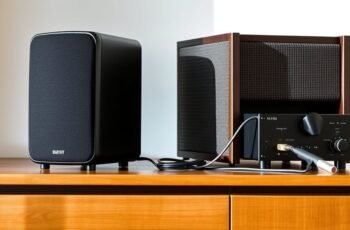
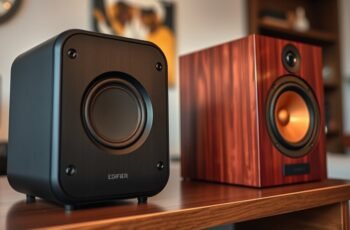
When it comes to choosing audio equipment, the question isn’t just about sound quality but how well the speakers integrate into your space and meet your listening needs. We often assume larger speakers automatically deliver better sound, yet the decision is more nuanced, hinging on design, performance, and practical considerations. Understanding these differences can considerably impact your listening experience, prompting a closer look at whether bookshelf or computer speakers are better suited for your environment.
Key Takeaways
- Bookshelf speakers offer superior sound quality and full-range audio, ideal for larger rooms and audiophile needs.
- Computer speakers are compact and budget-friendly, suitable for desktop use and casual listening.
- Placement and room size greatly influence sound performance; bookshelves excel in open spaces, while computer speakers suit smaller areas.
- Bookshelf speakers tend to be more expensive but provide better durability and sound fidelity over time.
- Choose based on space, use case, and desired audio quality—bookshelf for immersive listening, computer for convenience.
How Do Bookshelf Speakers and Computer Speakers Differ in Design and Construction?
While both bookshelf speakers and computer speakers serve to deliver audio, their design and construction reflect distinct functional priorities. Bookshelf speakers typically feature larger speaker enclosures that optimize acoustic resonance and minimize distortion, often employing high-quality materials for durability and sound fidelity. Their driver configuration usually includes multiple drivers—woofers and tweeters—arranged to produce a balanced, full-range sound. In contrast, computer speakers prioritize compactness and convenience, often having smaller, sealed enclosures that limit sound dispersion but save space. Their driver configurations tend to be simpler, frequently integrating a single driver or a minimal setup to produce acceptable audio output within size constraints. These structural differences directly influence their performance, with bookshelf speakers offering richer sound due to their larger enclosures and sophisticated driver arrangements.
Which Speakers Deliver Better Sound Quality for Different Uses?
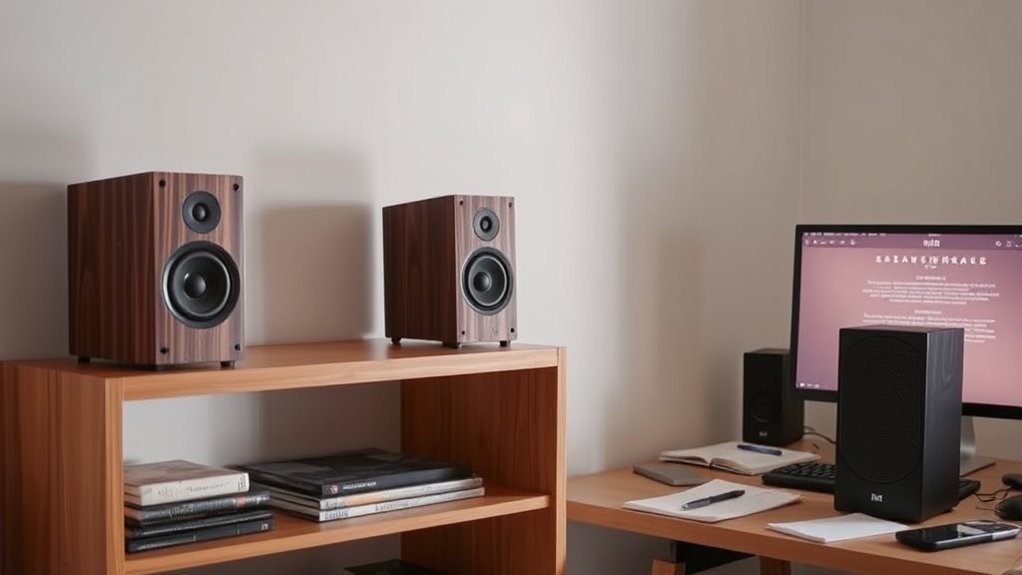
The design differences between bookshelf and computer speakers substantially influence their suitability for various audio applications. Bookhelf speakers typically offer superior acoustic performance due to their larger drivers and enhanced enclosure design, which support broader frequency ranges and better soundstage. Their ideal speaker placement—often on stands or shelves—maximizes sound quality, especially in larger rooms, providing clearer high and mid frequencies. Conversely, computer speakers are engineered for close-range use, with compact designs that prioritize direct sound delivery. While they may lack the depth and nuance of bookshelf speakers, their acoustic performance is well-suited for desktop setups, casual listening, or gaming. Ultimately, the choice depends on the intended use and how speaker placement impacts the overall sound experience.
What Factors Should You Consider When Choosing Between Them?
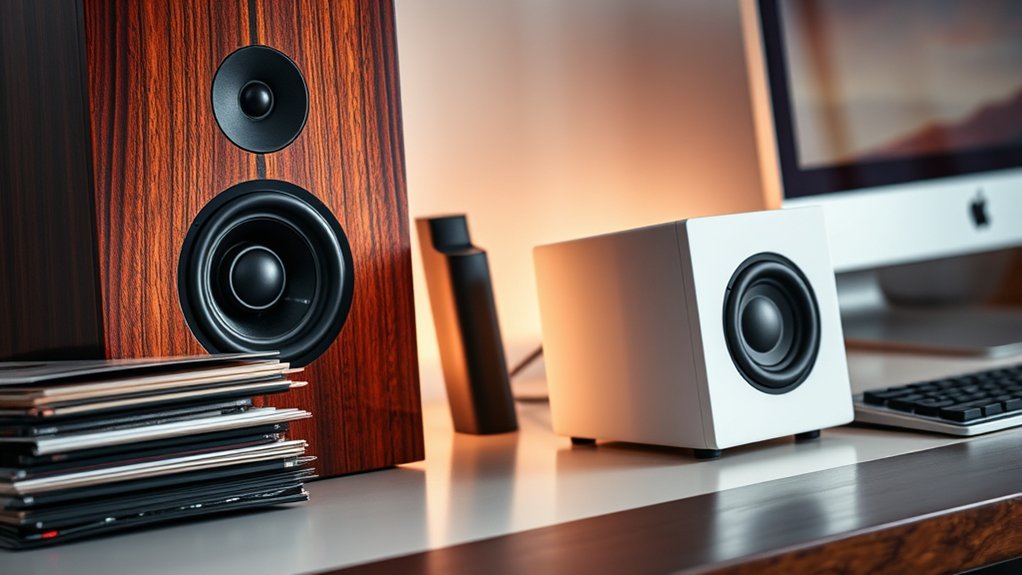
When choosing between bookshelf and computer speakers, several vital factors must be evaluated to guarantee the selection aligns with your specific audio needs and environment. Speaker placement greatly influences sound quality; bookshelf speakers typically benefit from ideal positioning away from walls to reduce bass muddiness, while computer speakers are often placed on desks, impacting their frequency response. The acoustic environment also plays an essential role—larger, open spaces favor bookshelf speakers for richer sound dispersion, whereas confined or cluttered areas may diminish their effectiveness. Consider the room’s size, shape, and reflective surfaces, as these elements affect sound clarity and spatial imaging. Ultimately, understanding how placement and environment interact helps determine which speaker type will deliver the best listening experience for your space.
How Much Do These Speakers Typically Cost, and Which Offers Better Value?
Typically, bookshelf speakers range from $200 to $2,000 per pair, while computer speakers are generally priced between $50 and $300. When evaluating value, consider these factors:
- Speaker durability: Higher-priced bookshelf models often feature more robust build quality, leading to longer lifespan and better resistance to wear.
- Brand reputation: Established brands tend to deliver consistent sound quality and reliable speaker durability, justifying higher costs.
- Sound quality per dollar: While bookshelf speakers usually offer superior sound fidelity, computer speakers provide decent quality at a lower price point.
- Long-term investment: Although initial costs are higher for bookshelf speakers, their durability and brand reputation often result in better overall value over time.
Ultimately, the better value depends on your needs for longevity and sound performance.
Which Speaker Type Is More Suitable for Your Space and Lifestyle?
Choosing between bookshelf speakers and computer speakers depends heavily on your available space and lifestyle needs. For smaller or cluttered environments, computer speakers offer a compact, integrated solution that minimizes space requirements, though they may sacrifice aesthetic appeal. Conversely, bookshelf speakers excel in larger spaces, providing superior sound quality and a more refined aesthetic appeal that enhances room decor. Brand reputation plays a vital role in decision-making; established brands typically guarantee durability and consistent performance, aligning with a lifestyle that values reliability. Ultimately, if your priority is a discreet setup with convenience, computer speakers are more suitable. However, for audiophiles seeking immersive sound and a visually appealing presence, bookshelf speakers better match your space and lifestyle.
Frequently Asked Questions
Can Bookshelf Speakers Connect Directly to a Computer?
We can connect bookshelf speakers directly to a computer if they have compatible wired inputs and match the computer’s audio output. Wireless connectivity requires additional adapters, and power requirements must be met, often needing an external amplifier.
Do Bookshelf Speakers Require an Amplifier or Receiver?
Bookshelf speakers generally require an amplifier or receiver due to their higher power requirements and specific speaker compatibility, which guarantees ideal performance and prevents damage, making them unsuitable for direct connection to most computers.
Are Computer Speakers Better for Gaming or Movies?
Like a symphony’s conductor, computer speakers excel in delivering immersive surround sound and crisp bass performance, making them superior for gaming and movies. Their targeted design enhances clarity, engaging us fully in every auditory detail.
How Much Space Do Bookshelf Speakers Typically Occupy?
We find bookshelf speakers typically occupy around 12 to 18 inches in width, 10 to 15 inches in height, and 10 inches in depth, balancing aesthetic design with installation requirements for ideal space efficiency and sound performance.
Which Speaker Type Is More Portable for Travel?
We find computer speakers more portable for travel, thanks to their compact, lightweight design that emphasizes travel convenience. Their streamlined form factor allows for easier packing and setup, making them ideal for on-the-go audio needs.
Conclusion
In essence, choosing between bookshelf and computer speakers is like selecting the right tool for a precise job — each has its strengths. If you prioritize full-range sound and durability, bookshelf speakers are your best bet. For compact, budget-friendly setups, computer speakers fit seamlessly. Assess your space, usage, and preferences carefully. By analyzing these factors, you’ll find the speaker type that not only meets your needs but elevates your listening experience to new heights.