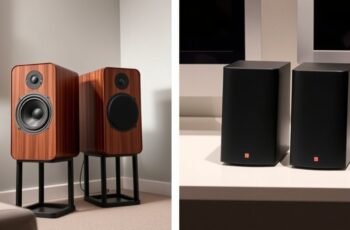
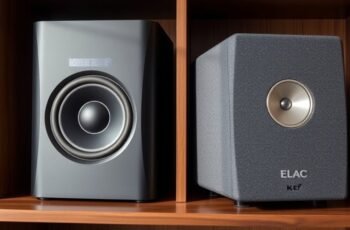
We examine how material choice influences sound transmission, how the acoustic properties of MDF and wood differ, and the effect of density on sound quality. We analyze resonance, vibrations, tonal warmth, clarity, aesthetic impact, and durability—each playing a role in overall performance. Understanding these factors helps determine which material best suits specific listening environments and preferences, prompting us to explore the nuanced differences that shape our audio experience.
Key Takeaways
- MDF offers uniform density, reducing internal resonances and vibrations for clearer, more precise sound reproduction.
- Solid wood’s natural grain introduces variability, potentially causing resonances that color sound quality.
- MDF’s dense structure absorbs vibrations effectively, enhancing sound clarity and damping unwanted vibrations.
- Natural wood provides warmth and unique tonal characteristics but may transmit vibrations, affecting sound purity.
- MDF is more cost-effective and environmentally friendly, ideal for controlled environments; wood offers aesthetic appeal and superior resonance.
How Do MDF and Wood Differ in Sound Transmission?
While both MDF (Medium Density Fiberboard) and solid wood are commonly used in speaker cabinet construction, they differ particularly in how they transmit sound. MDF’s uniform density minimizes internal resonances, resulting in clearer, more accurate sound transmission. Its damping properties absorb vibrations that could otherwise distort audio output. Conversely, solid wood’s natural grain and variable density can introduce resonances that color the sound, affecting clarity. The choice of cabinet color and the design of the speaker grill also influence perceived sound quality, as they impact acoustic reflections and visual aesthetics. MDF typically provides a neutral platform for these elements, maintaining consistent sound regardless of cabinet finish. Understanding these material differences helps optimize cabinet design for precise sound reproduction.
The Acoustic Properties of MDF and Solid Wood Cabinets
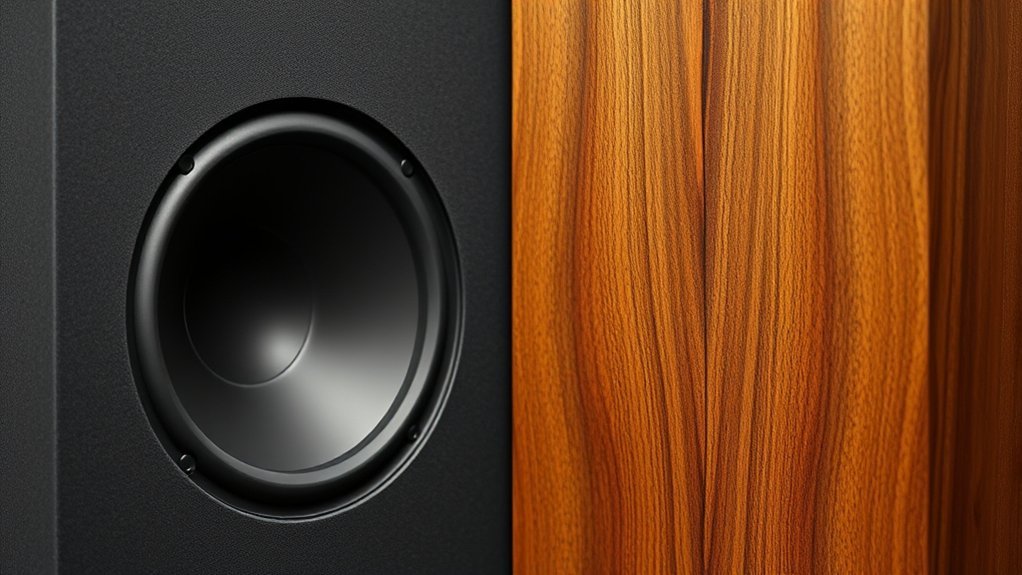
The inherent acoustic properties of MDF and solid wood considerably influence how their cabinets respond to sound waves. MDF’s uniform density reduces resonances, resulting in tighter sound control, while solid wood’s natural grain introduces variability, impacting resonance and damping. Material sustainability plays a role, as MDF derives from recycled fibers with eco-friendly manufacturing techniques, whereas solid wood involves harvesting practices affecting environmental impact. These differences affect sound clarity and resonance control. The table below compares key properties:
| Property | MDF | Solid Wood | Impact on Sound |
|---|---|---|---|
| Density | Consistent, moderate | Variable, often higher | Affects resonance and damping |
| Manufacturing techniques | Pressed fiber composites | Carving and drying | Influences material stability |
| Material sustainability | Recycled fibers, eco-friendly | Harvesting concerns | Long-term environmental impact |
| Damping qualities | Superior, uniform | Variable, grain-dependent | Affects sound clarity |
| Resonance control | Better due to uniformity | Less predictable | Impacts sound fidelity |
How Material Density Affects Speaker Sound Quality
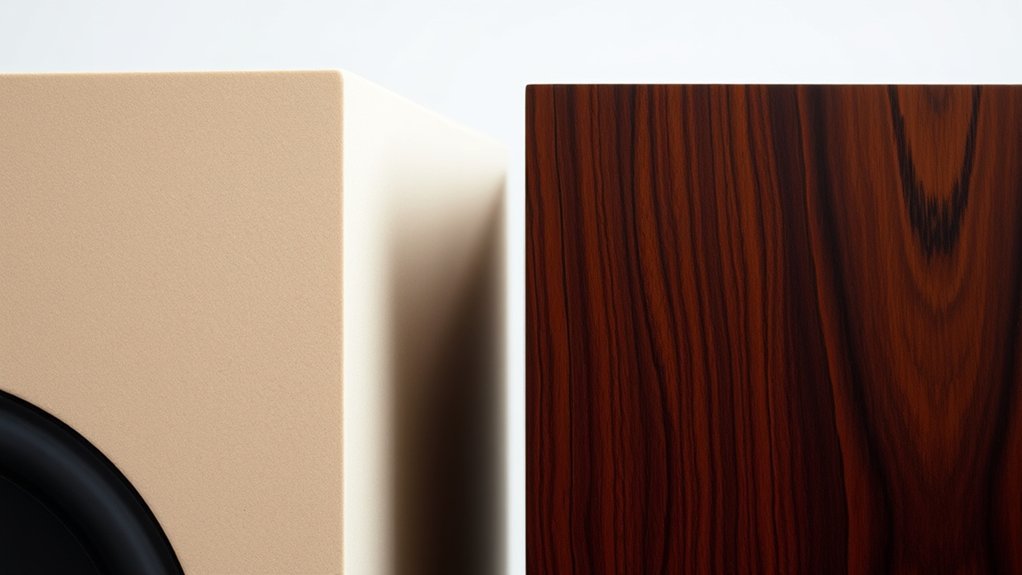
Material density directly influences sound resonance and clarity by affecting how vibrations propagate within the cabinet structure. Denser materials tend to minimize structural vibrations, resulting in a clearer and more focused tone, while lighter materials may introduce unwanted resonance. Understanding this relationship is essential for optimizing speaker sound quality through material selection.
Sound Resonance and Clarity
Density plays a crucial role in shaping the sound resonance and clarity of speaker cabinets, as it directly influences how vibrations propagate within the enclosure. Denser materials, like MDF, tend to dampen unwanted vibrations, resulting in clearer sound reproduction, while lighter woods may introduce resonance that colors the audio. Material sustainability also factors into this balance, as eco-friendly options often have varying densities affecting acoustic performance. Manufacturing techniques further refine how these materials perform; precise cutting and bonding influence internal damping and vibration control. Ultimately, selecting a material with ideal density and sustainable qualities, combined with advanced manufacturing, ensures a cabinet that minimizes resonance artifacts and delivers heightened clarity, providing a more accurate and refined listening experience.
Structural Vibrations and Tone
Vibrations within a speaker cabinet are directly influenced by the mass and stiffness of its construction materials, with density playing a pivotal role in how these vibrations manifest. Higher-density materials, such as certain hardwoods, tend to dampen unwanted resonances, resulting in clearer, more controlled tones. Conversely, lower-density materials like MDF may transmit vibrations more readily, potentially coloring the sound. Material sustainability also impacts these properties; sustainably sourced woods often exhibit different density characteristics due to growth conditions, influencing vibration behavior. Manufacturing processes further modify how these materials perform; precision milling and treatment can enhance damping qualities. Understanding these factors allows us to optimize tonal accuracy and structural integrity, balancing material choice with sustainability considerations to achieve an ideal acoustic environment.
Resonance and Vibrations: MDF vs Wood
MDF generally offers superior resonance control and dampening compared to natural wood, reducing unwanted vibrations that can color sound quality. Its dense, uniform structure absorbs vibrations more effectively, leading to cleaner audio reproduction. Understanding how these material differences influence vibration absorption and resonance behavior is essential when evaluating cabinet materials for maximum sound fidelity.
Resonance Control Differences
While both MDF and natural wood are commonly used in speaker cabinets, their resonance control properties differ considerably due to their intrinsic material characteristics. MDF’s dense, uniform structure minimizes internal resonance, providing a stable acoustic environment that reduces unwanted vibrations. This stability enhances sound clarity and prevents cabinet-induced distortion. Conversely, natural wood’s organic grain and varying density can amplify resonance, leading to potential coloration of sound. From an interior design perspective, MDF offers a consistent, sleek surface that maintains aesthetic appeal with minimal warping over time. Wood, however, introduces unique visual textures and character, which can complement a more natural or traditional aesthetic. Ultimately, the choice impacts resonance control, where MDF excels in damping vibrations, and wood offers aesthetic versatility that can influence the overall acoustic environment.
Vibration Absorption Qualities
The ability of a speaker cabinet to absorb vibrations considerably influences its overall acoustic performance, and this capacity varies markedly between MDF and natural wood. MDF’s dense structure effectively dampens unwanted vibrations, enhancing material durability and reducing resonance, which results in a cleaner sound. Conversely, wood’s natural fibers allow for more flex, potentially transmitting vibrations but adding aesthetic appeal due to its organic grain. To highlight these differences:
| Feature | MDF | Wood | Impact |
|---|---|---|---|
| Vibration Absorption | High | Moderate | MDF offers superior vibration damping |
| Material Durability | Consistent, resistant | Prone to warping | MDF maintains shape over time |
| Aesthetic Appeal | Limited, utilitarian | Unique grain patterns | Wood offers visual richness |
This comparison underscores MDF’s strength in vibration absorption, contrasted with wood’s aesthetic advantages.
Material Impact on Sound
Have you ever wondered how the choice of material influences a speaker cabinet’s resonance and vibrations? MDF and wood differ markedly in their impact on sound quality due to their material aesthetics and manufacturing techniques. MDF’s dense, uniform structure minimizes resonance, resulting in clearer sound reproduction. In contrast, natural wood’s grain patterns and varying density can introduce subtle vibrational nuances, adding warmth but potentially causing unwanted coloration.
- MDF’s stability reduces internal vibrations, enhancing accuracy.
- Wood’s natural grain creates complex vibrational modes, affecting tonal character.
- Manufacturing techniques influence how each material dampens or amplifies specific frequencies.
Understanding these factors helps us appreciate how material selection shapes the acoustic profile of speaker cabinets.
Impact on Tonal Warmth and Clarity
Different materials used in speaker cabinets considerably influence the tonal warmth and clarity of the resulting sound. Material flexibility plays a critical role, as more rigid materials tend to minimize unwanted resonances, enhancing clarity. Wood, with its natural damping properties, offers a warmth that softer, more flexible materials may lack, but it can introduce subtle resonances affecting tonal purity. Conversely, MDF’s consistent density and limited flexibility allow for precise manufacturing, reducing unwanted vibrations and delivering clearer sound reproduction. Manufacturing precision further amplifies these effects; tightly controlled fabrication reduces cabinet imperfections that could compromise sound clarity or warmth. Ultimately, material flexibility and manufacturing accuracy work in tandem to shape the tonal qualities, with MDF favoring clarity through rigidity and precision, while natural wood emphasizes warmth due to its inherent damping qualities.
Aesthetic Appeal and Its Acoustic Influence
Aesthetic appeal considerably influences both the visual perception and the acoustic performance of speaker cabinets. The choice of materials impacts not only the look but also the way sound interacts with the enclosure. For example, color options can enhance integration into various environments, while surface finishes affect visual clarity and perceived quality. Different materials offer distinct aesthetic qualities, like the natural grain of wood or the smooth uniformity of MDF painted in various hues. These visual elements can subtly influence listener perception of sound quality. Maintenance tips, such as avoiding abrasive cleaners, help preserve aesthetic integrity without compromising acoustic properties. Ultimately, selecting a material with favorable aesthetic and color options guarantees the cabinet complements space while maintaining acoustic fidelity.
Durability and Its Role in Sound Performance
Why does durability play a crucial role in the sound performance of speaker cabinets? Material longevity directly influences structural stability, reducing resonance issues that can distort sound quality. A durable cabinet maintains its shape over time, ensuring consistent acoustic performance. Aesthetic durability also matters; surfaces resistant to wear prevent visible damage that could distract or undermine the visual integrity of the speaker. We see that materials like MDF offer good longevity due to their dense composition, minimizing vibrations that degrade sound clarity. Conversely, natural wood, while aesthetically appealing, may be more susceptible to environmental factors impacting its resilience. Ultimately, selecting a material with high material longevity ensures that the cabinet preserves its acoustic and visual qualities, providing reliable, high-quality sound over extended periods.
Which Material Is Better for Different Listening Environments?
Choosing the appropriate speaker cabinet material hinges on the specific listening environment, as each setting presents unique acoustic and practical demands. For example, in controlled studio spaces, MDF’s acoustic neutrality offers precise sound reproduction, while in outdoor environments, natural wood’s resonance can enhance sound warmth. Material sustainability influences long-term environmental impact, favoring MDF due to its recyclability, whereas natural wood offers aesthetic and acoustic advantages. Manufacturing costs also vary; MDF is more cost-effective and easier to produce at scale, making it suitable for mass-market applications. Conversely, high-end wooden cabinets often involve higher costs but deliver superior resonance qualities. Ultimately, selecting between MDF and wood depends on balancing these factors against the environment’s acoustic needs and sustainability priorities.
How to Choose the Right Material for Your Speaker Cabinet
Selecting the right material for your speaker cabinet requires careful consideration of several key factors, including acoustic performance, environmental conditions, budget, and intended use. Room placement greatly influences this choice; for example, smaller rooms may benefit from denser materials that minimize resonance, while larger spaces might require materials with better damping. Speaker size also plays a critical role—larger speakers often generate more vibrations, necessitating rigid, well-damped materials like MDF or hardwood to prevent unwanted vibrations and sound coloration. Additionally, environmental factors such as humidity or temperature fluctuations should guide material selection to maintain structural integrity. Ultimately, balancing these considerations guarantees ideal sound clarity and durability aligned with your room setup and speaker specifications.
Frequently Asked Questions
How Does Moisture Affect MDF and Wood Speaker Cabinets Over Time?
Moisture absorption causes material degradation in both MDF and wood speaker cabinets, weakening their structure and altering sound quality over time. We analyze how sustained exposure impacts durability, emphasizing the importance of moisture-resistant coatings for long-term performance.
Are There Cost Differences Between MDF and Solid Wood for Speaker Cabinets?
We find that MDF typically costs less than solid wood, making it a budget-friendly choice, especially considering its material durability. While wood may be pricier, it offers superior resilience, influencing long-term performance and overall investment value.
Can the Choice of Material Influence Speaker Weight and Portability?
Material density considerably impacts speaker weight, influencing portability considerations; MDF’s higher density makes cabinets heavier and less portable than lighter, less dense wood, affecting transportation and setup ease for various applications.
How Do Environmental Factors Impact the Longevity of MDF Versus Wood Cabinets?
Environmental factors degrade MDF faster due to moisture absorption, affecting acoustic properties and aesthetic appeal, while wood’s natural resilience offers longer longevity. We analyze these impacts to optimize cabinet durability and sound quality under varying conditions.
Are There Specific Speaker Designs Better Suited for MDF or Wood Enclosures?
We find that designs emphasizing acoustic properties and customization typically perform better with MDF due to its uniform density, while wood enclosures suit traditional, aesthetic-focused designs where natural resonance and craftsmanship enhance sound quality.
Conclusion
Ultimately, choosing between MDF and wood is like selecting the right brush for a masterpiece—we shape the soundscape with precision. MDF offers a controlled, transparent canvas, minimizing internal resonances for clarity. Wood, with its organic grains, adds warmth and character, akin to subtle brushstrokes. Your environment and sonic preferences guide the decision, balancing technical performance with aesthetic appeal. By understanding these nuances, we craft speaker enclosures that resonate perfectly with our auditory ambitions.