Have we ever wished our compact speakers could sound like a serious audio setup without overwhelming our room or our budget?

What Makes the Edifier R1280DBs Stand Out?
When we look at bookshelf speakers in this price range, many promise rich sound and wireless convenience, but few actually deliver both. The Edifier R1280DBs Active Bluetooth Bookshelf Speakers aim to give us a studio-style listening experience with modern features like Bluetooth 5.0, optical input, and a subwoofer line out, all in a compact 2.0 system.
We get the feeling that these speakers are designed for those of us who want great everyday sound for music, movies, and gaming, without messing with complicated receivers or huge floor-standing speakers.
Key Features at a Glance
Before we get into the details, it helps to see the core features laid out clearly. This way we can quickly understand what we are getting and how it might fit our own setup.
| Feature | Details |
|---|---|
| Speaker Type | 2.0 Active Bluetooth Bookshelf Speakers |
| Total Power Output | 42W RMS (continuous undistorted power) |
| Tweeter | 13 mm silk dome tweeter |
| Woofer | 4-inch driver |
| Wireless Connectivity | Bluetooth 5.0 |
| Wired Inputs | Optical (OPT), Coaxial, Dual RCA line-in |
| Subwoofer Output | Yes, with auto crossover detection |
| Sound Enhancement | Soundfield Spatializer |
| Controls | Side panel knobs (bass, treble, volume), included remote |
| Color | Black |
| Use Cases | Music, TV audio, gaming, home office, small studio monitoring |
This quick summary already shows us that Edifier is trying to cover a lot of ground with this model: wireless convenience, flexible wired inputs, and the option to add a subwoofer later if we want more bass.

Design and Build Quality
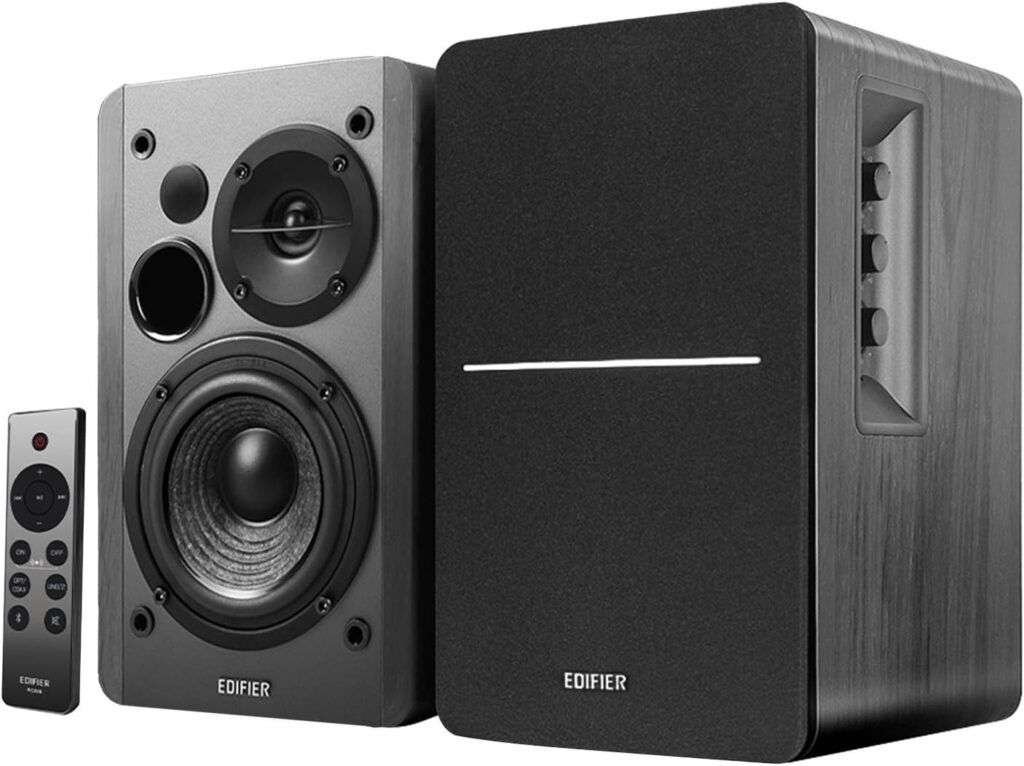
When we first set eyes on the Edifier R1280DBs, we notice that they carry the familiar Edifier bookshelf aesthetic: compact, understated, and clean. These speakers are designed to blend into our room rather than scream for attention, which is ideal for living rooms, bedrooms, and offices.
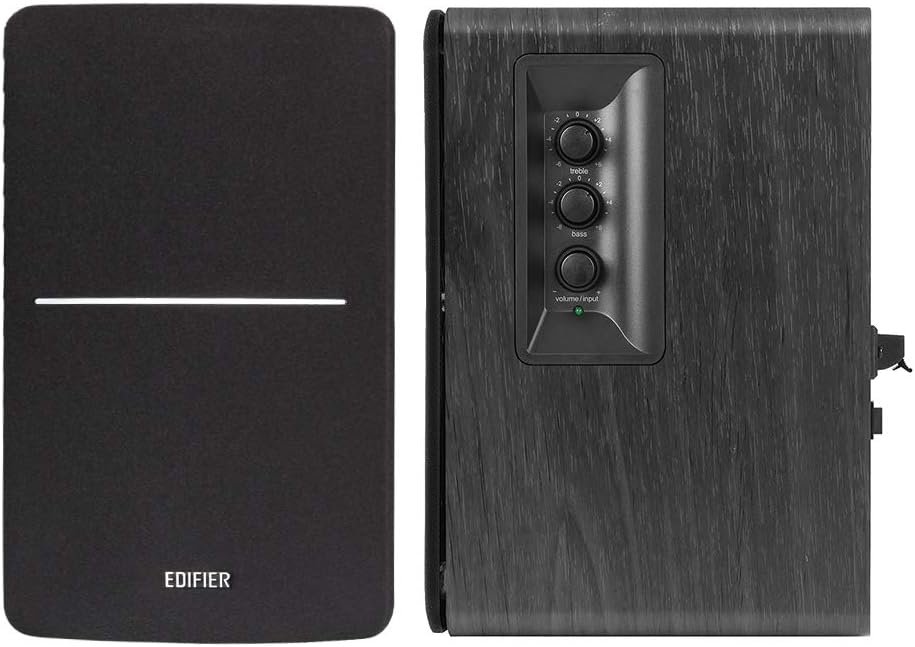
We get a pair of speakers where one is active (powered) and one is passive. The active speaker houses the amplifier, connections, and controls, while the passive one connects via a speaker cable. The black finish gives them a modern, professional look that pairs nicely with TVs, monitors, and most desktop setups.
Materials and Construction
The cabinets feel solid and well-built, which is important for sound quality because thin, flimsy enclosures can introduce unwanted vibrations and resonance. With the R1280DBs, we get a reasonably dense casing that helps control those artifacts.
We also get removable grilles, which allow us to choose between a cleaner, more minimal front or a slightly more “studio” look with the drivers exposed. The fit and finish are consistent with what we expect in this price bracket, and perhaps a bit better than many cheaper plastic-based alternatives.
Size and Placement
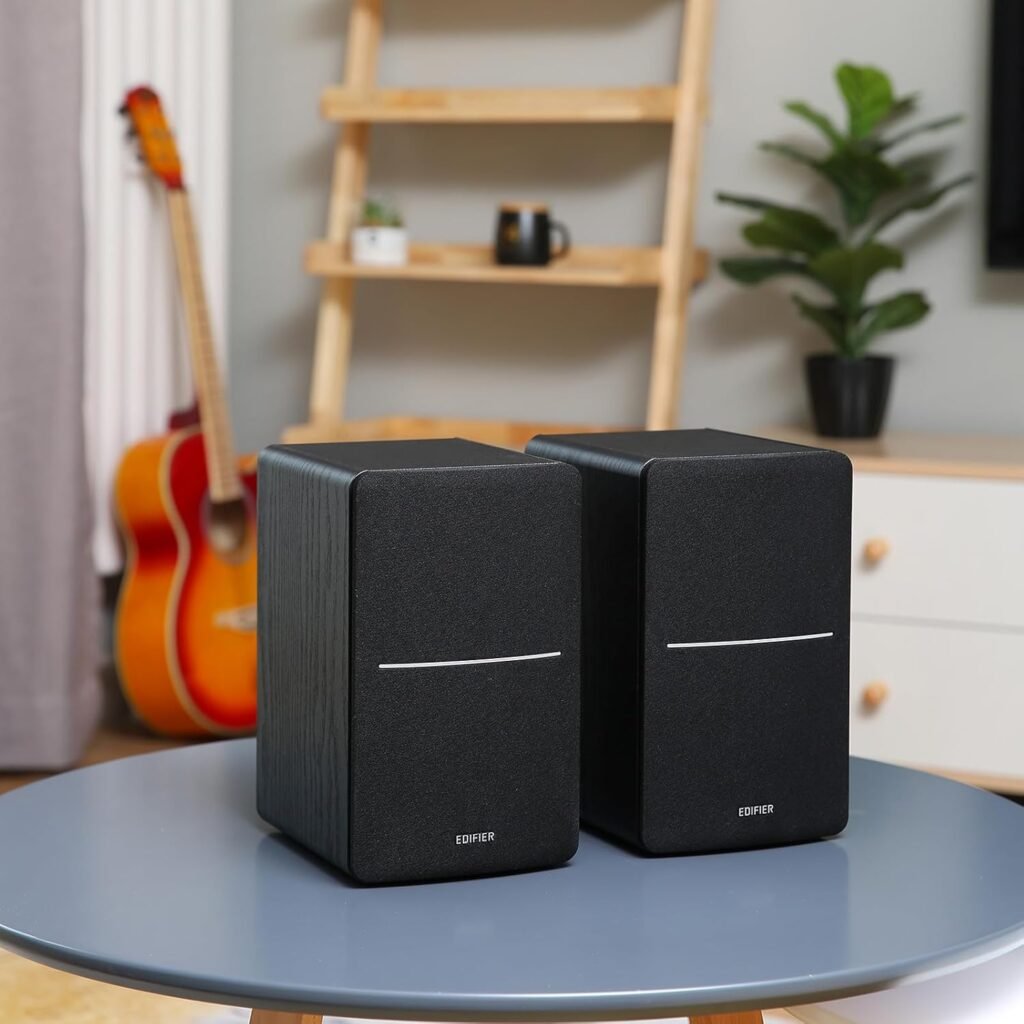
One of the strengths of bookshelf speakers is that they can work in small spaces. These are compact enough to sit on a desk alongside a monitor, on a TV stand, or on shelves.
We just need to keep in mind a couple of placement tips to bring out the best sound:
- Give them a bit of space from the back wall if possible.
- Aim the speakers so they point roughly toward our listening position.
- Try to keep them at roughly ear height when seated, especially the tweeters.
Even with minimal setup effort, we can get very satisfying results, and we do not need a huge room for them to shine.
Connectivity and Input Options
We often end up juggling multiple devices: phones, tablets, laptops, TVs, and game consoles. The Edifier R1280DBs try to simplify that by giving us several ways to connect, both wired and wireless.
Bluetooth 5.0 for Wireless Audio
With Bluetooth 5.0, we get more stable wireless streaming, lower latency than older versions, and better overall reliability. We can pair the speakers with our smartphone, tablet, laptop, or even some TVs that support Bluetooth audio.
In everyday use, Bluetooth 5.0 translates into:
- Quicker pairing and reconnection.
- Fewer dropouts at normal room distances.
- Enough bandwidth for high-quality compressed audio streams.
We can sit on the couch, control music from our phone, and not worry about a tangle of cables. For casual listening, streaming, and background music, this is very convenient.
Optical and Coaxial Digital Inputs
The optical (TOSLINK) and coaxial inputs are valuable if we plan to use the speakers with a TV or a desktop computer with digital output. These inputs allow us to send a digital signal directly to the speakers’ built-in DAC (digital-to-analog converter) for a clean, lossless connection.
When we use the optical or coaxial input:
- We reduce electrical noise from some analog outputs.
- We keep audio transmission digital until it reaches the speaker.
- We often get clearer, more consistent sound than with weak analog outputs on cheaper devices.
For TV setups in particular, optical is a big advantage. Many modern TVs offer optical audio as their main audio out, and using it with these speakers can be a simple and effective sound upgrade over built-in TV speakers.
Line-In Inputs for Analog Sources
The Edifier R1280DBs also include standard RCA line-in inputs. This makes it easy to hook up older devices such as:
- CD players
- Turntables with built-in preamps (or with a separate phono preamp)
- Older game consoles
- PCs or laptops using a 3.5 mm to RCA cable
We can keep more than one source connected and switch between them using the remote, which helps our setup feel more like a mini audio hub rather than a single-purpose speaker pair.
Subwoofer Line Out and Auto Crossover
One of the standout features is the subwoofer output with auto crossover detection. This means we can add an external powered subwoofer to extend the bass performance beyond what the 4-inch woofer can deliver on its own.
When we plug in a subwoofer:
- The speakers automatically detect it.
- A crossover kicks in so the main speakers and subwoofer share the work.
- The main speakers focus more on mids and highs, improving clarity.
- The subwoofer handles the deep bass frequencies.
This is a great upgrade path. We can start with the basic 2.0 setup and enjoy very good sound, then later add a sub to turn our system into a more full-range 2.1 setup if we decide we want more punch for movies and bass-heavy music.
Sound Quality Overview
For many of us, all the connection features are secondary to one main question: how do these speakers actually sound? The Edifier R1280DBs aim to deliver distortion-free, balanced audio that suits both casual listening and more focused sessions.
With 42W RMS (continuous, undistorted power), they have enough power for small to medium rooms. We do not need to max out the volume to fill our space with sound, and at moderate settings they stay clean and composed.
Tweeter and Woofer Combination
The use of a 13 mm silk dome tweeter and a 4-inch woofer is a proven formula in compact bookshelf speakers.
- The silk dome tweeter tends to produce smoother, more natural highs that are less fatiguing for long listening sessions.
- The 4-inch woofer handles mids and bass, giving body to vocals, instruments, and effects.
We end up with a tonal balance that is fairly neutral, leaning slightly warm, which is typical for Edifier’s bookshelf lines. That makes them easy to enjoy for long periods without harshness or “ear fatigue”.
Distortion-Free Power
Edifier advertises 42W of continuous undistorted power, which matters more than just listing a big wattage number. Many cheaper speakers exaggerate peak power without being able to deliver clean sound at real-world listening levels.
Here, we can turn the volume up to fill a typical living room or bedroom, and the speakers keep their composure. The lower distortion helps preserve detail in the music, from subtle background instruments to the “air” around vocals.
Soundfield Spatializer
The Soundfield Spatializer feature is designed to widen the soundstage and give us a sense that the speakers are farther apart than they really are. This can be handy if our physical placement options are limited, such as on a narrow desk.
When we activate this enhancement:
- The audio image feels wider and more open.
- We perceive a more immersive, “surround-like” effect.
- Some purists might prefer it off, but for movies and casual listening it can be enjoyable.
We can think of it like a virtual widening effect. It does alter the sound a bit for the sake of spaciousness, so we may want to experiment with it on and off for different content.
Bass, Mids, and Treble Performance
Breaking down the sound into low, mid, and high frequencies helps us understand what to expect in various listening scenarios.
Bass Performance
On their own, the 4-inch woofers provide a respectable amount of bass for compact speakers. We should not expect them to reproduce the deepest sub-bass that a large dedicated subwoofer can produce, but they handle most everyday music genres with confidence.
We get:
- Tight, controlled bass in the upper-bass and mid-bass regions.
- Enough punch for pop, rock, jazz, and many electronic tracks.
- A natural roll-off in the very low frequencies, as expected from this size.
For small rooms or nearfield desktop listening, the bass will often feel more than adequate. In larger rooms or for home theater fanatics, adding a subwoofer via the sub out will complete the low-end experience.
Midrange Clarity
The midrange is where vocals, guitars, pianos, and most of the musical “story” lives. The Edifier R1280DBs handle this range reliably, with good clarity and presence.
We can expect:
- Clear vocal reproduction, both male and female.
- Good separation of instruments in busy mixes.
- Natural-sounding dialogue for TV shows and movies.
For us, this is a major strength of these speakers. They make everyday content sound clean and intelligible without feeling overly sharp or thin.
Treble Detail
The 13 mm silk dome tweeters bring smooth, controlled highs. They are not excessively bright, which is important because bright speakers can become tiring when we listen for long periods.
In practical terms:
- Cymbals, strings, and high-frequency effects are defined but not piercing.
- We can listen at moderate to higher volumes without discomfort.
- The speakers pair well with many different genres without needing constant adjustments.
If we prefer a little more sparkle or slightly softer highs, we can use the treble knob on the side panel to tailor the sound to our liking.
Controls and Ease of Use
Good sound means more when the speakers are easy to live with day to day. The Edifier R1280DBs aim to be straightforward and user-friendly.
Side Panel Controls
On the active speaker, we find a side panel with three main knobs:
- Volume
- Bass
- Treble
This is our built-in EQ. We can adjust bass and treble to fit our room, our content, or our taste. Rooms that are very reflective (lots of bare walls and glass) may benefit from slightly reduced treble, while rooms that naturally absorb a lot of bass (dense furniture, rugs) might let us boost the low end a bit.
The side panel placement makes these controls easy to reach without being visually intrusive on the front of the speakers. For a desk setup, they remain accessible without having to move anything.
Updated Remote Control
The included remote is more than just an afterthought; it is an important part of how we interact with these speakers. With it, we can:
- Adjust volume.
- Mute and unmute quickly.
- Switch between Bluetooth, optical, coaxial, and line-in modes.
We no longer have to stand up and fiddle with buttons on the speaker every time we change sources. The updated layout is straightforward, so even those of us who are not tech enthusiasts can use it comfortably.
We should keep in mind that the remote uses infrared, so it works best when we point it toward the active speaker with clear line of sight.
Setup Scenarios and Real-World Use
To understand whether these speakers fit our life, it helps to picture some real-world setups. We can use them in a variety of ways, which adds to their appeal.
Desktop and Home Office Use
For a computer desk or home office, the Edifier R1280DBs can easily replace typical “PC speakers” and give us a major step up in sound.
We can:
- Connect our computer via the analog line-in or digital optical (if our PC has it).
- Use Bluetooth for quick playback from our phone while working.
- Adjust bass and treble to suit our nearfield listening position.
This makes music, video calls, and even casual gaming more enjoyable, while also giving us enough flexibility to handle other tasks like video editing or content creation that benefit from more honest audio reproduction.
TV and Living Room Use
In the living room, these speakers can function as a soundbar alternative. Many of us are not satisfied with the thin sound of built-in TV speakers, but we might not want a full surround receiver system.
With the optical input:
- We can connect our TV directly and use the R1280DBs as our main TV speakers.
- Dialogue becomes clearer.
- Movies and shows gain more impact, especially in the mid and high ranges.
- We can add a subwoofer later if we want stronger low-end for action scenes.
This setup is especially appealing in apartments or smaller living rooms where space is limited, but we still want a noticeable improvement over TV speakers.
Music Listening and Casual Studio Use
For music listening, the R1280DBs strike a good balance between enjoyment and balance. They are not hyper-analytical studio monitors, but they offer enough clarity and accuracy that we can use them for:
- Checking mixes from a home studio (as a secondary reference).
- Practicing instruments.
- Evaluating podcasts or content before publishing.
We would not rely solely on them for critical professional mixing and mastering, but for hobbyist production and general creation, they are quite capable.
Strengths and Limitations
No product is perfect, and understanding where the Edifier R1280DBs shine and where they may not be ideal helps us decide if they are right for us.
Main Strengths
Some of the big positives we get with this speaker pair include:
- Versatile connectivity: Bluetooth 5.0, optical, coaxial, and line-in cover almost all common devices.
- Subwoofer output with auto crossover: Good upgrade path for deeper bass.
- Clear, balanced sound: Strong mids, smooth highs, and respectable bass for size.
- Compact size: Fits desktops, bookshelves, and small TV stands easily.
- On-speaker EQ controls: Bass and treble knobs for easy tonal adjustment.
- Remote control: Makes source switching and volume changes easy from across the room.
These elements combine to create a system that can serve many roles without becoming complicated or intimidating.
Possible Limitations
We also need to consider where these might not meet every expectation:
- Deep bass limitations: Without an external subwoofer, very low frequencies will not match a full 2.1 or 5.1 system. Bass is solid for the size, but physics still applies.
- Not a full surround system: This is a stereo 2.0 (or 2.1 with sub) setup. Those of us who want immersive surround formats will need a different solution.
- Active/passive design: All connections and power are on one speaker, so we must plan cable routing thoughtfully.
- Remote dependence: Some controls, especially input switching, rely heavily on the remote, so losing it would be inconvenient.
These are not dealbreakers for many of us, but they are worth noting to avoid surprises.
Comparison to Typical Alternatives
When we are shopping in this category, we usually compare speakers like the Edifier R1280DBs to:
- Standard “PC speakers” or small USB-powered speakers.
- Soundbars of similar pricing.
- Studio monitor pairs without Bluetooth.
Compared with basic PC speakers, we gain:
- Much fuller, richer sound.
- Better separation between left and right channels.
- More connection options and higher overall build quality.
Compared with budget soundbars, we often get:
- More precise stereo imaging because the speakers can be spaced apart.
- More flexible placement (on desks, shelves, stands).
- More fine-tuned EQ control.
Compared with bare studio monitors, we trade:
- Some pro-level neutrality for more everyday user features like Bluetooth and a remote.
- Possibly a slight reduction in absolute accuracy, but we gain convenience and easier multi-device use.
For many home users, this mix of strengths makes the R1280DBs appealing as a central audio solution that serves many purposes well.
Ideal Users and Use Cases
To decide if this product fits us, we can think about who benefits most from what it offers.
We are likely a good match if:
- We want a clear step up from built-in TV speakers or tiny PC speakers.
- We value both wired and wireless connectivity.
- We enjoy music, movies, and gaming and want a single pair of speakers that can handle all three.
- We might want to upgrade later with a subwoofer for more bass.
- We prefer simple setup over complicated AV receivers and large multi-speaker systems.
On the other hand, we might need something else if:
- We are building a full surround home theater system.
- We need extremely deep, room-shaking bass without adding a subwoofer.
- We require professional-grade studio monitors with absolute flat response and advanced room correction.
Understanding our priorities helps us see whether the Edifier R1280DBs fit our current and future needs.
Practical Tips for Getting the Best Sound
Once we bring these speakers home, there are a few small steps we can take to get optimal performance.
Positioning and Angling
We can improve sound noticeably just by paying attention to placement:
- Try to form an equilateral triangle between our listening position and the two speakers.
- Angle the speakers slightly inward (toe-in) toward our ears.
- Avoid placing them flush against the wall; a little space behind them often improves clarity.
For a desk setup, we might want to use small stands or risers to bring the tweeters closer to ear level and reduce reflections from the desk surface.
Adjusting Bass and Treble
The side knobs give us quick tone control. We can treat them as our first line of room correction:
- If the sound feels too sharp or bright, reduce the treble slightly.
- If it feels thin or weak, especially at lower volumes, increase the bass a bit.
- If our room is small and the bass seems boomy, we can back off on the bass knob.
We do not need to rely on software EQ on our devices, which makes it easier when swapping between sources.
Using Soundfield Spatializer Wisely
The Soundfield Spatializer works best when:
- The speakers are relatively close together.
- We want a more enveloping, cinematic feel for movies or games.
If we are doing more critical listening, we may prefer it disabled for a more direct, unaltered stereo image. It is worth testing it with different content and making our own judgment based on what we enjoy most.
Longevity and Everyday Reliability
We also care about how a product holds up over time. Edifier has a long history in the powered speaker space, and their products are generally known for good reliability in this price range.
For long-term use, it helps to:
- Avoid running the speakers at maximum volume for extended periods.
- Keep them away from heat sources and direct sunlight.
- Dust them occasionally, especially around the drivers and ports.
Because the amplifier and electronics reside in the active speaker, treating that unit with a bit of extra care can help prolong the life of the system.
Value for Money
When we consider everything in the package—Bluetooth 5.0, digital and analog inputs, subwoofer out, remote, EQ adjustment, and the overall sound quality—the Edifier R1280DBs tend to offer strong value.
We are effectively getting:
- A compact stereo system that connects to nearly everything we own.
- Sound that is a solid step up from typical TV or PC audio.
- Expansion options through the subwoofer line out.
In its category, this product competes well with similarly priced powered bookshelf speakers and often outclasses many simple soundbar or PC speaker solutions that focus more on aesthetics than sound quality.
Summary of Pros and Cons
To bring things together, we can condense our impressions into a clear overview.
Pros
- Clear, balanced sound with smooth highs and solid mids.
- Enough power for small to medium rooms.
- Bluetooth 5.0 for convenient wireless streaming.
- Optical and coaxial inputs for direct TV and PC digital connections.
- Subwoofer output with auto crossover, making 2.1 upgrades easy.
- Side panel bass, treble, and volume controls.
- Remote control for mode switching and volume adjustments.
- Compact and tasteful design that fits various environments.
Cons
- Deep bass is limited without an external subwoofer.
- Stereo only (no built-in surround processing).
- All connectivity located on one speaker, which may influence placement.
- Reliance on the remote for some functions.
For many of us, the pros comfortably outweigh the cons, especially if we are upgrading from basic built-in speakers or simple desktop audio.
Final Thoughts
When we look at the “Edifier R1280DBs Active Bluetooth Bookshelf Speakers – Optical Input – 2.0 Wireless Studio Monitor Speaker – 42W RMS with Subwoofer Line Out – Black,” we see a product that balances everyday usability with genuinely enjoyable sound.
We get a clear, versatile audio solution that works across our devices, fits in modest spaces, and leaves room to grow through the subwoofer output. The combination of Bluetooth 5.0, multiple wired inputs, on-board EQ controls, and an easy-to-use remote makes it a strong candidate for anyone wanting to upgrade their desktop, TV, or small-room listening without stepping into the complexity of full hi-fi systems.
If we are aiming for a capable, friendly, and flexible speaker pair that can handle music, movies, and gaming with ease, the Edifier R1280DBs stand out as a well-rounded, practical choice.
Disclosure: As an Amazon Associate, I earn from qualifying purchases.