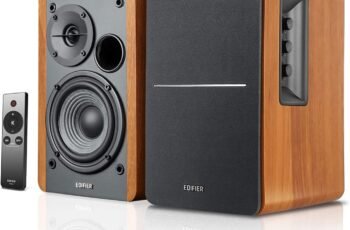
Have we ever wished our speakers could finally match the way we actually listen to music, movies, and games—without filling our room with bulky gear?

Why We Chose the Audioengine HD6 Premium Powered Bookshelf Speakers
When we first looked at the Audioengine HD6 Premium Powered Bookshelf Speakers | 150W Audiophile-Grade Bluetooth 5.0 Speakers with aptX HD | 24-Bit DAC | Real Wood Veneer, we were clearly aiming for something beyond basic desktop speakers. We wanted an all‑in‑one system that sounded refined, looked like real furniture, and did not force us to juggle receivers or extra boxes.
The HD6 positions itself as a serious, audiophile-leaning speaker system that still fits in a living room or home office. From the built‑in 24‑bit DAC to the Bluetooth 5.0 with aptX HD, everything about these speakers suggests they are designed for people who care a lot about sound but also about convenience and aesthetics.
Design and Build Quality
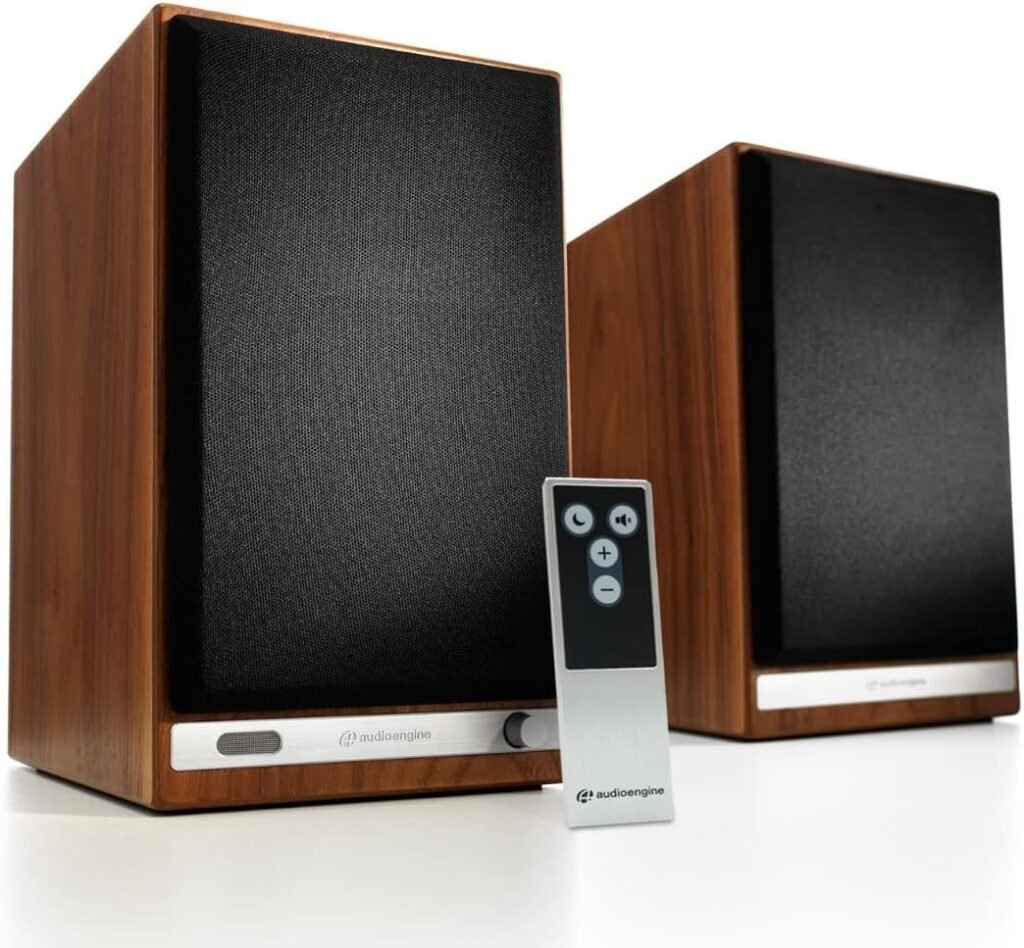
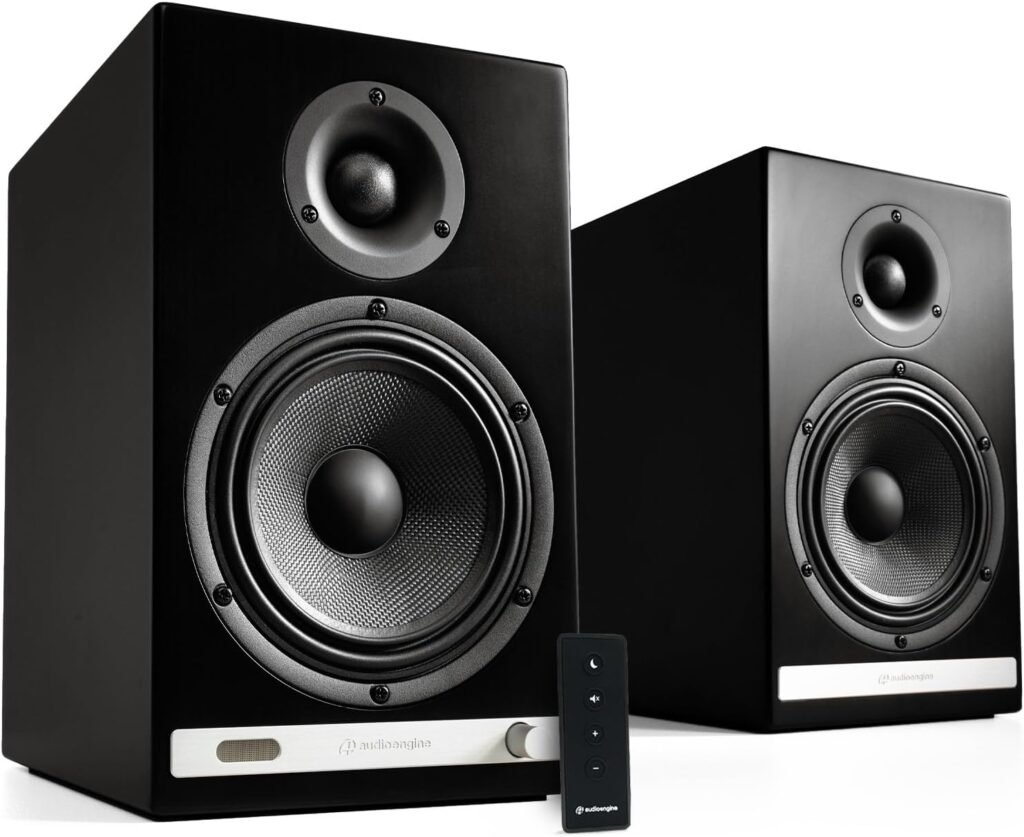
The first thing we notice about the Audioengine HD6 is that they look like proper, premium speakers, not plastic computer speakers with exaggerated styling. The real wood veneer cabinets immediately signal that this is a product intended to live in our space, not just our tech setup.
We can place these in a living room, on a media console, or in a dedicated listening area, and they will blend in rather than stick out. The craftsmanship and finishing are central to the HD6 experience.
Real Wood Veneer and Furniture-Grade Finish
The HD6 cabinets are constructed with real wood veneer, available in finishes such as Walnut, Black, and White. This is a big step up from vinyl wraps and glossy plastic shells that often look cheaper over time.
This kind of finish matters because these speakers are going to sit where everyone can see them. The grain, the understated sheen, and the solid feel all give us that sense that we are dealing with proper audio components, not disposable gadgets.
Drivers: Kevlar Woofers and Silk Dome Tweeters
Inside those cabinets, we have custom 5.5″ Kevlar woofers combined with 1″ silk dome tweeters. Kevlar is a material we typically associate with high-end speaker designs for its strength and low distortion characteristics, especially at higher volumes.
Silk dome tweeters are known for their smooth, non-fatiguing sound. This combination suggests that Audioengine is aiming for clarity and detail, without the harshness that can creep into some budget systems when we push them.
Magnetic Grilles and Aluminum Trim
The HD6 includes magnetic speaker grilles that attach cleanly and come off easily without awkward clips. When we want a more minimalist, modern look, we can remove the grilles and show off the drivers. When we want something more understated, we keep them on.
The aluminum trim adds a subtle visual accent without going over the top. It frames the speakers nicely and contributes to that “hi-fi component” vibe.

Overall Sound Quality
At the end of the day, the real question for any speaker is: how does it sound? The Audioengine HD6 focuses on delivering a full‑range, room‑filling audio experience that works well for both music and movies.
We get a sound signature that leans toward natural and engaging rather than clinical. These speakers are meant to be enjoyed, not just measured.
Frequency Range and Tonal Balance
The HD6 is rated for a frequency response of 50Hz–22kHz. That means we are getting substantial low-end presence, though not true sub‑bass territory, and clear, extended highs. For most music genres—rock, jazz, acoustic, electronic, pop—this range is more than enough.
We notice that the bass is warm and full without being bloated, mids are articulate, especially for vocals and guitars, and treble is smooth but detailed. They do not sound thin or sharp, which can easily happen with smaller speakers.
Clarity and Detail Across Genres
With audiophile‑grade ambitions, the HD6 places a lot of emphasis on clarity and detail retrieval. When we listen closely, we can distinguish instruments, pick out subtle room reverb, and appreciate the texture in vocals.
Whether we queue up a well-recorded jazz trio, an electronic track with layered synths, or an orchestral piece, the HD6 reveals enough detail to keep critical listening satisfying. At the same time, casual background listening remains enjoyable and non-fatiguing.
Volume and Room-Filling Power
With 150W total power (50W RMS per channel), the HD6 is more than capable of filling an average living room, bedroom, or office. We do not need to push the volume knob to extremes before things feel immersive.
What stands out is how composed the speakers remain as we increase volume. The Kevlar woofers and solid cabinets help keep distortion in check, so the sound stays clean even when we want to feel the music a bit more.
Built-In Amplification and DAC
One of the biggest advantages of the HD6 is that it is a complete system. We do not need a separate amplifier or receiver, which simplifies setup and saves space.
This integration also means Audioengine can closely match the amp to the drivers and the cabinet design, which is often beneficial for overall sound quality.
150W Total Power: What That Means for Us
The HD6 includes an internal amplifier that delivers 50W RMS per channel, which translates to 150W total peak power. For powered bookshelf speakers, this is a generous amount of power.
In practical use, this means we can:
- Fill medium to large rooms with sound
- Maintain clarity and dynamic impact at higher volumes
- Run a TV, turntable (with a phono preamp), or computer through these without worrying about underpowered audio
We get the muscle we need without needing an extra box.
24-Bit DAC and Digital Processing
The integrated 24‑bit DAC processes digital signals up to 24‑bit/192kHz, and this is especially important if we listen to music from a computer, TV, or streaming device.
By bypassing the often mediocre sound cards inside laptops, tablets, or budget streamers, the HD6 gives us a cleaner, more precise signal path. Our digital music gains clarity, tighter bass, and better imaging compared to running straight from a headphone jack.
We are essentially getting a high‑quality digital‑to‑analog conversion stage built directly into the speakers.
Connectivity and Inputs
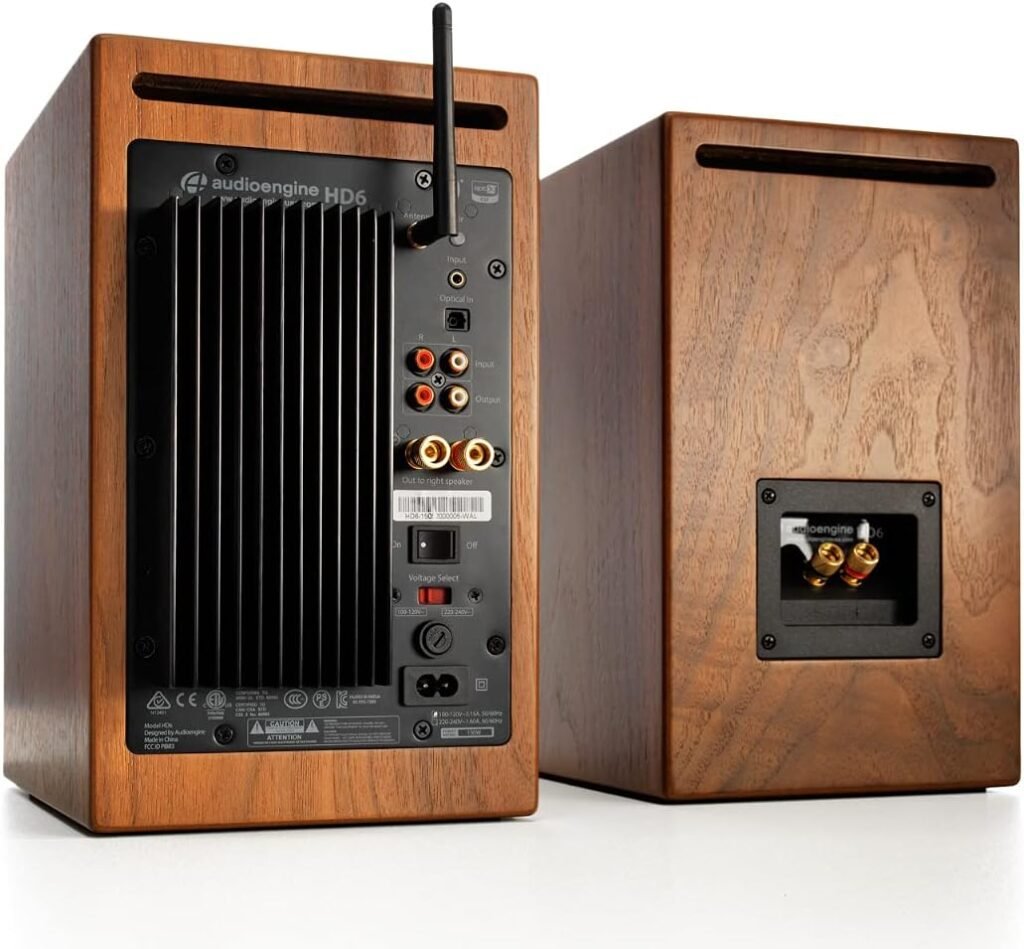
One of the standout features of the Audioengine HD6 is how it handles connectivity. We are not limited to a single use case. Whether we listen via Bluetooth, optical, RCA, or 3.5mm, the HD6 is ready.
This flexibility means we can place them in a living room as TV speakers, in a studio as nearfield monitors, or in a living space as our main music system—often without swapping cables all the time.
Bluetooth 5.0 with aptX HD
The HD6 uses Bluetooth 5.0 and supports aptX HD, which is a high‑resolution Bluetooth codec. This is a significant upgrade over basic SBC Bluetooth.
With aptX HD, we get lower latency, better dynamics, and overall sound that is much closer to wired quality. When we are streaming from a compatible smartphone, tablet, or laptop, we can enjoy very good audio without cords snaking across the room.
The 100ft wireless range (line of sight) is generous, so we can move around the space without audio cutting out.
Optical, RCA, and 3.5mm Inputs
In addition to Bluetooth, the HD6 offers multiple wired inputs:
- Optical (Toslink): Ideal for TV audio, media streamers, or digital outputs from some computers.
- RCA: Great for turntables (with an external phono preamp), CD players, or other analog gear.
- 3.5mm (AUX): Handy for phones, portable players, or older devices lacking modern connections.
This variety means we can run multiple devices simultaneously and select which one we use simply by changing the input on the speaker. It keeps our setup neat and flexible.
Perfect for Turntables, TVs, and Computers
With all those connections, the use cases open up in meaningful ways:
- As TV speakers, we can connect via optical and enjoy a massive upgrade over thin-sounding built-in TV speakers.
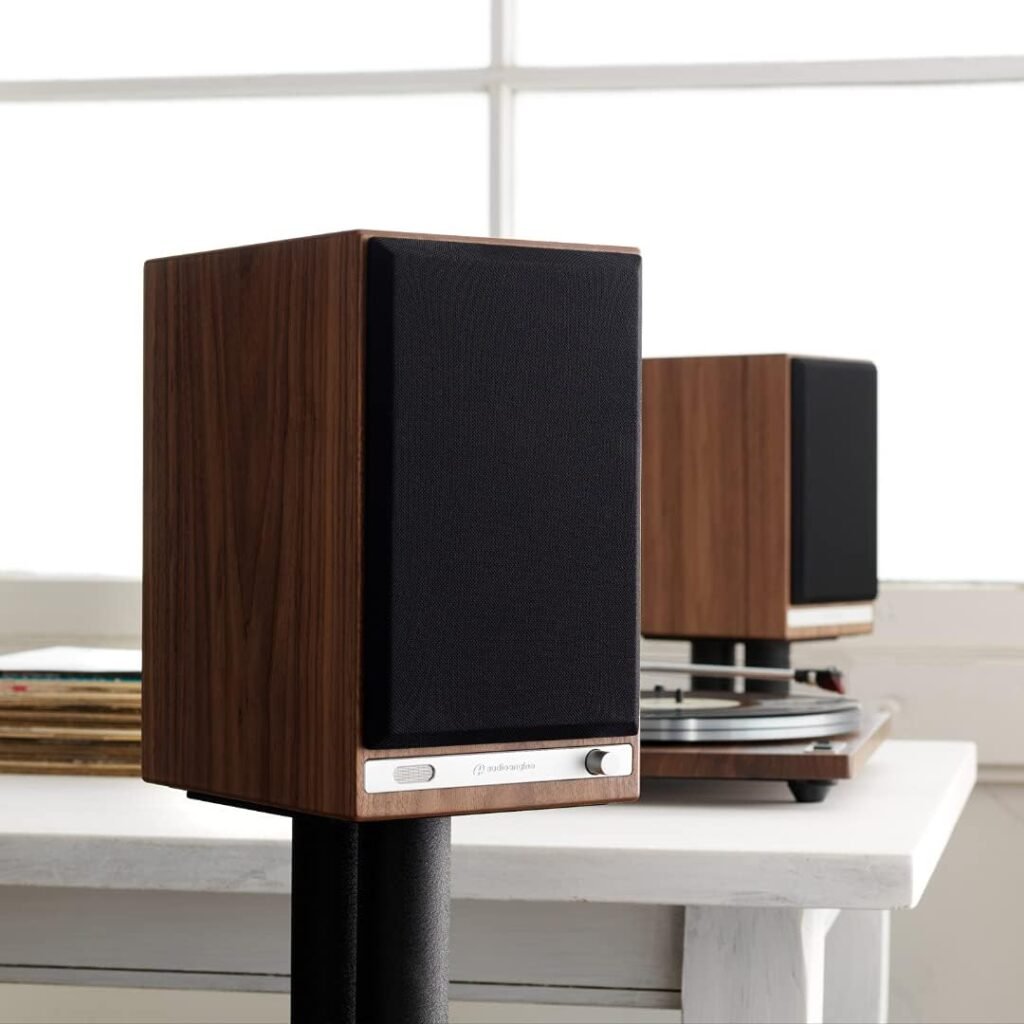
- For turntables, we run the turntable into a phono preamp, then into the RCA inputs, giving us a streamlined vinyl system.
- For computers, we can either use Bluetooth aptX HD or a direct wired connection, turning the HD6 into a high-fidelity desktop audio solution.
We are effectively replacing a stack of components with a single, elegant pair of powered speakers.
Setup and Everyday Usability
Part of the appeal of powered speakers is how easy they are to live with day to day. The Audioengine HD6 is designed to be plug‑and‑play, even for those of us who do not want to tinker with audio gear too much.
We are not assembling a complex hi-fi stack; we are simply hooking up source devices and enjoying the sound.
Simple Plug-and-Play Configuration
One HD6 speaker is the powered unit containing the amplifier and most of the connections. The other is a passive speaker that connects to the main one via standard speaker wire (included).
We just:
- Place the two speakers on stands, on a console, or on a desk.
- Connect the passive speaker to the powered speaker with the included cable.
- Plug in power.
- Add our source: Bluetooth, optical, RCA, or 3.5mm.
Within minutes, we are up and running. There is no need to worry about matching amps, figuring out impedance, or sourcing separate DACs unless we really want to.
Included Remote and Cables
The HD6 includes an aluminum remote control, which feels more premium than basic plastic remotes often bundled with audio gear. With the remote, we can:
- Adjust volume
- Mute
- Control power
This is especially helpful when we use the HD6 as a TV or living room system, where getting up to tweak the volume each time would get old quickly.
Audioengine also includes all necessary cables, so we do not immediately need to buy extra wiring just to get started.
Day-to-Day Experience
Everyday use is straightforward. We power the speakers on, select our input, and listen. Bluetooth reconnects automatically for paired devices, and volume control is smooth and predictable.
Because the HD6 is an all‑in‑one solution, we are not constantly managing multiple boxes or troubleshooting HDMI handshakes. It simply works, which makes us more likely to use it daily for everything from casual background playlists to intentional listening sessions.
Use Cases: How We Actually Live with the HD6
To really judge a speaker like this, we have to think about how we use it across different scenarios. The HD6 is meant to be versatile, not just good in a single role.
We can easily reframe them as primary living room speakers, desktop monitors, or mixed‑use speakers shared among family members or roommates.
As a Living Room Music System
In a living room, the HD6 can serve as a full‑time music system:
- Connect a streamer or smart device (via Bluetooth or optical).
- Place the speakers on stands or on a media console.
- Control playback from our phone.
We get room-filling sound with enough refinement for serious listening nights, but everything is convenient enough for day‑to‑day playlists or social gatherings.
As TV or Home Theater Front Speakers
The HD6 works extremely well as an upgrade to TV audio:
- Use the optical input from the TV.
- Keep the speakers flanking the TV, slightly angled toward our seating position.
We then get:
- Clearer dialogue
- More impactful sound effects
- Better separation between music, voice, and ambient sounds in shows and movies
While this is not a full surround-sound system, the improvement over built‑in TV speakers or many soundbars is dramatic, particularly for stereo imaging and music.
As a Desktop or Studio Speaker Pair
On a large desk, the HD6 becomes an impressive nearfield listening solution:
- Connect directly to our computer via optical or analog.
- Use them for music production, mixing, or simply high‑quality listening while we work.
The imaging at close range can be extremely satisfying. We get a wide, coherent soundstage and enough bass that we do not automatically feel the need for a subwoofer, especially in a smaller room.
Specification and Feature Overview (Table)
To make it easier for us to see what the HD6 offers at a glance, we can break down the core features and specs in a simple table:
| Feature | Details |
|---|---|
| Product Type | Powered bookshelf speakers (one powered, one passive) |
| Total Power | 150W total (50W RMS per channel) |
| Drivers | 5.5″ Kevlar woofers, 1″ silk dome tweeters |
| Frequency Response | 50Hz – 22kHz |
| Wireless Connectivity | Bluetooth 5.0 with aptX HD (approx. 100ft range, line of sight) |
| Digital Input | Optical (Toslink), up to 24-bit/192kHz via built-in DAC |
| Analog Inputs | RCA, 3.5mm (AUX) |
| DAC | Integrated 24-bit DAC (up to 24-bit/192kHz) |
| Cabinet Material | Hand-built with real wood veneer (Walnut, Black, White options) |
| Grilles | Magnetic speaker grilles |
| Remote Control | Aluminum remote included |
| Included Accessories | Cables, remote, power cord, speaker wire |
| Warranty | 3-year warranty |
| Trial Period | 30-day risk-free trial (where applicable) |
Listening Impressions and Performance Details
Beyond raw specifications, the lived experience with the HD6 is what really matters. Over time, several characteristics stand out in everyday listening.
We notice how the speakers behave at low volume, how they respond to different recording qualities, and whether we can listen for hours without fatigue.
Bass Response and Low-End Presence
For bookshelf speakers rated down to 50Hz, the HD6 delivers satisfying bass. We are not dealing with overpowering or subwoofer-like rumble, but we get genuine weight in kick drums, bass guitars, and electronic low‑end elements.
In small to medium rooms, especially near walls or in corners, these speakers can sound surprisingly full. If we are deep into bass-heavy genres, we might still prefer adding a subwoofer, but for most listening, the HD6 holds its own and feels well‑balanced.
Midrange and Vocals
The midrange is often where music lives, and the HD6 treats it with care. Vocals sound immediate and natural, not recessed or overly forward. Acoustic guitars, pianos, and strings carry a pleasant warmth and realism.
We can clearly follow dialogue in movies and podcasts as well, which matters for TV use. The midrange feels neither overly colored nor sterile—it simply presents content in a way that feels engaging and authentic.
Treble and High-End Detail
The silk dome tweeters give the treble a smooth, airy character. We can hear cymbals shimmer, reverbs tail off, and subtle studio effects without sharpness or glare.
This top-end behavior helps us listen for long periods without fatigue. For those of us who are sensitive to harsh treble, this is a real advantage, especially when pairing the HD6 with digital sources that can be a bit bright on some systems.
Soundstage and Imaging
The HD6 creates a broad and convincing stereo soundstage, especially when we position the speakers properly (angled slightly toward our listening position, spaced apart with some room behind them).
Imaging is precise, so instruments and voices feel like they are placed in distinct positions between the speakers rather than all crowded in the center. This brings music and film soundtracks to life in a way that basic speakers simply cannot manage.
Style and Integration with Home Décor
We care not only about how speakers sound, but also how they look in our space. The HD6 pays particular attention to aesthetics, which can be a deciding factor if we share our space with others or care about interior design.
We can treat them as both tech and furniture, which is rare in this category.
Real Wood Veneer: Why It Matters
Real wood veneer gives these speakers a more timeless look. Over time, that kind of finish tends to age much more gracefully than synthetic surfaces. Scratches and marks often look less glaring, and the natural grain gives each speaker a bit of character.
This means we can keep the HD6 as part of our space for years without feeling that they have become visually outdated.
Fits Modern, Classic, and Minimalist Spaces
The available finishes—Walnut, Black, and White—allow us to match the speakers to different décor themes:
- Walnut: Warm, traditional, and inviting, great for classic or eclectic interiors.
- Black: Sleek and understated, ideal for modern setups or mixed electronics.
- White: Clean and contemporary, perfect for minimalist or Scandinavian-inspired rooms.
Because the design is not flashy, the HD6 can sit comfortably next to a TV, record player, or computer monitor without clashing.
Reliability, Warranty, and Support
With a product at this level, we expect longevity and proper support. Audio products are investments, and we want confidence that they will last and that the company stands behind them.
The HD6 is positioned as a long-term component, not a short-lived gadget.
3-Year Warranty and 30-Day Risk-Free Trial
Audioengine backs the HD6 with a 3-year warranty, which is generous compared to many consumer electronics products. This suggests confidence in the build quality, internal components, and general reliability.
In addition, the 30-day risk-free trial (where applicable) lets us audition them in our own space, with our own gear and music, which is far more meaningful than hearing them in a store.
Build Quality and Long-Term Ownership
Everything from the cabinet construction to the internal electronics is designed for years of use. While any powered speaker includes active electronics that can eventually fail, the HD6’s reputation and warranty ease those concerns.
We can treat these as a central piece of our home audio setup for a long time without constantly chasing upgrades.
Pros and Cons: A Balanced Take
No product is perfect for everyone, so it helps to weigh what the HD6 does particularly well and where it might not be ideal for some of us.
We want to be realistic about what we are getting and what trade‑offs we might be making.
What We Like Most
- Audiophile-leaning sound: Clear, detailed, and engaging across genres.
- True all-in-one solution: Built-in amp and DAC mean no extra boxes needed.
- Versatile connectivity: Bluetooth 5.0 with aptX HD, optical, RCA, and 3.5mm cover most scenarios.
- Beautiful design: Real wood veneer and refined styling integrate well with home décor.
- Solid power: 150W total is more than enough for most rooms.
- Quality of life touches: Aluminum remote, magnetic grilles, included cables.
- Strong warranty: 3-year coverage and a 30-day trial offer peace of mind.
Where They Might Not Be Perfect
- No dedicated subwoofer output on some versions: While the bass is robust, bass fanatics might want a clear sub-out option, depending on configuration.
- Not portable: These are meant to be stationary home speakers, not carried around the house.
- Requires some space: To really shine, they need room to breathe; tiny desks or cramped corners might not do them justice.
- Powered speaker approach: If we prefer separate components (amp, DAC, passive speakers), we might find the all‑in‑one design limiting, even though it simplifies setup.
Who the Audioengine HD6 Is Best Suited For
Different listeners have different priorities, so it helps to pinpoint whom the HD6 will satisfy the most. We can then decide if we fit that profile.
The HD6 is not a generic budget speaker; it targets listeners who want something more complete and enduring.
Music Lovers Wanting a Simple but High-Quality Setup
If we love music and want it to sound truly good without building a full component rack, the HD6 is an excellent fit. We plug in a source or use Bluetooth and have a system that can anchor our listening room.
We get high‑end sound without a complicated signal chain, which is perfect for those of us who value sound but do not want audio gear to become a full‑time hobby.
People Upgrading from Soundbars or TV Speakers
For those of us currently using a TV’s built-in speakers or a modest soundbar, the HD6 can be a transformative step up. Dialogue clarity, dynamic impact, and overall immersion improve dramatically.
Movies, sports, and streaming series sound more cinematic, and when we switch to music, we get a performance level many soundbars simply cannot match.
Home Office or Studio Users Who Care About Audio
If we spend long hours in front of a computer—working, studying, or producing music—the HD6 can turn our desk into a legitimate listening environment.
We can use them for both casual listening and detailed work, benefitting from:
- Clear imaging
- Neutral-ish tonality
- Smooth top‑end that does not fatigue us during long sessions
Final Thoughts on the Audioengine HD6 Premium Powered Bookshelf Speakers
When we step back and look at everything the Audioengine HD6 Premium Powered Bookshelf Speakers | 150W Audiophile-Grade Bluetooth 5.0 Speakers with aptX HD | 24-Bit DAC | Real Wood Veneer bring to the table, they deliver a compelling blend of performance, style, and ease of use.
We get:
- Audiophile-grade sound in a compact, attractive form factor
- Modern connectivity including Bluetooth 5.0 with aptX HD, optical, RCA, and 3.5mm
- An integrated 24-bit DAC that elevates our digital sources
- Real wood cabinets that lend a premium, furniture-like presence
- Sufficient power to fill most rooms with dynamic, detailed audio
For anyone who wants a serious upgrade over basic speakers or soundbars, yet does not want the complexity of separate amps and DACs, the HD6 stands out as a smart, future‑friendly choice. It respects our ears, our space, and our time, giving us a system we can simply set up, live with, and enjoy every day.
Disclosure: As an Amazon Associate, I earn from qualifying purchases.