Looking for bookshelf speakers that can act both as warm HiFi partners for your favorite records and as accurate monitors for your content work?

Quick summary
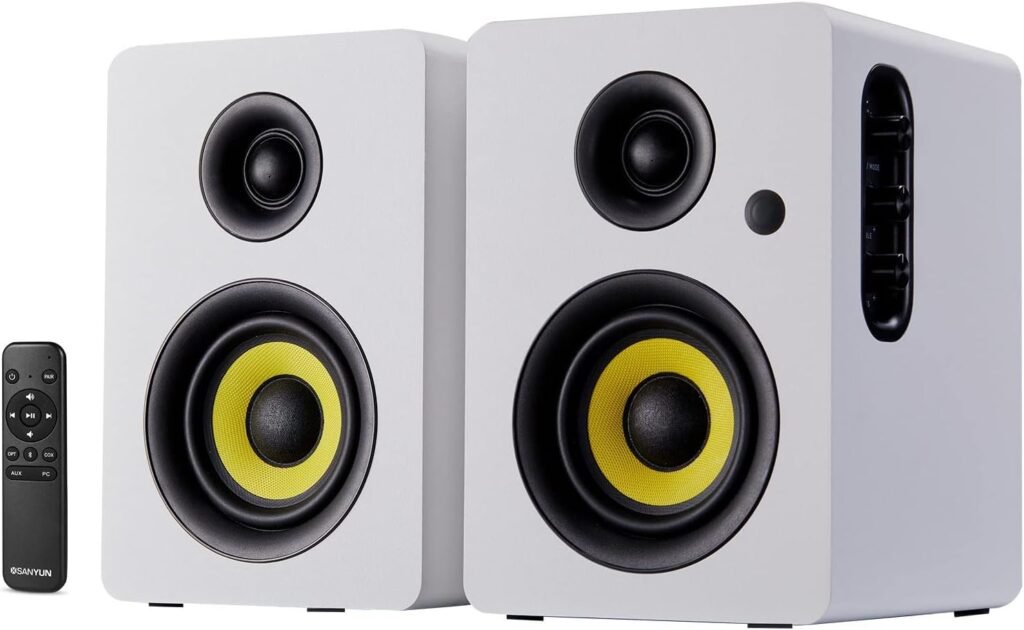
You get a versatile active two-way bookshelf system with the Sanyun SW206 4” HiFi Bookshelf Speakers with Studio Mode, 80W Active, Bluetooth 5.4/Optical/Coaxial/TRS/Aux/24bit DAC USB, for Turntable TV PC Desktop, MDF Cabinet, Remote Control, White. These speakers pack a 4” carbon-fiber woofer, a 25mm silk dome tweeter, a one-button HiFi/Studio mode switch, a built-in 24-bit USB DAC, and many inputs — all in a compact MDF cabinet. If you want both musical warmth and accurate monitoring without complicated setup, these make a compelling choice.
First impressions
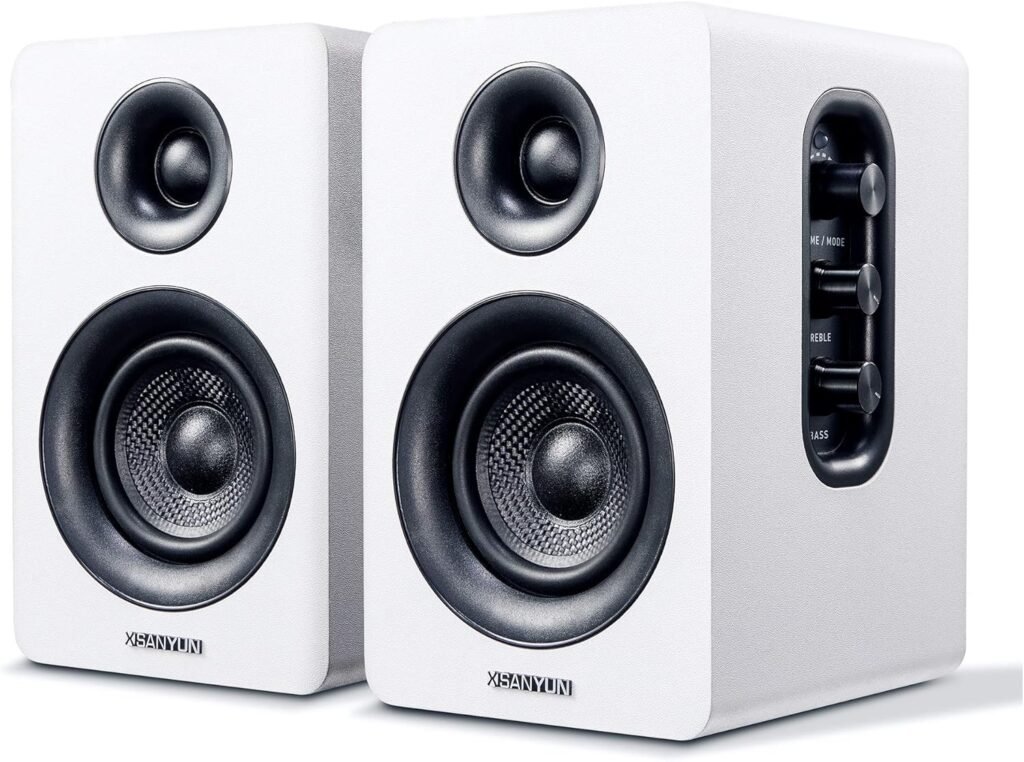
You’ll notice the clean white matte finish and compact footprint right away. The speakers look modern and unobtrusive, which makes them easy to place on a desk, bookshelf, or TV stand without drawing too much attention.
Design & finish
The smooth-touch matte PVC finish resists fingerprints and fits minimalist rooms well. The neutral white keeps the focus on the sound rather than flashy aesthetics, and the cabinet edges and grille are tidy and understated.
Build quality & materials
You’ll find dense MDF cabinetry that helps reduce resonance compared with low-grade plastics. The drivers and ports are snugly mounted, and the included remote and controls feel solid enough for daily use. Overall, the build feels more premium than many budget active speakers.

Acoustic design & drivers
These speakers aim to balance musicality and accuracy with a specific driver configuration and cabinet construction.
4” carbon fiber woofer
The 4-inch carbon fiber driver delivers tight mid-bass and quick transient response. Carbon fiber keeps cone breakup controlled and helps with clarity in the midrange, so vocals and acoustic instruments have good definition without sounding bloated.
25mm silk dome tweeter
The 25mm silk dome tweeter produces smooth, non-fatiguing highs. Silk domes typically trade extreme air and sparkle for a gentler top end, which makes long listening sessions comfortable and reduces sibilance on vocal-heavy material.
MDF enclosure & cabinet resonance
The MDF cabinet reduces unwanted coloration and vibration, so the sound stays focused. You’ll benefit from lower cabinet resonance compared with thinner materials, which helps the speakers maintain clarity at higher volumes.
Sound modes: HiFi vs Studio Monitor
A key selling point here is the one-key switching between HiFi and Studio Monitor modes. That gives you two distinct voicings for different tasks.
HiFi warmth
In HiFi mode, the voicing is a touch warmer and more engaging. You’ll notice a fuller lower midrange and a slightly rounded high end that emphasizes musicality and listener enjoyment. This mode is great for casual listening, vinyl, and genres that reward warmth like jazz and classic rock.
Studio precision
Studio mode flattens the frequency response and reduces coloration so you can make more objective decisions during mixing and content creation. You’ll hear more detail in upper mids and a tighter low end that helps with critical listening, podcast editing, or leveling tracks.
Switching & use cases
Switching is immediate and convenient, so you can go from laid-back listening to critical monitoring in seconds. If you work on tracks then switch to relaxed listening, this flexibility saves you from buying separate monitors and hi-fi speakers.
Connectivity & inputs
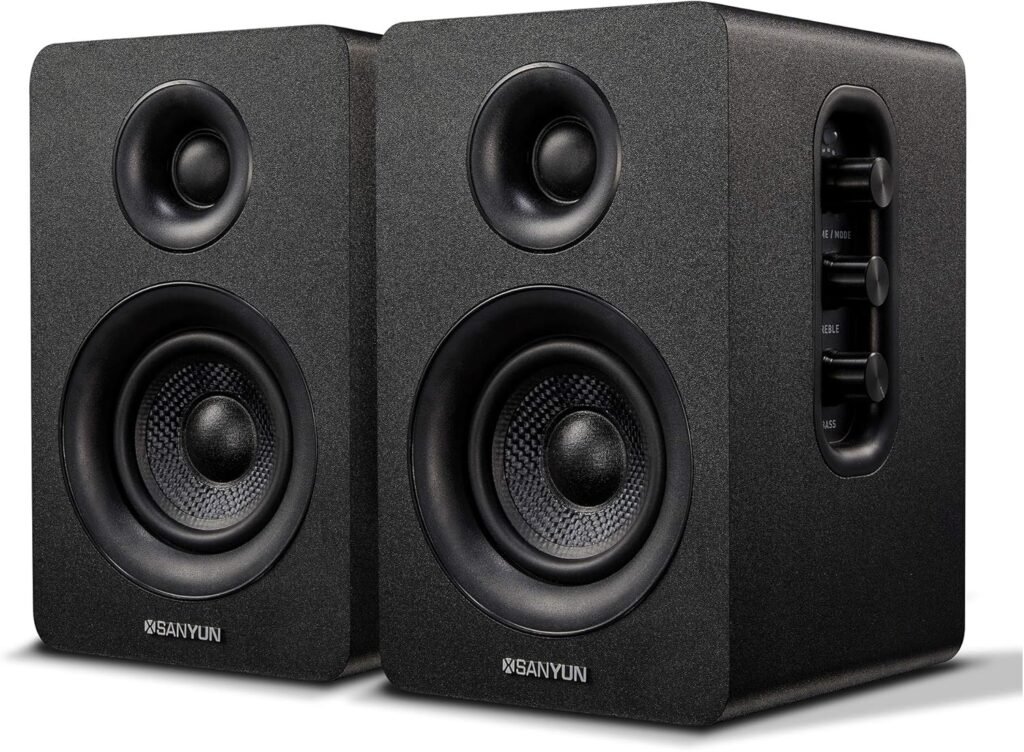
You won’t be limited by ports. These speakers offer flexible digital and analog connections, including a built-in USB DAC and Bluetooth 5.4.
Below is a clear breakdown of the essential specs and inputs so you can quickly see what connects where.
| Item | Details |
|---|---|
| Product name | Sanyun SW206 4” HiFi Bookshelf Speakers with Studio Mode, 80W Active, Bluetooth 5.4/Optical/Coaxial/TRS/Aux/24bit DAC USB, for Turntable TV PC Desktop, MDF Cabinet, Remote Control, White |
| Total power | 80W (active) |
| Woofer | 4” carbon fiber with multi-layer voice coil technology |
| Tweeter | 25mm silk dome |
| Cabinet material | Dense MDF with matte PVC finish |
| Modes | HiFi mode / Studio monitor mode (one-key switching) |
| Bluetooth | Bluetooth 5.4 |
| Digital inputs | Optical (TOSLINK), Coaxial (RCA digital) |
| USB | USB input with built-in 24-bit DAC |
| Analog inputs | 1/4” (6.35mm) TRS balanced, 3.5mm AUX |
| Special input | Turntable with preamp (connect via RCA/AUX) |
| Remote | Infrared remote for volume, input switching, power |
| Finish | White matte |
| Use cases | Turntable, TV, PC, Desktop, Home studio, Streaming |
| Size & placement | Bookshelf/desktop-friendly footprint |
USB & 24-bit DAC performance
You can plug a Windows or Mac computer directly into USB to use the internal 24-bit DAC. That gives you improved digital-to-analog conversion compared with many built-in laptop or TV DACs, so you’ll hear more detail and better dynamics when using a digital source. For critical work you’ll want to confirm sample-rate support and driver behavior on your platform, but the basic advantage is cleaner, lower-noise playback from digital sources.
Bluetooth 5.4 & wireless performance
Bluetooth 5.4 gives stronger wireless connections and lower latency compared with older Bluetooth versions, which matters when watching video or using a phone as your source. Expect improved range and fewer dropouts, though codec support (SBC, AAC, aptX, LDAC) depends on implementation and may vary — check the manual or seller listing if codec details matter for your phone or device.
Analog & digital inputs (Optical/Coaxial/TRS/AUX)
You’ve got optical and coaxial digital inputs for TVs, set-top boxes, and game consoles, plus a 3.5mm AUX for phones and unbalanced devices. The 1/4” TRS balanced input lets you connect mixers, interfaces, or pro gear with lower noise and better ground isolation. This makes the SW206 a flexible hub for both consumer and semi-pro setups.
Setup & integration
Setting these up is straightforward, and you’ll appreciate how they adapt to different use environments.
Physical setup & placement
Place the speakers shoulder-width apart, angled slightly toward your listening spot, and give them a small gap from walls to avoid bass buildup. On a desk you’ll want isolation pads or small stands to reduce coupling to the surface. If you’re using them for TV, center the left/right pair with the display and keep the listening distance consistent for stereo imaging.
Connecting a turntable, TV, PC, phone
For a turntable with a built-in preamp, connect directly to the AUX input. If the turntable requires a phono preamp, route it through a dedicated preamp before feeding the SW206. For TV and consoles, optical is the cleanest digital route and avoids the pitfalls of analog TV outputs. For PC, use USB to get the benefit of the 24-bit DAC. For phones and casual sources, Bluetooth or 3.5mm AUX work fine.
Balanced TRS input for pro gear
If you use mixers, audio interfaces, or guitars with balanced outputs, the 1/4” TRS balanced input gives cleaner signal transfer and lower noise over longer cable runs than standard 3.5mm or RCA connections. This is especially useful when you build a small home studio or need reliable connections during live streaming.
Remote & controls
Controlling these speakers is convenient from your listening position, which saves you from reaching over to the amp constantly.
Remote features & usability
The included infrared remote handles volume, input switching, and power/standby. You’ll appreciate being able to switch sources and change levels from your couch or workstation without digging around. The IR requires line-of-sight, so keep that in mind if the speakers sit behind objects.
Front-panel controls & indicators
The front panel typically includes basic controls and status LEDs, making local adjustments quick when you do need them. For fine tuning you’ll rely on your source or your room placement rather than onboard EQ, which keeps the signal path simpler and cleaner.
Performance in real-life use cases
These speakers are designed to be multi-purpose. Here’s what you can expect across common scenarios.
Music listening (phonograph, streaming, genres)
In HiFi mode, the SW206 presents music warmly and enjoyably. Vinyl lovers will appreciate the rounded highs and full midrange that suit acoustic, jazz, and classic rock. Electronic and modern pop will still sound engaging, though you might notice the silk tweeter tames extreme shimmer. If you prefer very forward treble, these won’t be hyper-analytical, but they’ll keep you listening longer without fatigue.
Watching movies & TV
For TV and movie sound, the optical input gives clear dialogue and consistent performance. These speakers are bookshelf-sized, so you won’t get cinematic room-shaking bass, but the mid-bass provides enough impact for dialogue and effects at normal listening levels. If you want deeper low-frequency extension, pair these with a subwoofer through the appropriate output or crossover if available.
Gaming & desktop use
For desktop gaming, the SW206 gives coherent imaging and responsive transients. The quick woofer response helps with footsteps and directional cues, while the silk dome ensures long sessions remain comfortable. The low-latency advantage of Bluetooth 5.4 helps a bit for wireless gaming, but wired optical or USB is preferable for the lowest latency.
Content creation, mixing & podcasting
Studio mode is where the SW206 shines for creators. You’ll hear a flatter, more transparent presentation that helps you judge levels, EQ, and vocal clarity. Use the balanced TRS input when connecting an audio interface to reduce noise, and reference your mix in both Studio and HiFi modes to ensure it translates for listeners.

Measurements & expected performance
While not lab measurements, you can expect practical characteristics from the designed hardware.
Bass, mids, treble characteristics
- Bass: Tight and controlled with good mid-bass punch, but limited extension below ~50Hz due to cabinet size.
- Mids: Clear and present; vocals and instruments sit forward in the mix without being shouty.
- Treble: Smooth and non-fatiguing; detailed enough for most uses while avoiding excessive brightness.
Imaging, soundstage, dynamics
You’ll get a focused stereo image for near-field listening when positioned correctly. Dynamics are respectable for the size and power available, making these speakers responsive to complex transients. Don’t expect the wide three-dimensional soundstage of much larger speakers, but you will get stable imaging for critical listening and casual enjoyment.
Pros & cons
Here’s a concise summary to help you decide quickly.
Pros:
- One-key HiFi/Studio switching for versatile voicing.
- Solid 4” carbon fiber woofer and silk dome tweeter combination.
- Dense MDF cabinet for reduced resonance and cleaner sound.
- Wide connectivity: USB 24-bit DAC, Bluetooth 5.4, optical, coaxial, TRS, and AUX.
- Balanced TRS input for pro gear and low-noise connections.
- Remote control for convenient operation.
- Clean aesthetic that blends into modern setups.
Cons:
- Limited deep bass extension due to small cabinet size; subwoofer recommended for home theater bass.
- IR remote requires line-of-sight.
- Bluetooth codec details may be limited in specifications; check if you need specific codecs.
- No onboard parametric EQ for room correction — you’ll rely on placement or external DSP.
Comparison with competitors
If you’re weighing options against common rivals, here’s what matters to you.
- Compared to pure studio monitors (e.g., near-field 5” monitors), the SW206’s HiFi mode gives a warmer, more musical voicing that some studio monitors intentionally avoid. You get more listening comfort, but some extreme analytical accuracy may be missing in HiFi mode.
- Compared to bookshelf hi-fi speakers (passive), the SW206 removes the need for an external amp, and adds the convenience of a built-in DAC and multiple digital inputs.
- Compared to other active all-in-one speakers in the same price band, the combination of one-button mode switching, balanced TRS input, and 24-bit USB DAC makes the SW206 unusually flexible.
Practical tips & troubleshooting
A few tips help you get better sound and avoid common pitfalls.
- Placement: Keep the speakers at ear height and form an equilateral triangle between you and the two speakers. Slight toe-in helps imaging.
- Isolation: Use foam pads or stands to decouple from desks and reduce bass bloom.
- Bass management: If you want deeper bass for movies, add a powered subwoofer and set its crossover around 60–80Hz to blend smoothly.
- Turntable setup: If your turntable lacks a phono preamp, purchase a standalone phono preamp rather than trying to push a phono-level signal into a line input.
- USB setup: If the USB DAC isn’t recognized immediately, check the speaker’s manual for any driver requirements or alternate sample-rate settings on your computer.
- Remote issues: Ensure the remote has a fresh battery and clear line-of-sight to the speakers for consistent IR operation.
Final verdict & who it’s for
If you want a compact, attractive pair of active speakers that can switch between warm, engaging HiFi and accurate studio monitoring, the Sanyun SW206 4” HiFi Bookshelf Speakers with Studio Mode, 80W Active, Bluetooth 5.4/Optical/Coaxial/TRS/Aux/24bit DAC USB, for Turntable TV PC Desktop, MDF Cabinet, Remote Control, White offers a terrific balance of features and performance. You’ll love them if you:
- Need a single pair of speakers for music listening, TV, and content creation.
- Want balanced inputs for connecting pro gear.
- Prefer a clean, non-fatiguing treble response for long sessions.
- Appreciate a built-in 24-bit USB DAC for computer audio.
If you need chest-rattling bass or extremely analytic studio monitors for mastering full-range mixes, consider adding a subwoofer or looking at larger monitors. For most home studios, desks, and living rooms, the SW206 will serve you well.
Frequently asked questions (FAQ)
You’ll likely have a few final questions before buying. Here are answers to the ones most people ask.
Q: Can you use these as powered monitors for mixing? A: Yes. Use Studio mode and connect via balanced TRS or USB for the most accurate monitoring experience. They’re suitable for drafting mixes and podcasts, though for mastering you may want more low-end extension or larger reference monitors.
Q: Will these work with a turntable? A: Yes, if your turntable has a built-in preamp you can connect directly via AUX. If your turntable needs a phono preamp, use an external phono preamp between the turntable and the speakers.
Q: Can you add a subwoofer? A: These speakers do not advertise a dedicated subwoofer output on the spec sheet provided, so check the rear panel for a dedicated sub out or use a line-level workaround via a splitter if needed. Adding a sub will extend bass for movies and bass-heavy music.
Q: Is Bluetooth latency low enough for TV and gaming? A: Bluetooth 5.4 improves latency and stability, but wired connections (optical or USB) still provide the best synchronization for gaming and video. Use wired digital inputs when absolute low latency is required.
Q: How loud will these get? A: With 80W of total power, they can fill a small to medium room at comfortable levels. For larger rooms or very loud listening, you may notice limits in deep bass and headroom.
Final notes You’re getting a versatile, attractive, and practical pair of powered bookshelf speakers that suit many modern needs: music, streaming, content creation, and TV. The one-key HiFi/Studio switch and broad connectivity set them apart, so if you want a single system that adapts to both relaxed listening and critical work, the Sanyun SW206 is worth a serious look.
Disclosure: As an Amazon Associate, I earn from qualifying purchases.