Have we ever wished our desk speakers sounded as rich and full as a proper stereo system, without taking over the entire room?

Overall Impression of the Edifier R1280Ts
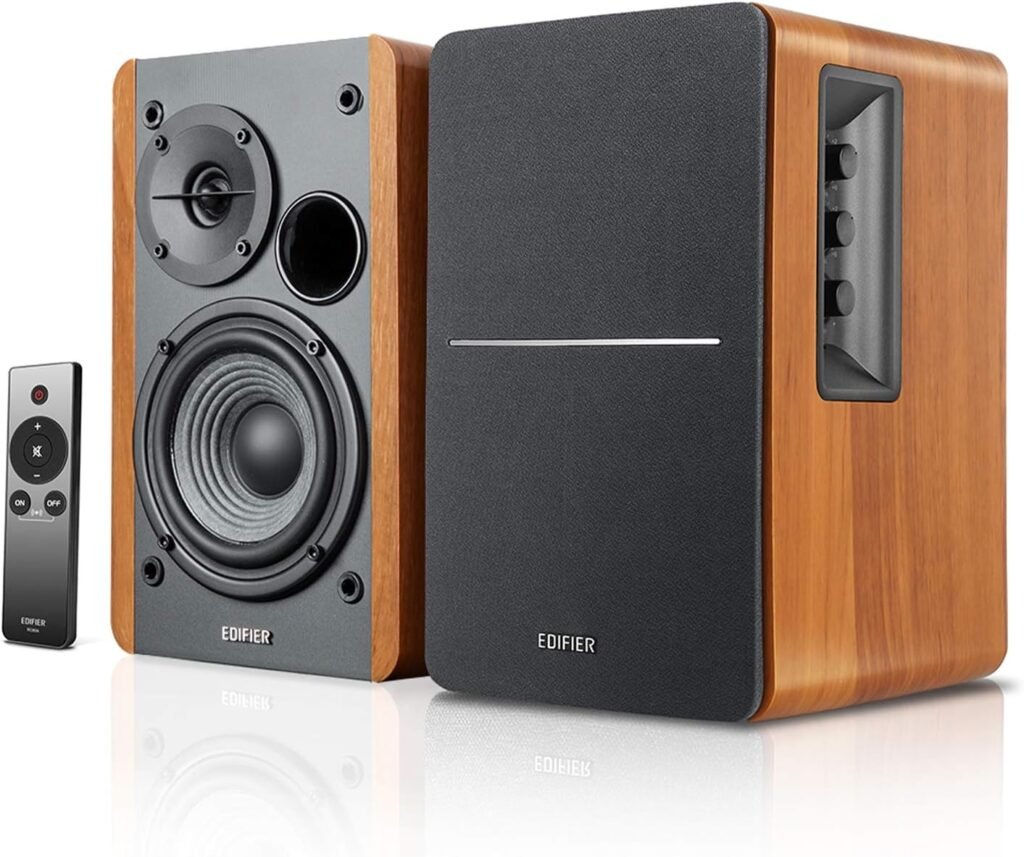
When we first set up the Edifier R1280Ts Powered Bookshelf Speakers, we were struck by how polished they feel for their price and size. Between the wooden cabinets, the extra subwoofer output, and the handy remote, these speakers position themselves as a bridge between casual desktop speakers and serious entry-level studio monitors.
From our experience and research, they’re ideal for:
- Small home studios and near-field listening
- Desktop setups for music, movies, and gaming
- TV/console setups in bedrooms or smaller living rooms
- Anyone who wants a simple 2.0 system with an easy upgrade path to 2.1 via sub-out
They are not trying to be reference-grade, ultra-flat studio tools, but rather very capable, fun, and flexible speakers with a touch of studio-style clarity.
Design and Build Quality
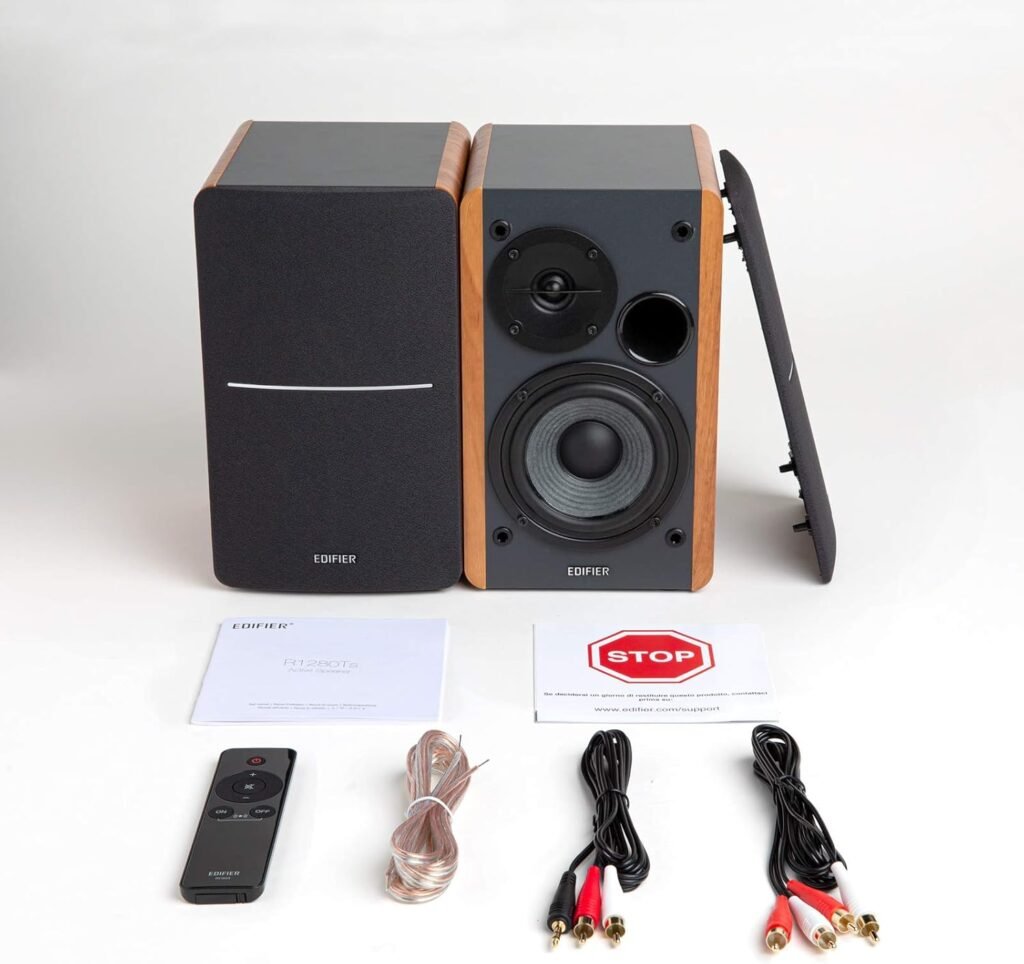
The first impression we get from the Edifier R1280Ts is that they look far more expensive than they are. The wooden enclosure instantly adds a warm, classic aesthetic that blends well in most rooms, whether we place them on a desk, shelf, or TV stand.
The cabinets feel solid and well put together, with a reassuring heft that suggests decent internal bracing and materials. These are not flimsy plastic boxes—we can feel that as soon as we pick them up.
Aesthetic and Finish
From a style perspective, the speakers combine a modern front panel with a more traditional woodgrain wrap around the sides. This gives them a semi-professional, semi-home-theater look that works nicely in:
- Home offices
- Studios
- Living rooms
- Bedrooms
The removable front grilles keep the design clean, but we can take them off to show the drivers if we prefer the more “studio monitor” look. Either way, they manage to look compact yet serious.
Build Quality and Durability
The overall build quality feels robust for this category:
- The cabinets are solid and non-creaky
- The knobs on the side panel have resistance and don’t feel loose
- The binding between the active and passive speaker looks sturdy
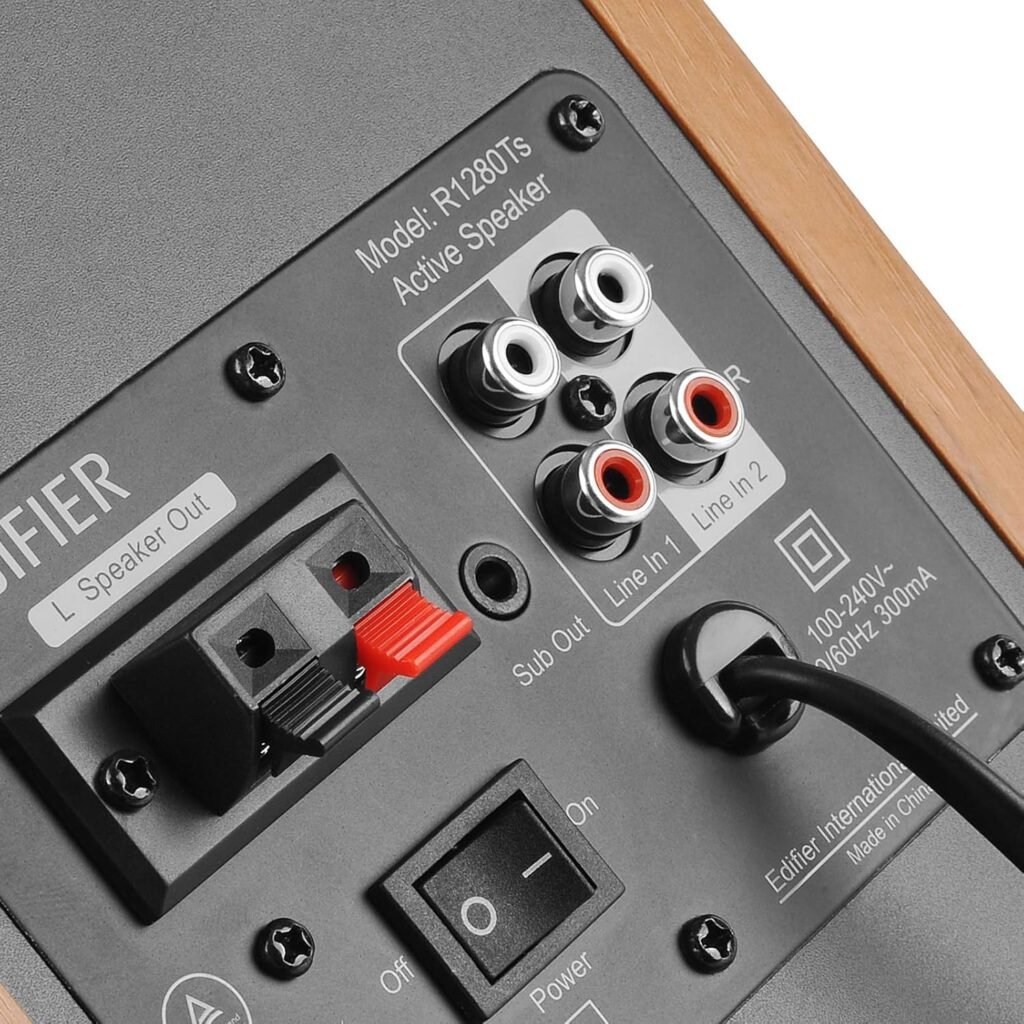
- The connectors on the back feel firm, not flimsy
We’d comfortably keep these on a busy desk or in a small music setup without worrying they’ll fall apart after a year of use.

Technical Specifications at a Glance
Sometimes it’s easier to understand a product when we see the key numbers side by side. Here’s a quick breakdown of the main specs and what they actually mean for us in real-world use:
| Feature | Specification / Description | What It Means for Us |
|---|---|---|
| Configuration | 2.0 Powered Bookshelf Speakers | Stereo pair with built-in amplification |
| Total Power Output | 42W RMS (continuous) | Plenty of power for desks and small to medium rooms |
| Woofer Size | 4-inch sub-woofer (mid-bass) driver | Strong mid-bass and body, good for music and movies |
| Tweeter Size | 13mm silk dome tweeter | Smooth, non-fatiguing high frequencies |
| Enclosure Material | Wooden cabinet | Warmer sound, reduced resonance vs cheap plastic |
| Inputs | Dual RCA inputs (RCA to RCA / 3.5mm–RCA supported) | Connect two devices at once (e.g., PC + TV) |
| Subwoofer Output | Dedicated sub-out with automatic detection and crossover | Easy 2.1 upgrade path with built-in bass management |
| Controls | Side panel (bass, treble, volume) + remote control | Convenient tuning from both the speaker and sofa |
| Special Feature | Soundfield Spatializer button | Wider, more immersive stereo image |
| Wireless | None (no Bluetooth) | Pure wired signal, no wireless compression |
These core specs make the R1280Ts a kind of “sweet spot” speaker: big enough to sound substantial, small enough to fit anywhere, and powerful enough for everyday and hobbyist-level audio use.
Sound Quality Overview
Sound quality is where we feel the Edifier R1280Ts really justify their popularity. For this price point and form factor, they punch above their weight in clarity, warmth, and overall enjoyment.
We would characterize their sound as:
- Slightly warm and full in the lower mids and bass
- Pleasantly smooth in the highs
- Clear enough in the midrange for vocals and acoustic instruments
- Not clinical, but also not muddy when we set the EQ reasonably
These are speakers that make us want to keep listening—whether we’re putting on a playlist, watching a movie, or mixing a podcast.
Bass Performance
For speakers with a 4-inch woofer, the bass performance is impressive. We’re not talking about earth-shaking sub-bass, but we do get:
- Solid low-end presence for music
- Enough punch for movie effects and game soundtracks
- A warm foundation for rock, pop, hip-hop, and electronic genres
The bass character is more about tight punch in the mid-bass rather than ultra-deep rumble. When we push the bass knob up on the side panel, the speakers can add some extra thump, though we might want to be moderate with this on boomy desks or corners.
With the subwoofer output, we can offload the deepest frequencies to an external sub, letting the R1280Ts handle the mids and highs more cleanly. That combination transforms the overall low-end into something far closer to a full home theater or studio-lite experience.
Midrange Clarity
The midrange is where these speakers really shine for everyday listening. Vocals come through clearly and naturally, and instruments like guitars, pianos, and strings sound rich without becoming too forward or harsh.
For:
- Podcasts and audiobooks
- YouTube and streaming content
- TV dialogue and movies
we find speech particularly clear, which makes these a great option for a combined entertainment and productivity setup.
The balance leans slightly warm, but not to the point of overshadowing details in the midrange. If we prefer a slightly brighter or leaner sound, we can fine-tune the bass and treble via the side panel.
Treble and High Frequencies
The 13mm silk dome tweeter provides a smooth and relaxed high-end. We don’t get the brittle, edgy top end that some cheaper powered speakers can have. Instead, we get:
- Gentle brightness without harshness
- Enough detail for cymbals, strings, and atmospheric effects
- A fatigue-free listening experience for long sessions
If we like a bit more sparkle, the treble control on the side panel lets us add some extra top end. It’s nice to have hardware EQ available, especially when room acoustics and desk placement can change the perceived brightness.
Volume and Power Handling
With 42 watts RMS on tap, these speakers get louder than we might expect from their size. For:
- Desktop near-field use: They have way more power than we’ll usually need.
- Small to medium rooms: They can handle background music or even party levels up to a point.
- TV setups: They’re easily capable of filling a bedroom or small living area with sound.
We don’t have to push them near their maximum to enjoy solid dynamics. At lower to moderate levels, they maintain good clarity and bass presence without distortion. As with any compact speaker, extreme max volume will have its limits, but for normal daily listening, they feel comfortably powerful.
Connectivity and Inputs
One of the standout practical features of the R1280Ts is the dual RCA input design. This might look simple, but it solves a lot of everyday problems elegantly.
Dual RCA Inputs: Two Devices at Once
Having two RCA inputs means we can connect two audio sources at the same time, such as:
- PC + TV
- Laptop + turntable (with preamp)
- Game console + media player
- Phone (with 3.5 mm to RCA cable) + desktop
We don’t need to constantly plug and unplug cables just to switch from one device to another. Once both devices are connected, we just choose which device is sending audio in the moment.
This simplicity is a big quality-of-life improvement. A lot of affordable speakers still force us into a single input, which becomes a hassle when we want a central set of speakers for multiple devices.
Wired-Only: No Bluetooth by Design
The R1280Ts model we’re focusing on is specifically the non-Bluetooth version. This can be either a drawback or a benefit, depending on how we look at it:
Benefits:
- No wireless compression or latency
- More stable, consistent audio quality
- Less chance of interference or pairing issues
Limitations:
- We can’t stream directly from our phone without a cable
- If we want wireless, we’d need an external Bluetooth receiver
If our priority is plug-and-play reliability and consistent sound, wired-only can be an advantage. If we absolutely need built-in Bluetooth, though, we’d have to look at one of Edifier’s Bluetooth-equipped models instead.
The Extra Sub-Out Port and Built-In Crossover
The subwoofer output is one of the most compelling features of the Edifier R1280Ts. Many compact powered speakers don’t offer a dedicated sub-out, which limits their upgrade potential. Here, we get a straightforward path to transform the system into a 2.1 setup.
How the Subwoofer Output Works
The sub-out is designed for an active (powered) subwoofer. Once we connect a sub, the system:
- Automatically detects the subwoofer
- Activates a built-in crossover
This built-in crossover is crucial. Instead of both the speakers and sub trying to play the same bass frequencies and muddying the sound, the crossover lets:
- The sub handle the deep low end
- The R1280Ts focus more on mids and highs
This division of labor improves overall clarity and prevents the small 4-inch woofers from being overworked trying to produce sub-bass they physically can’t deliver as effectively.
Why the Sub-Out Matters
We might not want a subwoofer right away, especially if we’re on a budget or lack floor space. However, having sub-out means:
- We can start with the speakers alone and add a sub later
- Our investment is more future-proof
- We can tailor the system to different rooms or listening tastes
For example, in a small office we might use the speakers alone. Then, if we move to a bigger room or create a dedicated entertainment corner, we can bring in a sub and get a much more cinematic sound without replacing the entire system.
Updated Remote Control and Everyday Usability
Convenience often makes the difference between gear we enjoy and gear we tolerate. The updated remote control on the R1280Ts turns these from simple powered speakers into a more complete, living-room-friendly system.
What We Can Do with the Remote
From across the room, the remote lets us:
- Adjust the volume
- Mute/unmute quickly
- Toggle features like Soundfield Spatializer (depending on the revision)
This means we don’t need to lean over to the speaker every time a YouTube ad is too loud or a movie gets unexpectedly intense. We can make quick adjustments on the couch, at our desk, or in bed.
Side Panel Controls: Fine-Tuning the Sound
On one of the speakers, we have a side control panel with:
- Volume knob
- Bass knob
- Treble knob
These knobs are very handy for customizing the sound to our room and preferences. For example:
- If our desk is against a wall and bass feels boomy, we can turn bass down a bit.
- If our room is heavily carpeted and curtains absorb high frequencies, we might turn treble up slightly.
- If we’re listening late at night and want a softer, more relaxed sound, we can roll both bass and treble back.
Side panel controls are also quicker to adjust than software EQ, and they affect any device we connect, not just one app or operating system.
Soundfield Spatializer: A Wider Stereo Image
A standout extra feature for the R1280Ts is the Soundfield Spatializer button. This is essentially a built-in processing mode designed to make the soundstage feel wider and more immersive.
What Soundfield Spatializer Does
When we press the Soundfield Spatializer button, the speaker’s internal processing alters the phase and EQ in a way that:
- Widens the perceived left–right separation
- Makes the speakers sound physically further apart
- Increases the sense of space and immersion
For movies, games, and some music, this can be really enjoyable. It helps the sound “escape the boxes” and feel like it’s more broadly spread in front of us, rather than coming from two narrow points.
When to Use (and Not Use) Spatializer
We might use Soundfield Spatializer when:
- Watching movies or TV shows for a more cinematic feel
- Playing games where positional audio helps immersion
- Listening casually when we want a large, enveloping sound
We might turn it off when:
- Doing audio work that requires more accurate stereo imaging
- Listening critically to mixes, where we want to hear the original panning choices
- Comparing audio gear or doing serious A/B tests
It’s reassuring that this feature is optional: we’re not locked into a wide mode all the time. We can treat it as a “soundstage enhancer” that we toggle based on content and mood.
Use Cases and Ideal Scenarios
The Edifier R1280Ts are versatile speakers, and it helps to imagine how they fit into real-world setups. Here are some scenarios where they shine.
Desktop and Near-Field Listening
On a computer desk, they provide a huge upgrade over typical plastic PC speakers. We get:
- Rich, full sound for music streaming and gaming
- Clear voices for video calls, online classes, and content creation
- Better immersion compared to small soundbars or cheap speakers
Near-field listening (sitting close, like at a desk) plays to their strengths: we get a precise stereo image and can appreciate the clarity without needing massive volume.
Small Home Studio or Content Creation Setup
For home recording, podcasting, or video editing, the R1280Ts offer:
- Detailed mids for hearing voices and instruments
- Enough clarity to do basic mixing and editing
- A more honest sound than overly bass-heavy consumer speakers
They’re not intended as high-end studio reference monitors, but for many hobbyists, podcasters, and editors, they offer a good compromise between accuracy and enjoyment.
TV and Entertainment System
Paired with a TV, streaming box, or console, the R1280Ts can become an excellent sound upgrade over built-in TV speakers:
- Better dialogue clarity
- Stronger, more engaging bass and sound effects
- An easy plug-and-play wired setup
Add an active subwoofer to the sub-out, and we get the core of a very solid 2.1 home theater system, without needing a full AV receiver or large tower speakers.
Strengths of the Edifier R1280Ts
Summarizing the main advantages helps us see why these speakers are so frequently recommended.
Key Advantages
-
Excellent Value for Money
For their price, the combination of build, sound, and features is very compelling. -
Subwoofer Output with Auto Crossover
This is a standout: we can expand to 2.1 simply by adding a powered sub, and the built-in crossover helps keep the sound clean. -
Dual RCA Inputs
The ability to keep two devices connected all the time is extremely practical. -
Solid, Attractive Wooden Cabinets
The wood finish adds both aesthetic appeal and acoustic benefits over cheap plastic enclosures. -
Remote Control + Physical EQ Knobs
We can easily adjust volume and sound character without touching software settings. -
Soundfield Spatializer
Having a built-in widening mode is a fun and useful feature for entertainment. -
Balanced, Enjoyable Sound Signature
Warm, clear, and not fatiguing—easy to listen to for hours.
Limitations and Things to Consider
No product is perfect, and it’s helpful to know the trade-offs so we can decide if these fit our needs.
Main Drawbacks
-
No Built-In Bluetooth
If we want to stream wirelessly from phones or tablets, we need a separate Bluetooth receiver or a different speaker model. Some of us might prefer this for sound quality, but it’s still a limitation for convenience. -
Not True “Pro” Studio Monitors
While they can be used for hobbyist mixing and content creation, they are not perfectly flat reference monitors. Those who need ultra-accurate monitoring might eventually want to upgrade. -
Bass Limits Without Subwoofer
For their size, bass is good, but physics still applies. Very deep sub-bass (for some electronic, cinematic, or organ music) will require a subwoofer if we want full impact. -
Wired-Only Setup
All connections are RCA-based. That’s easy and reliable, but if we prefer digital inputs (optical, USB), we’ll need additional gear like DACs or adapters.
Setup Tips for Best Performance
To get the most out of the Edifier R1280Ts, we can pay attention to how we place and configure them.
Positioning the Speakers
A few simple placement choices can make a big difference:
- Place them so that the tweeters are roughly at ear level when we’re seated.
- Aim the front of each speaker slightly toward our listening position for a better stereo image.
- Avoid pushing them all the way into corners against the wall, which can exaggerate bass.
If desk space is limited, we might consider small stands or risers to lift the speakers and reduce vibrations.
Using the EQ Controls Wisely
The bass and treble controls are there to help, but it’s worth adjusting them carefully:
- Start with both bass and treble set to neutral (center position).
- Listen to familiar tracks and then tweak slightly:
- If it sounds too bright, lower treble a bit.
- If it sounds thin, add a touch of bass.
Small adjustments are usually more effective than extreme ones, especially in small rooms where room echoes and reflections already shape the sound.
Who These Speakers Are Best For
When we think about who will be happiest with the Edifier R1280Ts, a few user profiles stand out.
Ideal Users
- Home office workers who want better sound for music, calls, and streaming.
- Students or hobbyists who need a good all-round speaker for a dorm, bedroom, or small studio.
- Casual creators (podcasters, YouTubers, musicians) looking for honest, enjoyable sound without breaking the bank.
- TV and console users in smaller rooms who want real stereo and the option to add a sub later.
- Anyone upgrading from cheap plastic speakers, looking for a serious step up in quality.
They’re particularly appealing if we value:
- Clean, wired connectivity
- Expandability via sub-out
- A balance between fun listening and reasonable accuracy
Who Might Want Something Else
It’s also useful to be honest about where these might not be the ideal match.
We might want to look elsewhere if:
- We must have Bluetooth built-in for everyday convenience.
- We want true studio reference monitors with extremely flat response.
- We need very high volume for large rooms or party scenarios.
- We prefer digital inputs (optical/USB) directly from a TV or computer without external converters.
In those cases, Edifier and other brands offer other models with different connectivity or performance characteristics that might be a better fit.
Long-Term Value and Upgradability
One aspect we really appreciate in the R1280Ts is how they support gradual upgrading instead of forcing an all-or-nothing purchase.
Starting Simple, Growing Over Time
We can begin with:
- Just the speakers, connected to our main device (PC, TV, turntable, etc.).
Then later:
- Add a second device via the second RCA input.
- Add a powered subwoofer to the sub-out for deeper, more cinematic bass.
We don’t have to replace the speakers to get a better, fuller system. That flexibility helps spread out costs and lets us build a more capable setup over time.
Durability and Reliability
The solid cabinet construction and straightforward analog design give us confidence that these can last for years with normal use. There are no overly complex software layers or fragile plastic parts to worry about.
Paired with the evergreen nature of RCA inputs (which have been around for decades and won’t vanish overnight), these speakers feel like a stable long-term foundation for everyday audio.
Final Thoughts: Are the Edifier R1280Ts Worth It?
Putting everything together, we see the Edifier R1280Ts Powered Bookshelf Speakers as a smart, well-rounded choice for anyone wanting serious sound in a compact, affordable, and flexible package.
We get:
- Warm, clear, and enjoyable sound
- Solid wooden cabinets that look and feel substantial
- Dual RCA inputs for multiple devices
- A dedicated sub-out with automatic crossover for easy 2.1 expansion
- Handy side-panel EQ controls and a remote for day-to-day convenience
- The optional Soundfield Spatializer to make movies and games more immersive
We give up built-in Bluetooth and digital inputs, and we accept that these aren’t hyper-analytical studio tools. In return, we gain a robust, straightforward, great-sounding speaker pair that feels just as comfortable in a home office as it does under a TV or in a bedroom studio.
For us, that combination of sound quality, usability, and upgradability makes the Edifier R1280Ts a very compelling option and a strong recommendation for anyone looking to step into higher-quality audio without venturing into high-end pricing.
Disclosure: As an Amazon Associate, I earn from qualifying purchases.